
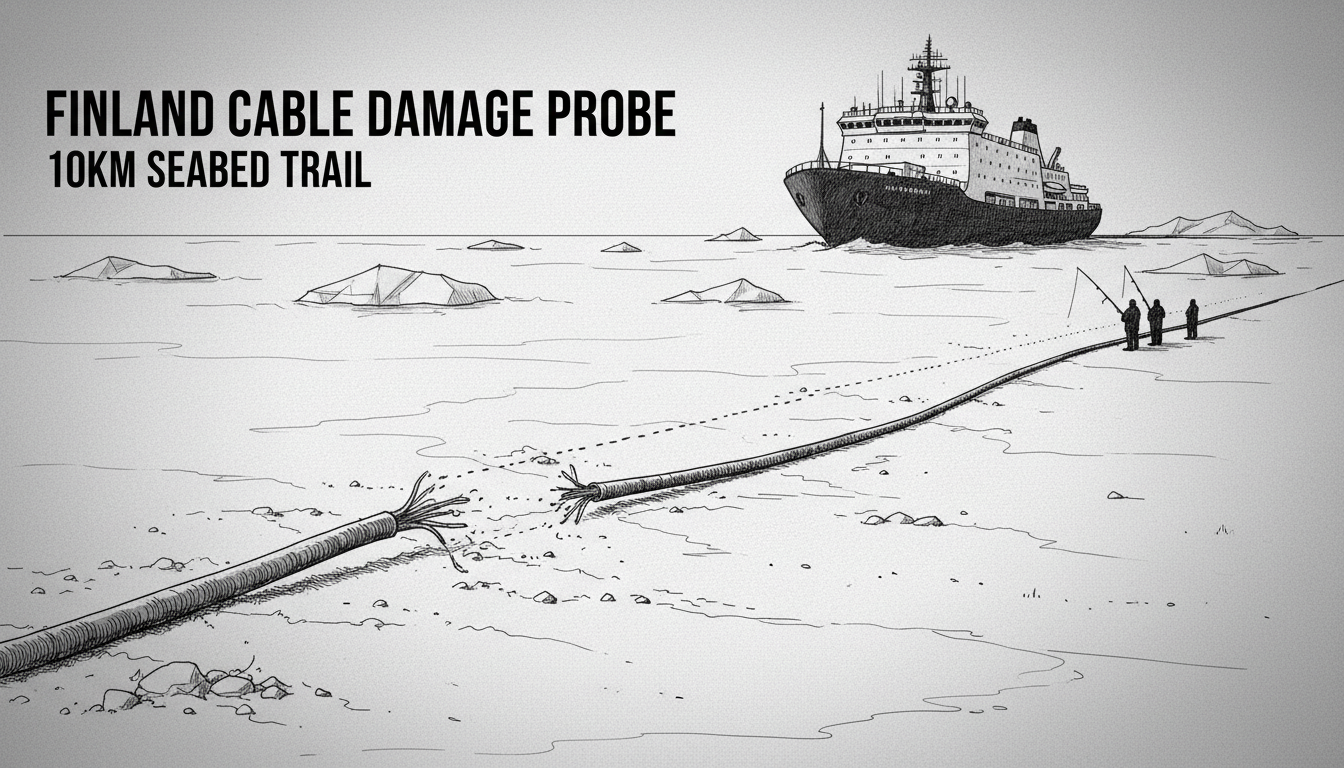
Finland cable damage investigation reveals tens of kilometers of dragging marks on the Baltic Sea floor. Police have arrested one crew member from the cargo ship Fitburg suspected of severing a critical Elisa telecommunications cable on New Year's Eve. This discovery, announced in early January 2026, marks a significant development in a case that echoes heightened regional concerns over the vulnerability of undersea infrastructure.
A Trail of Destruction on the Seabed
Investigators mapping the seafloor have uncovered physical evidence stretching for dozens of kilometers. "Based on the investigations so far, there is reason to suspect that the Fitburg's anchor and anchor chain have dragged along the seabed for at least tens of kilometers before the damage point of the telecommunications cable," police stated. This extensive trail suggests the vessel's anchor was not properly secured during transit, leading to a prolonged, destructive path along the sensitive seabed. The damaged cable, owned by Finnish telecom giant Elisa, carries data traffic between Finland and Estonia. Such cables form the backbone of international finance, communications, and data transfer, making their protection a national security priority.
The Suspect Vessel and a Crew Member in Custody
The focus of the probe is the cargo ship Fitburg. While details of the arrested individual—their nationality, role on the ship, or specific charges—remain under wraps due to the ongoing investigation, the arrest indicates authorities are pursuing criminal negligence or intent. Maritime law experts note that damaging submarine cables through negligent dragging of an anchor is a prosecutable offense under Finnish law and international conventions. The Finnish Border Guard, which patrols the nation's vast maritime territory, likely provided crucial tracking data pinpointing the Fitburg's location at the time of the incident. The vessel's operator and flag state will face intense scrutiny as the inquiry proceeds.
A Fraught Context for Baltic Infrastructure
This incident does not occur in a vacuum. It follows the October 2023 sabotage of the Balticconnector gas pipeline and damage to another telecom cable between Finland and Estonia. Those events, which NATO labeled as "deliberate, reckless, and irresponsible," triggered a massive multinational investigation and exposed the soft underbelly of undersea critical infrastructure. While the Fitburg case currently points to potential maritime accident or negligence, it unfolds within an atmosphere of acute strategic tension in the Baltic Sea. "Every incident, whether deliberate or accidental, forces a costly and time-consuming response," says a Helsinki-based maritime security analyst. "The sheer scale of the dragging mark indicates a profound failure in standard seafaring procedures. In today's Baltic, there is no room for such error."
The Technical and Economic Fallout
The immediate impact involves Elisa, a major player in Finland's technology sector, having to reroute data and repair a cable that lies in deep, icy waters—a complex and expensive operation. Longer-term, the incident fuels arguments for greater investment in infrastructure resilience. This includes more robust cable armor, improved real-time monitoring networks on the seabed, and enhanced coordination between civilian telecom operators and national defense authorities. For a digitally advanced nation like Finland, where 5G networks, cloud services, and the gaming industry rely on flawless connectivity, such disruptions have a tangible economic cost. Finnish tech companies, from Nokia's networking division to Helsinki's thriving startup hubs, depend on this invisible lattice of subsea cables.
Navigating Blame in Murky Waters
A central challenge for investigators will be definitively proving causality. They must link the physical damage on the cable to the specific anchor of the Fitburg, a task requiring forensic analysis of metal marks and precise alignment of the ship's track with the seabed trail. The process is painstaking. Furthermore, determining culpability hinges on whether the crew failed to secure the anchor properly or if a mechanical failure was to blame. The arrested crew member's testimony will be pivotal. International maritime corridors like the Gulf of Finland are among the world's busiest, with constant traffic from tankers, container ships, and ferries. Enforcing strict navigation protocols is a perennial challenge for coast guards.
A Wake-Up Call for Maritime Governance
The New Year's Eve cable cut serves as another stark wake-up call. It highlights that threats to undersea infrastructure are not solely geopolitical; they can stem from routine maritime incidents amplified by negligence. In response, Finland and its Baltic neighbors are likely to push for stricter reporting requirements for vessels dragging anchor and enhanced satellite-based surveillance of shipping lanes near known cable routes. "Protecting this infrastructure is no longer just about countering sabotage," the maritime analyst adds. "It's about enforcing higher standards of seamanship and accountability across all commercial shipping. The Baltic Sea is too crowded and too critical to be a zone of accidental destruction." As the police investigation continues, the long scar on the seafloor remains a silent testament to a single ship's path and the fragile wires upon which modern society depends.