
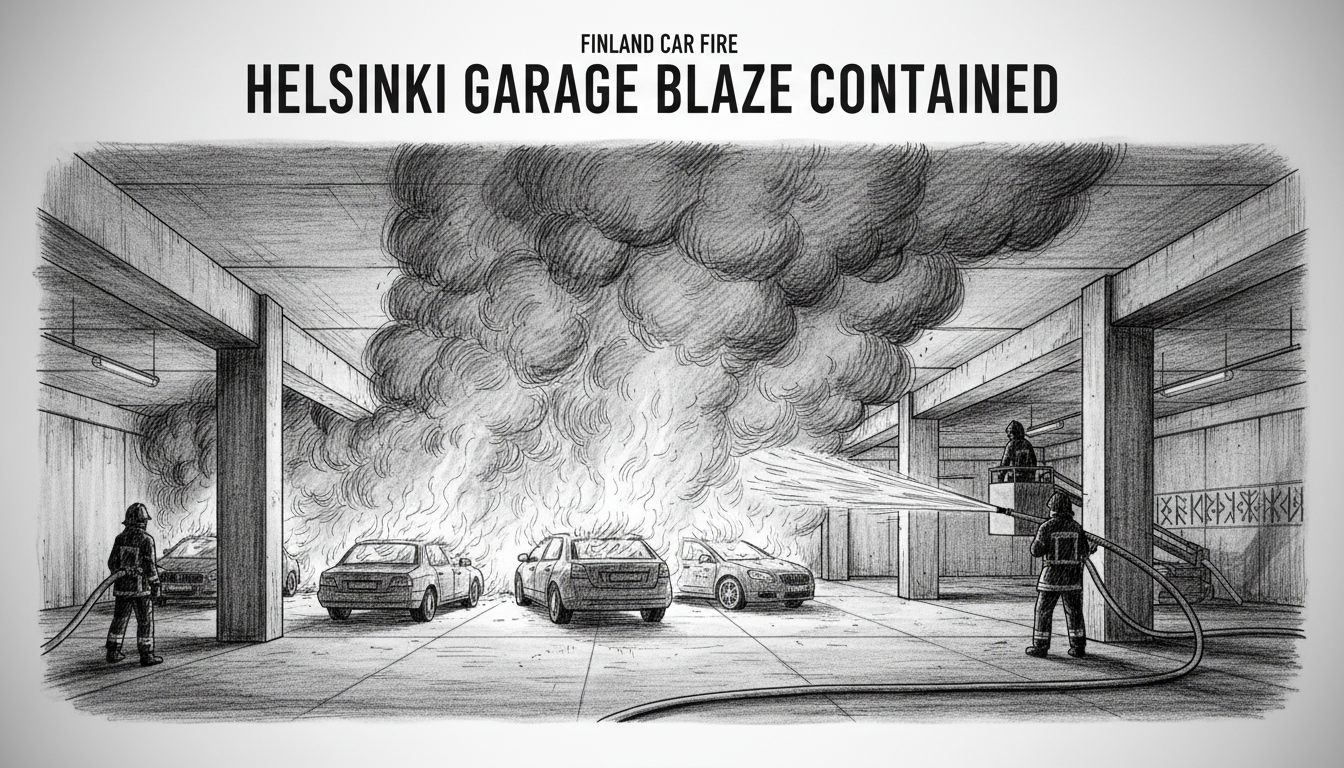
Finland's capital Helsinki saw a swift emergency response Saturday after a passenger car ignited inside a garage in the Pohjois-Haaga district. The Helsinki Rescue Department received an alarm for a building fire on Ida Aalbergin tie at 11:50 AM, dispatching eight rescue units to the scene. By just after noon, officials confirmed the fire was extinguished and posed no further risk of spreading, averting potential disaster in the residential area.
A Rapid Response in a Residential Enclave
The incident occurred in Pohjois-Haaga, a quiet northwestern subdistrict of Helsinki known for its mix of post-war apartment buildings and single-family homes. The street, Ida Aalbergin tie, is named for the celebrated late 19th-century Finnish actress Ida Aalberg, a detail that underscores the area's established, community-focused character. The prompt alarm and large-scale deployment—eight units—highlight the standard operational protocol for the Helsinki Rescue Department when a fire is reported within a structure, even before the full scope is known. This precautionary approach is rooted in Finland's stringent fire safety culture, where the potential for rapid escalation, especially in attached garages or older wooden buildings, is taken extremely seriously.
“The priority is always to prevent a contained fire from becoming a structural fire that threatens lives and neighboring properties,” explained a veteran fire safety engineer familiar with Helsinki's protocols, who spoke on background. “A car fire in an enclosed garage presents specific hazards, including toxic fumes and the risk of explosion from fuel or a battery, which justifies a significant initial response.” The successful containment to the single vehicle indicates that the building's compartmentalization, a key requirement in Finnish building codes, functioned as intended.
Finland's Proactive Fire Safety Framework
This incident, while minor in outcome, serves as a real-world test of the comprehensive fire safety infrastructure that Finland has built over decades. Finnish building regulations, particularly the National Building Code of Finland, are among the most rigorous in Europe, with specific mandates for fire-resistant materials, compartmentation to prevent spread, and mandatory smoke alarms. These rules are even more critical in a climate where residents spend much of the year indoors and where older housing stock, especially in suburbs like Pohjois-Haaga, may contain wooden elements.
The role of the Helsinki Rescue Department (Helsingin pelastuslaitos) is central to this system. As an integrated emergency service, it handles fire, rescue, and ambulance operations, allowing for coordinated responses. Their performance metrics for urban response times are publicly tracked and consistently rank among Europe's best. This efficiency is not accidental; it results from continuous investment in training, equipment, and strategic station placement across the capital region. The department also runs extensive public prevention campaigns, emphasizing the importance of working smoke detectors and fire extinguishers in homes and ancillary buildings like garages.
The Hidden Risks in Residential Garages
Expert analysis of such incidents typically points to common risk factors often overlooked by homeowners. A residential garage is frequently a storage area for more than just vehicles; it can house propane tanks, paint thinners, gasoline cans, and other flammable materials. “A car fire can quickly become a catastrophic garage fire if it ignites these secondary fuels,” the fire safety engineer noted. “Modern vehicles also add complexity with high-voltage lithium-ion batteries in electric and hybrid cars, which pose unique and challenging fire risks requiring specific suppression techniques.”
While the cause of the Pohjois-Haaga car fire remains officially undetermined and may never be publicly disclosed for minor incidents, common culprits include electrical short circuits, faults in fuel lines, or overheating components. The season is also a factor; during colder months, vehicles are under more strain, and some owners may use auxiliary heaters or engage in maintenance work indoors, increasing risk. Fire safety advocates use these events to remind the public that garages should be equipped with heat detectors (which activate at a higher temperature than smoke detectors, reducing false alarms from exhaust fumes) and a readily accessible Class B fire extinguisher suitable for flammable liquids and electrical fires.
A Model of Containment and Public Assurance
The communication from authorities following the blaze was typically Finnish: factual, concise, and reassuring. The swift update that the fire was out and held no spreading danger provided immediate clarity to the neighborhood and the public. This transparency is a key component of maintaining public trust and preventing the spread of misinformation during local incidents. It also reflects a systemic confidence in the capabilities of the response teams and the built environment's resilience.
Contrast this with jurisdictions where building codes are less strict or emergency services are slower to arrive; a similar garage fire could easily have led to a total loss of the structure, adjacent property damage, or even casualties. The Finnish model demonstrates how upfront investment in regulation, infrastructure, and professional emergency services ultimately reduces long-term economic loss and protects lives. The incident on Ida Aalbergin tie, resolved within minutes of the first alarm, is a testament to a system working precisely as designed—so well that its success often goes unnoticed.
The Unseen Success of Prevention
Ultimately, the most significant fires are the ones that never happen. While Saturday's car fire in Helsinki was a minor emergency, it offers a window into the high-stakes world of urban fire safety that operates largely out of public view. Every building code enforced, every firefighter trained, and every smoke detector installed contributes to a collective safety net. The residents of Pohjois-Haaga likely returned to normalcy quickly, perhaps only briefly noting the fire engines on their street. This return to calm is the ultimate goal of Finland's safety philosophy: not dramatic, last-minute heroics, but the reliable, methodical prevention of disaster through preparation and swift, effective action.
As cities globally grapple with new challenges like evolving construction materials and electric vehicle integration, Finland's consistent, no-nonsense approach offers a proven template. The question for other urban centers is whether they will invest in the unseen, unglamorous work of prevention before a major tragedy forces their hand. For Helsinki, the quiet afternoon in Pohjois-Haaga after the engines departed was not just good luck—it was the system working.