
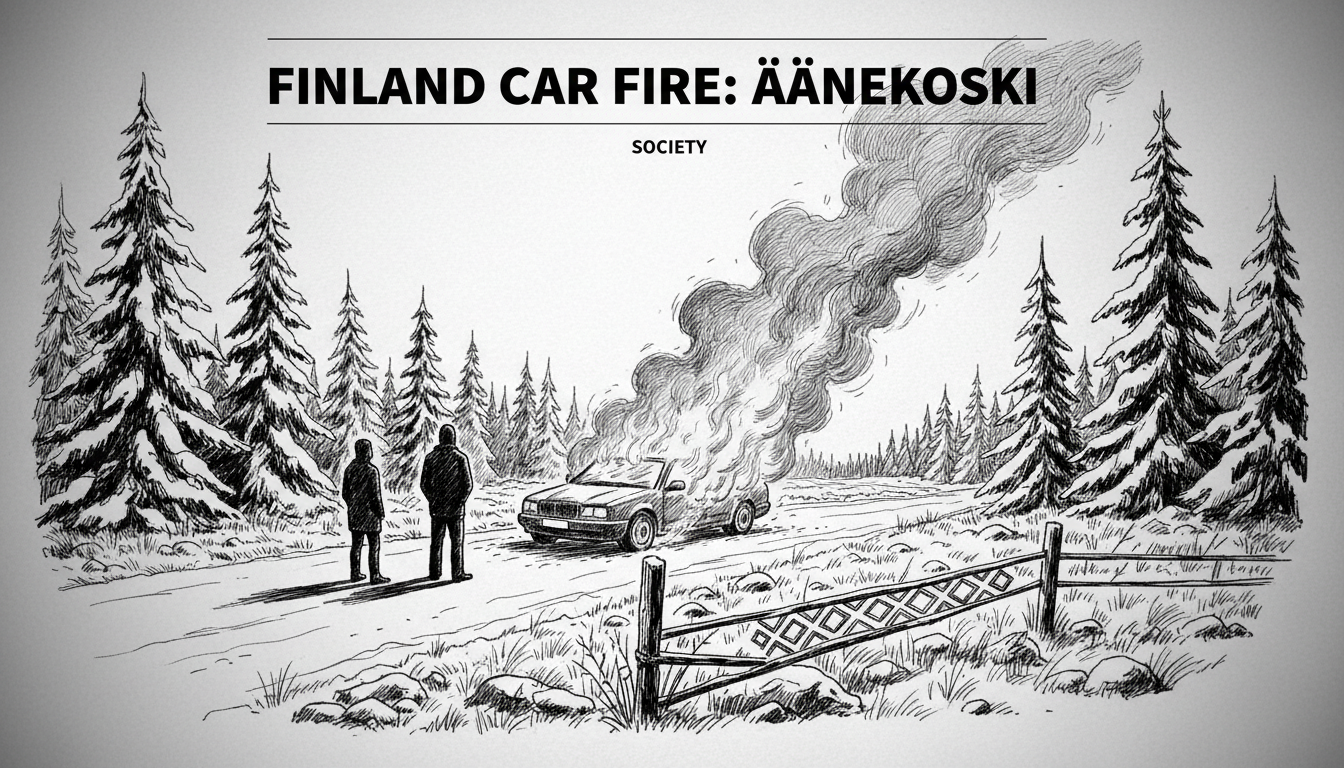
Finland car fire incidents like the one in Äänekoski on Thursday afternoon are a routine yet disruptive emergency for rescue services across the country. A parked combustion-engine car burst into flames on Liimattalantie road in the Konginkangas village area, leading to a swift response from the Central Finland Rescue Department. The alarm was logged precisely at 17:06, marking the start of a contained but destructive event that left the vehicle a total loss. While no injuries were reported and the fire did not spread, the incident highlights the persistent risk of vehicle fires even in quiet, rural settings.
A Routine Call with a Fiery Outcome
The call to the Central Finland Rescue Department was for a traffic vehicle fire, a common classification in their emergency logs. Crews arrived at the scene on Liimattalantie, a road in the Konginkangas district of the industrial town of Äänekoski. Their primary objective was containment and extinguishment, a task they accomplished efficiently. Despite their efforts, the intensity of the blaze rendered the personal car a complete write-off, with damage assessed as beyond economical repair. The fact that the car was stationary and unoccupied at the time of ignition likely prevented a more serious outcome, allowing firefighters to focus solely on the vehicle itself without the complication of a rescue operation.
This incident fits a familiar pattern for rescue services. Vehicle fires can originate from multiple points: electrical short circuits in aging wiring, fuel system leaks, overheated braking systems, or catalytic converter issues. In a parked vehicle, the cause often points to an electrical fault that smoldered before erupting into open flame. The Central Finland Rescue Department’s successful containment, ensuring the fire did not jump to nearby vegetation or structures, is a standard procedural victory but underscores the ever-present danger. For the car owner, the event transforms from a statistical probability into a sudden, total loss of property.
The Investigation and Insurance Aftermath
Following the extinguishment, the procedural aftermath begins. While not every car fire warrants a full-scale criminal investigation, authorities typically conduct a preliminary examination to rule out obvious signs of foul play. Fire investigators look for telltale indicators such as multiple points of origin or the presence of accelerants, which would shift the incident into a potential arson case. In the absence of such signs, the likely conclusion will point to a technical or mechanical failure. The vehicle, now a charred shell, becomes evidence for both the rescue department’s report and the owner’s insurance claim.
The insurance process is straightforward in these total-loss scenarios. An adjuster will assess the vehicle’s pre-fire value against the cost of repairs, which in a case of severe fire damage is almost always prohibitive. The car is then declared a total loss, or "lunastuskuntoon" as stated in the report, meaning it is only suitable for salvage or scrap. The owner’s comprehensive insurance policy would cover this loss, minus any applicable deductible. This financial resolution, however, does little to mitigate the immediate inconvenience and disruption caused by the sudden destruction of a primary means of transport, especially in a rural area where public alternatives are limited.
Vehicle Fire Trends in Finnish Context
Finland sees hundreds of vehicle fires annually. They are a consistent, if not leading, category of calls for rescue services nationwide. These incidents occur across all seasons, though some experts note potential correlations with extreme cold, which stresses batteries and electrical systems, and dry summer periods, where a roadside fire poses a greater risk of spreading. The Äänekoski incident, occurring in spring, does not fit those seasonal patterns, leaning more toward random mechanical failure or an undetected manufacturing flaw. The model and age of the vehicle, details not released in initial reports, are significant factors; older cars with degraded insulation and newer models with complex electrical architectures can both be susceptible.
From a policy perspective, vehicle fires sit at an intersection of consumer safety, manufacturing standards, and emergency service resource allocation. Finland adheres to stringent EU-wide vehicle type-approval regulations, which include safety tests. However, these tests primarily focus on crash safety and emissions rather than long-term fire risk from component degradation. There is no routine public data breakdown comparing fire rates between combustion engines and the growing fleet of electric vehicles in Finland, though both categories have distinct risk profiles. For rescue services, the response protocol is well-drilled, but each call consumes resources and carries inherent risk for the firefighters involved.
The Local Impact in Konginkangas
For residents of Konginkangas, the event was a brief spectacle of emergency activity on an otherwise ordinary Thursday evening. Äänekoski, a town deeply connected to the forest industry, has a community familiar with industrial safety protocols, but a private car fire on a residential road is a more personal disruption. It serves as an unwelcome reminder of the vulnerabilities of everyday technology. The swift response by the Central Finland Rescue Department reinforces public confidence in local emergency services, capable of managing crises from industrial accidents to domestic blazes.
The incident also highlights the importance of vehicle maintenance. While not all fires are preventable, regular checks of electrical systems, fluid levels, and recalls can mitigate risk. For the public, the takeaway is often a renewed awareness: noticing unusual smells, smoke from the dashboard, or warning lights should prompt immediate stopping and investigation, not continued driving. The parked car in Konginkangas did not offer that warning; it simply ignited, suggesting a failure that may have been hidden from the owner until it was too late.
A Contained Incident with Broad Implications
The Äänekoski car fire concluded as a contained, single-vehicle incident. No one was hurt, no other property was damaged, and the emergency response was executed flawlessly. By all measurable outcomes, it was a successful operation for the rescue services. Yet, it represents a minor breakdown in the complex system of personal transportation that society relies upon. Each such fire is a small data point in a larger set, informing safety reviews and, occasionally, leading to vehicle recalls if a pattern emerges across a specific model or component.
For the individual involved, it is a total and sudden loss. For the community, it is a passing event. For analysts, it is a case study in routine emergency management. The charred vehicle on Liimattalantie road is a testament to the latent energy contained in everyday machines and the thin line between normal operation and catastrophic failure. As Finland continues to modernize its vehicle fleet, the causes of fires may evolve, but the essential job of the rescue services—to respond, contain, and protect—remains a constant, vital safeguard in both bustling cities and quiet villages like Konginkangas.
Will the silent, parked cars in our driveways and on our streets ever be completely free from this unpredictable risk, or is it an inherent price of mechanical and electrical complexity? The answer likely lies not in eliminating the risk entirely, but in the continued vigilance of owners, manufacturers, and the firefighters who stand ready when prevention fails.