
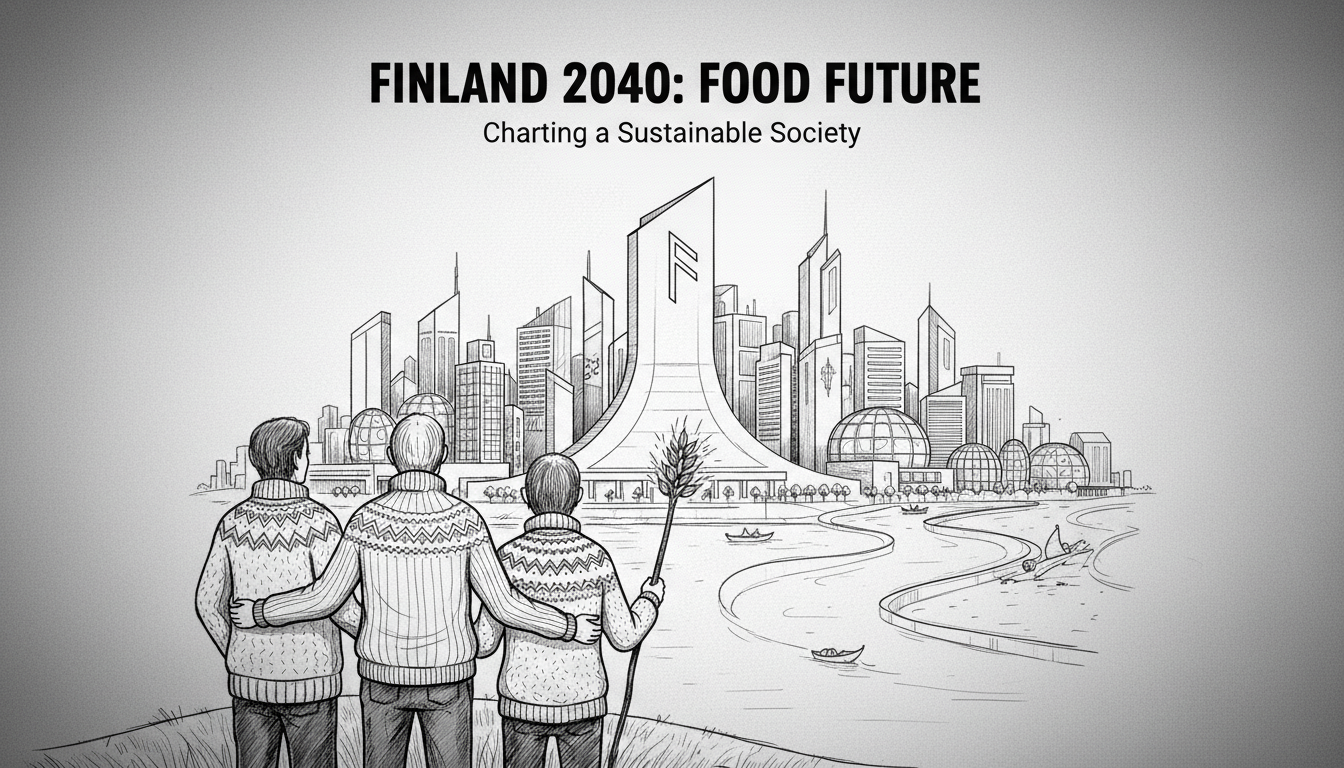
Finland's government has unveiled a sweeping national food strategy designed to fundamentally reshape the country's food system by 2040. The Ministry of Agriculture and Forestry published the long-term roadmap today, emphasizing responsibility, sustainability, and collaboration across the entire supply chain. At its core, the plan seeks to rebalance economic power to ensure farmers receive a fairer share of the consumer's euro, a move that addresses long-standing grievances in the sector.
The strategy outlines four primary goals: improving profitability and fairness for producers; ensuring everyone has access to healthy, sustainable food; strengthening the entire food chain's resilience and self-sufficiency; and making Finland's food system a global example of responsibility. The 2040 vision frames food not merely as a commodity but as a cornerstone of national wellbeing, economic stability, and environmental health.
A Blueprint for Fairer Fields
The most immediate and politically resonant goal is reworking the financial dynamics between farmers, processors, and retailers. The strategy states a clear objective: within 15 years, farmers must have genuine negotiating power to determine a fair price for their goods. Currently, the ministry acknowledges that the euros consumers pay for food are not distributed fairly, leaving primary production economically precarious. This aim strikes directly at the power of large retail chains and global market pressures that often squeeze producer margins. It suggests potential future policy tools, from enhanced cooperative rights to stricter supply chain transparency laws, though specific legislative measures are not yet detailed.
This focus on farmer viability is set against the backdrop of the EU's Common Agricultural Policy (CAP), which provides crucial subsidies to Finnish farmers. The national strategy must operate within this EU framework while pushing its boundaries towards greater fairness. Finland's northern climate, with its short growing season and high costs, makes this economic challenge even more acute. The plan implicitly argues that sustainability cannot be achieved without economic sustainability for those working the land.
Sustainability from Soil to Supper
Beyond economics, the strategy embeds environmental and climate goals into every link of the food chain. It promotes a shift towards more plant-based production and consumption, reduced food waste, and farming practices that enhance biodiversity and soil health. The vision for 2040 is a circular bioeconomy where side streams from agriculture and forestry are utilized efficiently. This aligns with broader EU Green Deal ambitions, particularly the Farm to Fork strategy, positioning Finland to potentially become a testbed for green food production methods suited to northern conditions.
The plan also emphasizes national resilience. While Finland maintains a high degree of self-sufficiency in key staples like grains, dairy, and meat, the strategy seeks to strengthen this position. It considers security of supply in an era of climate disruption and geopolitical instability as a non-negotiable priority. This involves supporting diverse production, investing in agricultural research for hardy crop varieties, and maintaining strategic production capacity.
Expert Scrutiny and Implementation Hurdles
Policy experts are already dissecting the ambitious blueprint. Professor Juha Helenius, a prominent agro-food systems researcher at the University of Helsinki, acknowledges the strategy's comprehensive vision but highlights the execution gap. 'Setting a 15-year horizon for equitable farmer pricing is a strong political statement. The real test will be the interim steps—the five-year reviews, the annual budget allocations within the CAP framework, and the government's willingness to regulate powerful market actors if voluntary measures fail,' Helenius notes. He points out that global commodity markets and EU trade policies will heavily influence what is domestically achievable.
Another challenge lies in reconciling potentially competing goals. Boosting exports for economic gain while prioritizing domestic consumption for sustainability requires careful calibration. Similarly, increasing production for self-sufficiency must be balanced against stringent environmental targets. Consumer behavior is another critical variable; the strategy's success partly depends on convincing Finns to choose sustainable, possibly more expensive, local options over cheaper imports.
The Political Appetite for Change
The strategy's publication kicks off a long-term political process. It will require commitment across multiple parliamentary terms and governments of varying compositions. The current ruling coalition, led by Prime Minister Petteri Orpo's National Coalition Party, has placed a strong emphasis on rural livelihoods and export competitiveness. Agriculture Minister Sari Essayah, from the Christian Democrats, framed the strategy as a contract between producers and consumers. 'This is not just a plan for the ministry or farmers. It is a roadmap for all of Finland, showing how we can build a food system that is strong, fair, and capable of feeding our nation well into the future,' Essayah stated during the launch.
Opposition parties, particularly the Centre Party with its strong rural base, are likely to scrutinize whether the plan's fairness rhetoric translates into tangible support. The Social Democrats and Green League will push for stricter environmental benchmarks. The strategy, therefore, becomes a living document against which future agricultural budget negotiations and policy initiatives will be measured.
A Nordic Model for Food?
Finland's approach reflects a broader Nordic tendency to plan systemic transitions with long time horizons, from carbon neutrality to digitalization. By setting a 2040 target, the government aims to provide certainty for investment and innovation in the food sector. If successful, Finland could present a Nordic model for food that merges high welfare standards, environmental stewardship, and economic fairness. The strategy consciously aims to make 'Finnish food' a brand synonymous with trust and responsibility globally.
The journey from this strategic launch to the dinner tables of 2040 will be long and complex. It will involve difficult negotiations in Brussels over CAP rules, continuous dialogue with domestic stakeholders from smallhold farmers to major retailers, and a societal conversation about the true value of food. The plan's ultimate legacy will be determined not by its elegant vision, but by the political courage and consistent investment applied to it year after year. As climate pressures intensify and global supply chains face new shocks, Finland's attempt to future-proof its food system may offer lessons far beyond its borders.