
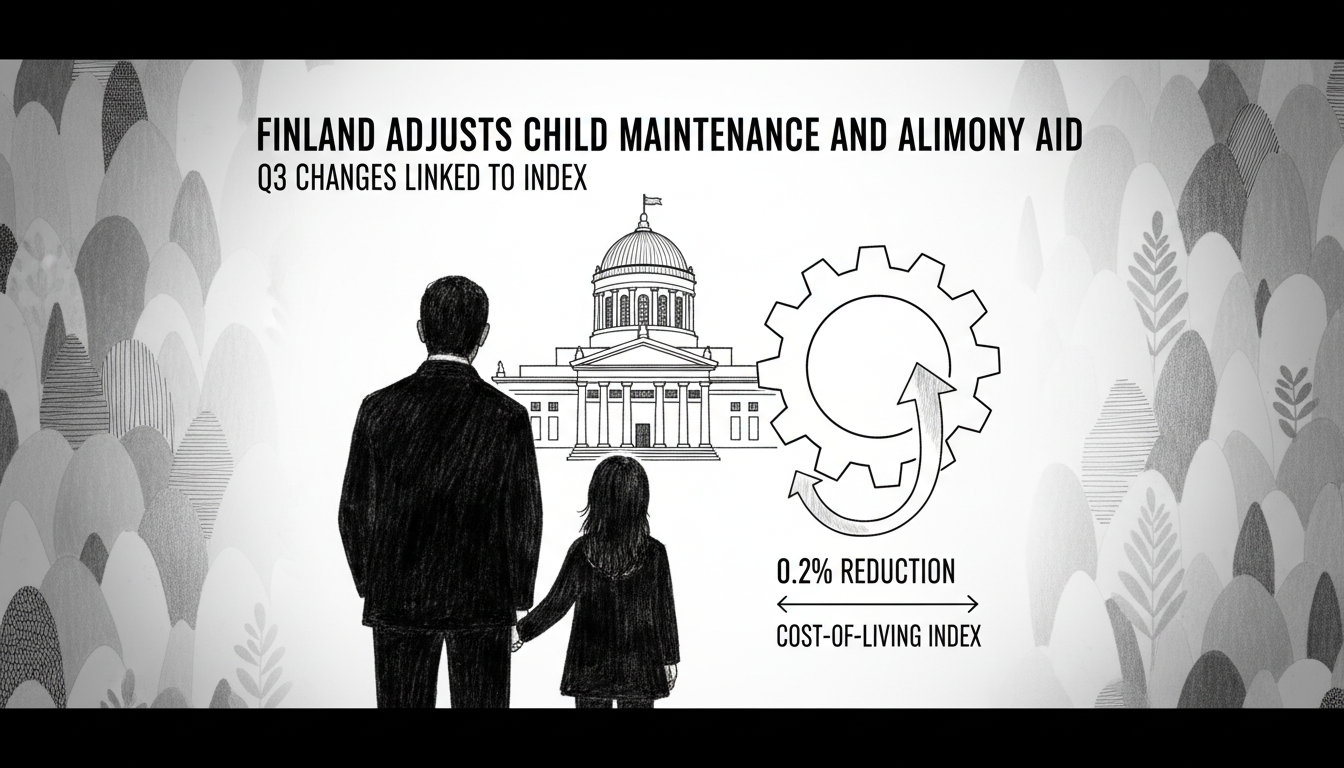
The Finnish government will implement reductions to key social security payments related to child maintenance at the start of the next calendar year. The Social Insurance Institution, known as Kela, confirmed that both child maintenance support and basic alimony aid will decrease by 0.2 percent. This adjustment stems from an automatic link to the national cost-of-living index, which recorded a minor negative fluctuation. The change affects thousands of families across Finland and alters the financial obligations for non-custodial parents.
Kela operates under the Ministry of Social Affairs and Health, administering benefits tied to complex legislative formulas. The 0.2 percent reduction applies to the statutory basic alimony aid paid by the state to custodial parents when the other parent defaults. More critically, it also lowers the official reference amount used to calculate private child maintenance payments between separated parents. Kela will not issue individual notifications about the new reference amount to liable parents. Each parent paying child support must proactively ensure they adjust their monthly payments to the correct new sum from January onward.
This procedural detail places a significant administrative burden on families. A parent who fails to reduce their payment accordingly could technically overpay, while underpaying could lead to enforcement actions. For cases where Kela is already providing child maintenance support because the liable parent has not paid, the new amount will be visible in the OmaKela online service by early January. The system relies on digital self-service, a hallmark of Finland's welfare administration, but it assumes a high degree of citizen engagement and financial literacy.
Concurrent changes affect income limits for debt relief from unpaid child support. A liable parent can now qualify for a payment exemption if their monthly income does not exceed 1,336 euros. This threshold increases by 334.01 euros for each minor child they support, though children for whom Kela already pays maintenance support do not trigger this increase. These figures are set by government decree and reflect ongoing calibrations to Finland's extensive social safety net. The adjustments aim to balance fiscal responsibility with adequate family support, a perennial challenge for coalition governments in Helsinki.
From a policy perspective, this index-linked change is technically neutral, merely reflecting statistical data. Yet its real-world impact is a direct reduction in support for single-parent households, a group often facing higher poverty risks. The governing coalition, led by Prime Minister Petteri Orpo, has emphasized budgetary discipline across all ministries. This minor cut aligns with that broader fiscal policy, even if it originates from an automatic mechanism rather than a new parliamentary vote. The Eduskunta's Social Affairs and Health Committee oversees such benefit structures, and these technical adjustments rarely prompt political debate unless they coincide with larger austerity measures.
For international observers and expatriates in Finland, this update highlights the precision and complexity of the Nordic welfare model. Benefits are frequently adjusted, often in small increments, based on indices and predetermined formulas. This can create a sense of stability but also means household budgets are subject to frequent, minor recalibrations. The change also underscores a key difference from many other systems: the state provides a safety net through Kela, but the primary responsibility for child support remains firmly with the parents, enforced through a combination of legal obligation and digital self-service platforms.
What happens next? Families must monitor the OmaKela portal and adjust their finances. The change is small but symbolic of a wider trend of fine-tuning welfare provisions. Future index reviews could reverse the cut, but for now, it represents a slight tightening. The government's approach continues to prioritize automated, rule-based adjustments over discretionary spending increases, a principle deeply embedded in Finnish social policy design.