
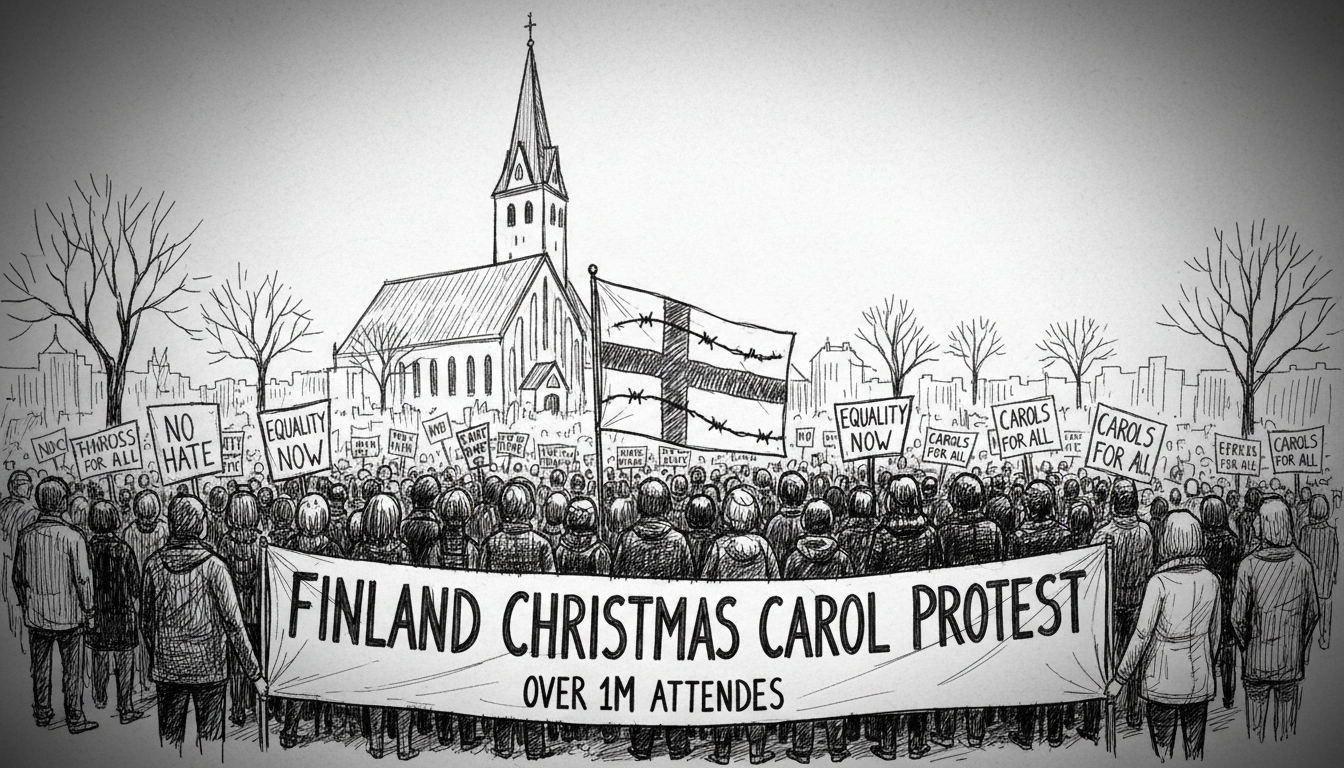
"Somehow one hopes that we could celebrate this holiday season in Finland in a good spirit." Finnish Missionary Society director Pauliina Parhiala's wish underscores a growing tension within one of the nation's most cherished Advent traditions. Finland's Kauneimmat Joululaulut (The Most Beautiful Christmas Carols) events attract over a million participants annually, yet the organization now navigates a stream of feedback that includes racist remarks. This conflict highlights the delicate balance between preserving a half-century-old cultural staple and adapting to modern societal values.
A Half-Century of Harmonic Tradition
The Finnish Missionary Society, founded in 1859, launched the Kauneimmat Joululaulut initiative in 1973. It was conceived as a way to foster community and raise funds for missionary work through shared song. The model is simple: the society publishes a booklet of selected carols, and churches, community centers, and even shopping malls host gatherings where people sing together. This practice has woven itself into the fabric of Finnish December, becoming as predictable as the first snow. For many, attending a carol-singing event is a non-negotiable start to the holiday season, a moment of collective calm and reflection. The tradition's endurance speaks to its deep resonance, creating a shared cultural touchstone for generations.
The Three Streams of Feedback
According to Parhiala, feedback on the carol selection falls into three distinct categories. First, many people write to express how meaningful the tradition is to them, often lamenting if a personal favorite is absent in a given year. Second, there is commentary on the musical choices themselves—debates over which hymns or songs deserve inclusion. The third category, however, is more troubling: outright racist feedback. This racism is often linked to perceptions that changes to the songbook are driven by excessive political correctness or a dilution of traditional Finnish culture. While Parhiala notes the total volume of feedback is small compared to the millions who participate, its nature is concerning. She explicitly lamented the racist comments, emphasizing a desire for harmonious celebration.
The Case of the Missing Carol
The discussion intensified with the decision to remove "Sylvian joululaulu" (Sylvia's Christmas Song) from the booklet for the 2023 events. This popular carol, a perennial favorite, was omitted as part of the society's regular review process to refresh the collection. Its absence sparked a noticeable spike in responses, with some criticism veering into the racist territory described by Parhiala. It is crucial to note that the song was not banned; individual congregations could and did still choose to sing it. This incident mirrors a similar reaction the previous year when the hymn "Enkeli taivaan" (Angel of Heaven) was temporarily left out. These episodes demonstrate how deeply personal and emotionally charged these musical traditions can be for participants.
Understanding the Scale of Participation
The emotional investment is understandable given the tradition's massive reach. A survey conducted by Taloustutkimus for the Finnish Missionary Society indicated that approximately one in three Finns attends a Kauneimmat Joululaulut event each year. This translates to well over a million participants, cementing its status as a national phenomenon. When a change affects a tradition of this magnitude, even a small percentage of vocal feedback can create a disproportionate sense of controversy. Parhiala put this in perspective: with participation in the millions, receiving a hundred or so pieces of critical feedback is statistically minor. Yet, the content of that feedback, particularly the racist element, carries significant social weight beyond its quantity.
Expert Analysis: Evolution of a Cultural Institution
Cultural historians and ethnomusicologists point out that this situation is a classic example of a living tradition encountering the pressures of a changing society. "No cultural practice is static, not even those we perceive as immutable Christmas traditions," notes Dr. Liisa Matveinen, a researcher in Finnish folk culture at the University of Helsinki. "The songbook itself has evolved over five decades, adding and removing pieces. What's new is the public, digital magnification of the debate and the injection of broader societal tensions into it." The racist feedback, experts suggest, may less be about the specific carols and more a channel for expressing anxiety over national identity and cultural change. The challenge for custodians of traditions like the Missionary Society is to curate with both respect for heritage and sensitivity to contemporary inclusive values.
The Broader Context in Finnish Society
This carol controversy does not exist in a vacuum. Finland, like many European nations, is engaged in ongoing conversations about immigration, integration, and what constitutes national culture. The Finnish Missionary Society's work itself has evolved from its 19th-century origins towards a focus on diaconal and development aid, reflecting broader shifts in religious and social mission. The racist feedback aimed at a Christmas event arguably mirrors these larger, sometimes fractious, discussions. The society's response—acknowledging the problem, emphasizing community spirit, and continuing its curatorial work—represents one institutional approach to navigating these waters. It chooses to highlight the unifying power of song while not ignoring the discordant notes from the fringe.
Looking Ahead to Silent Nights?
The future of Kauneimmat Joululaulut will likely involve more of these careful deliberations. The society will continue to update its songbook, perhaps with increased transparency about its selection criteria to foster understanding. The goal, as Parhiala's opening quote makes clear, is to preserve the tradition's core purpose: bringing people together in a spirit of peace and goodwill during the dark Finnish winter. Whether the racist feedback represents a loud minority or a symptom of deeper division remains to be seen. For now, the carols will continue to ring out in Munkkivuori Church and hundreds of other venues. The true test may be if the collective act of singing can, over time, quiet the voices of division and reinforce the simple, inclusive joy the tradition was founded to promote.