
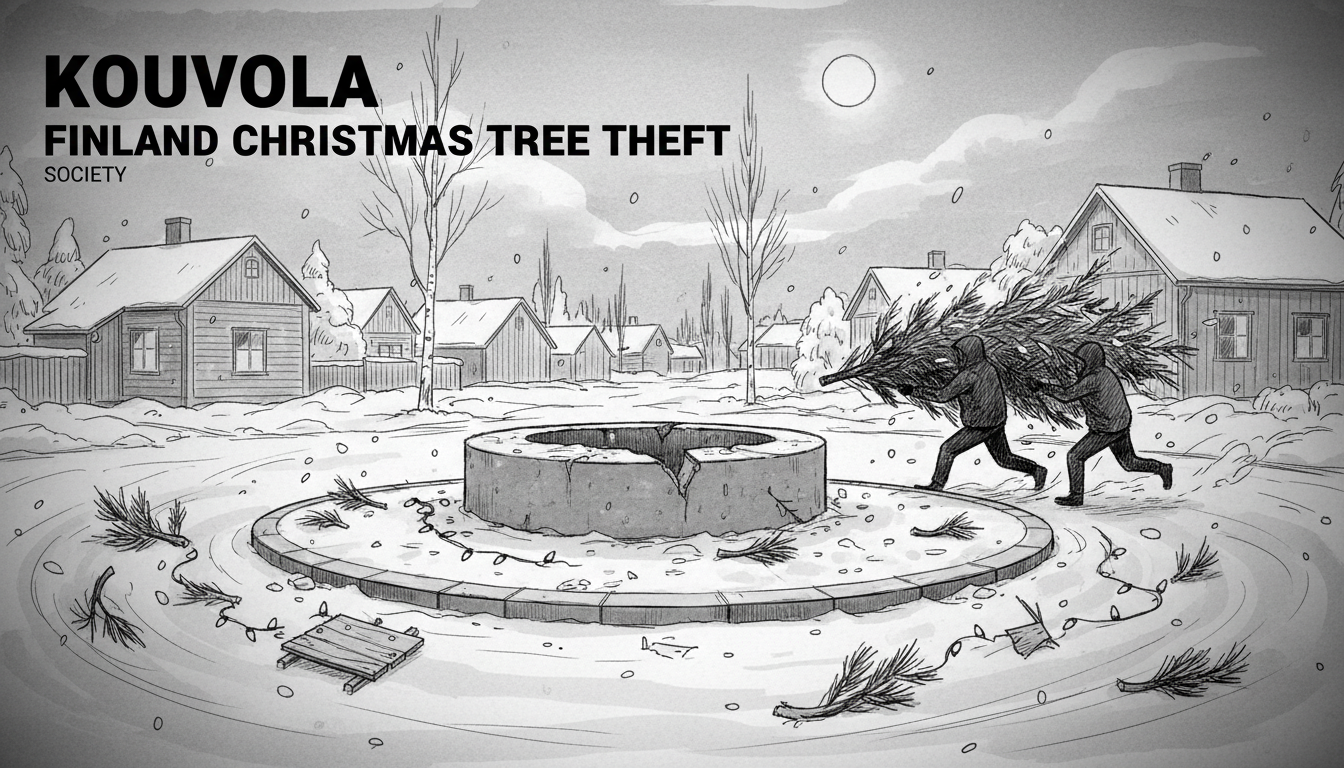
Finland Christmas tree theft has struck the southeastern city of Kouvola, where a freshly decorated public spruce vanished from a busy roundabout overnight. The Keltakangas roundabout's holiday centerpiece, installed just five days earlier by municipal workers, was stolen between Wednesday and Thursday night, leaving behind only a bare stand and a puzzled community. Local police have launched an investigation and are appealing to the public for any information regarding the stolen tree and the individuals responsible for what they classify as theft and vandalism.
This incident, while seemingly minor, taps into a deeper Finnish cultural contract regarding public decorum and the shared ownership of seasonal symbols. In a country where the dark December weeks are brightened by communal displays of light and greenery, the removal of a public Christmas tree is viewed as an attack on collective spirit. The Kouvola Police Department confirmed the investigation is active, though no suspects have been identified yet. 'We treat all reports of vandalism seriously, as they impact the community's sense of security and well-being,' a police spokesperson said in a statement, urging residents with doorbell or dashcam footage from the Keltakangas area to come forward.
A Short-Lived Symbol of Holiday Cheer
The stolen spruce was a typical municipal Christmas tree, selected for its shape and size to withstand the winter weather and serve as a focal point in the traffic circle. Kouvola's city maintenance department had erected and decorated the tree as part of its annual holiday preparations, a process repeated in town squares and roundabouts across Finland throughout late November. Its theft after a mere five days represents a significant waste of public resources and effort. The cost of the tree, its transportation, installation, and decoration, while not enormous, is ultimately borne by taxpayers. More importantly, its absence creates a tangible void in the public space intended for everyone's enjoyment.
Local residents expressed disappointment upon discovering the empty roundabout. 'It's just mean-spirited,' said one Kouvola local passing by the site. 'It's not about the tree's value, it's about what it represents. Someone went out of their way to take away a bit of joy that was meant for all of us.' This sentiment is common in Finland, where public trust in authorities is high and respect for shared property is a generally held social norm. Acts of petty vandalism, therefore, often generate disproportionate outrage because they violate these foundational societal expectations.
The Unwritten Rules of Finnish Public Space
Finland's relationship with public order and seasonal traditions provides crucial context for this theft. The country consistently ranks highly in global surveys measuring social cohesion and trust. The annual installation of Christmas trees in public areas is a small but meaningful ritual that reinforces community identity during the darkest time of the year. Their lighting ceremonies are often local events, especially in smaller towns. While isolated acts of vandalism occur, the widespread preservation of these decorations across the nation speaks to a general consensus about their intangible value.
Security expert and former police officer Marko Forss, now a lecturer at the Police University College, notes that such crimes are rarely economically motivated. 'A cut Christmas tree has very little resale value,' Forss explains. 'This type of act is usually either a impulsive prank, often influenced by alcohol, or a deliberate, albeit minor, act of anti-social behavior. The intent is to disrupt the normal order and communal feeling. Fortunately, these incidents are not part of a larger trend, but each one damages the local social fabric in a small way.' Forss points out that investigation resources are limited, and without public tips or clear video evidence, finding the perpetrators can be challenging.
Municipal Response and the Cost of Vandalism
The City of Kouvola now faces a decision: whether to replace the stolen tree. A spokesperson for the city's technical services indicated that a replacement is being considered, but it depends on budget and resource availability this late in the season. 'Our crews have moved on to other winter maintenance duties,' the spokesperson noted. 'Finding, transporting, and securing a new tree requires planning. We hope the police investigation yields results, but our primary focus is on essential services.' This practical response highlights the administrative nuisance caused by such vandalism, diverting attention from planned work.
Finland does not maintain nationwide statistics specifically for Christmas tree theft, as it falls under broader categories of theft or damage to public property. However, municipal associations confirm that similar incidents are reported a handful of times each winter in different parts of the country. The response varies; some cities swiftly replace the tree as a matter of principle, while others may leave the space empty, judging that the risk of a repeat incident is too high. The decision often reflects the local government's reading of the community's mood and its own budgetary constraints.
Beyond Kouvola: A Seasonal Challenge Across the Nordics
While this story is focused on Kouvola, the phenomenon is not uniquely Finnish. Neighboring Nordic countries also grapple with occasional vandalism of holiday decorations. The motivations appear similar across the region: drunken mischief, teenage dares, or rare acts of deliberate cultural protest. What differs is the scale of public reaction. In Finland's tight-knit communities, even in a city of over 80,000 like Kouvola, such an act feels personal. The tree was not owned by a distant corporation but by the city itself—an entity seen as an extension of the citizenry.
Sociologist Anna-Leena Liimatainen from the University of Helsinki studies Finnish community behavior. 'The public Christmas tree is a powerful symbol because it is apolitical and inclusive,' Liimatainen says. 'It doesn't represent a government policy or a commercial interest in the same way a flag or an advertisement might. It represents light, continuity, and a pause in the ordinary. Stealing it is a rejection of that shared, gentle pause. It's interesting that the thieves likely understood its symbolic weight—that's precisely why taking it had meaning, beyond the value of the physical tree.'
A Community's Choice: Cynicism or Resilience
The aftermath of the theft now presents a subtle test for the Kouvola community. Will the story become a brief anecdote about modern disrespect, or will it spur a positive counter-reaction? In past instances elsewhere in Finland, similar acts have sometimes inspired local businesses or community groups to fund a replacement, occasionally organizing a small, defiant re-lighting ceremony. This transforms an act of taking into an opportunity for communal reaffirmation. Whether Kouvola follows this path remains to be seen.
For now, the Keltakangas roundabout stands a little darker. The police investigation continues, relying on the community's eyes and ears. The story of the missing spruce is a small, peculiar footnote to the holiday season—a reminder that even in societies built on high trust, that trust is occasionally, and pointlessly, broken. Yet, the very fact that its disappearance is newsworthy underscores how firmly the expectation of shared respect remains ingrained in the Finnish psyche. The ultimate lesson may be that the value of a public symbol is most clearly revealed not in its presence, but in the collective reaction to its absence. Will the response be a shrug, or a statement?