
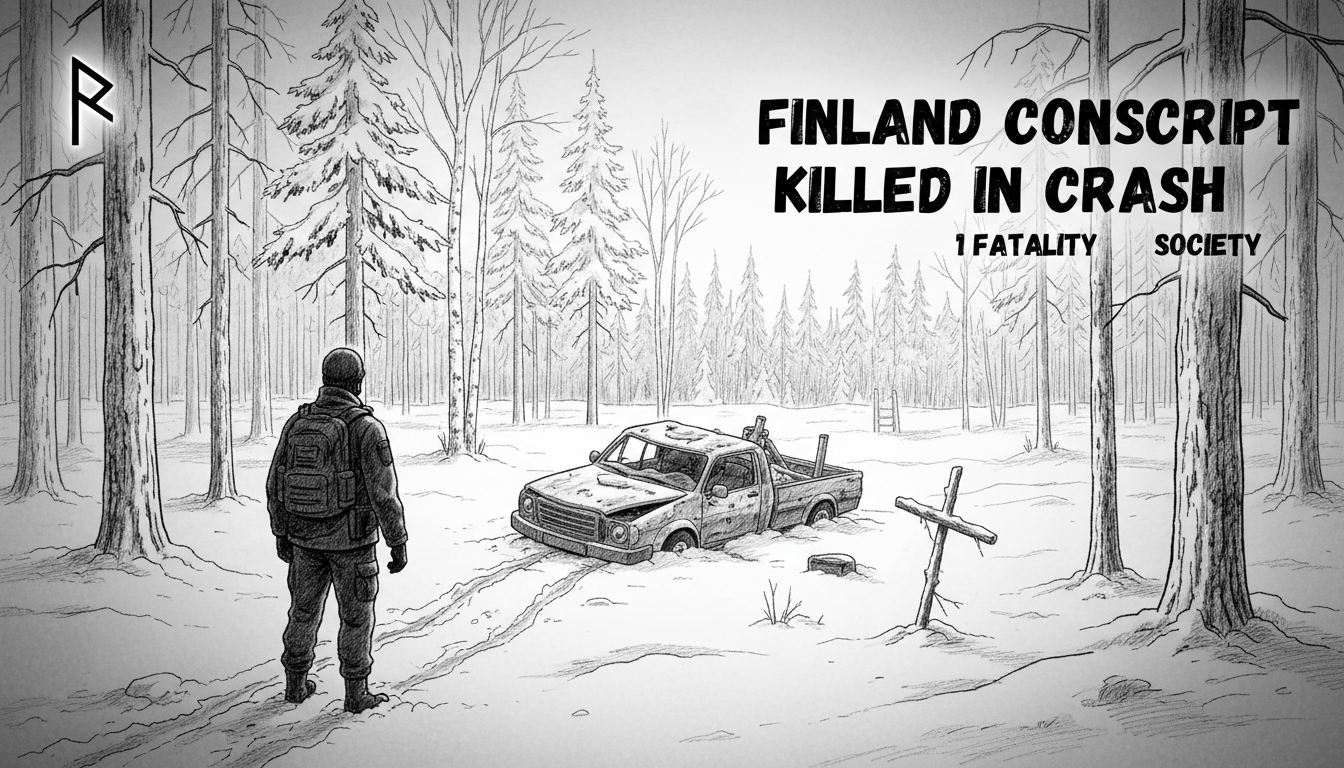
Finland's mandatory military service has recorded one fatality as a conscript died in a Kouvola car accident hours after completing his service. The tragic collision occurred at 4 PM on Thursday at the intersection of Highway 6 and Karjalankatu, cutting short the young soldier's homecoming. Police are investigating the circumstances, while the Karelia Brigade has mobilized crisis support for affected personnel. This incident highlights the often-overlooked vulnerabilities faced by soldiers transitioning back to civilian life.
A Sudden and Tragic End
The conscript had just been discharged from the Karelia Brigade in Vekaranjärvi, a key unit responsible for defending Finland's eastern border. He was on his direct route home when the accident happened, turning a moment of celebration into one of profound grief. Authorities have notified his family, and the defense forces have expressed deep condolences. For many Finns, this loss resonates personally, given that approximately 20,000 young men undergo compulsory service each year.
Road safety data from the Finnish Transport and Communications Agency shows that traffic accidents remain a leading cause of death among young adults. While specific statistics for newly discharged conscripts are not systematically tracked, experts note that the period following intense military training can involve heightened risk. The intersection where the crash occurred is a known busy junction in Kouvola, a city in southeastern Finland with significant through-traffic.
The Immediate Aftermath and Investigation
Local police in Kymenlaakso region have launched a standard crash investigation, which will examine factors like vehicle speed, road conditions, and driver behavior. No other serious injuries were reported, but the scene required several hours of clearance. The Finnish Defence Forces confirmed the deceased's recent service status and emphasized their full cooperation with civilian authorities. This protocol underscores the seamless coordination between military and municipal entities in Finland.
Defence Minister Antti Häkkänen, in a statement to the Eduskunta's Defence Committee, said, 'Every loss in our defense community is deeply felt. We are providing all necessary support to the family and fellow soldiers.' The Karelia Brigade has activated its crisis management team, offering psychological services to any conscripts or permanent staff impacted. Such responses are standard under the defence forces' comprehensive care directives.
Understanding the Transition from Service
Mandatory military service in Finland lasts between 6 to 12 months, involving rigorous training and discipline. Dr. Elina Saarelma, a military psychologist at the Finnish Institute for Health and Welfare, explains, 'The transition back to civilian life can be a vulnerable phase. Soldiers adapt to a structured environment, and sudden return to normalcy may involve disorientation or reduced alertness, potentially affecting driving.' She stresses that while not directly causative, this context is crucial for holistic support.
Road safety expert Professor Jari Lyytimäki from the University of Helsinki notes, 'Intersections like Highway 6 and Karjalankatu have moderate accident rates, but any fatality triggers a review. We must consider driver fatigue, celebration distractions, or adjustment periods post-service.' He advocates for enhanced safety campaigns targeting young drivers, including those leaving military bases. Finland's overall road death toll has declined in recent years, yet accidents persist as a national concern.
Systemic Responses and Support Frameworks
The Finnish Defence Forces have long-standing protocols for casualty incidents, extending support to families and units. This case will likely be reviewed internally to identify any preventive measures for future discharges. The Eduskunta has previously allocated funds for soldier welfare programs, reflecting broad political consensus on defense community care. Unlike some EU countries, Finland maintains conscription, making such incidents a matter of public interest and policy scrutiny.
From an EU perspective, Finland's model of national service is unique among Nordic peers, with Sweden and Denmark having voluntary systems. This tragedy may inform broader European discussions on soldier reintegration and road safety initiatives. Helsinki's government district has monitored similar incidents historically, leading to incremental improvements in post-service briefing sessions that include travel safety reminders.
Analysis: Gaps and Opportunities in Safety Nets
This death exposes potential gaps in the transition from military to civilian life. While the defence forces provide extensive training, the immediate hours after discharge are less structured. Experts suggest that brigades could implement mandatory cool-down periods or travel risk assessments for long-distance commuters. However, any policy changes must balance safety with personal freedom, a sensitive topic in Finnish society.
Military service is a rite of passage for Finnish men, and fatalities, though rare, spark national reflection. The incident coincides with ongoing Eduskunta debates on defense spending and soldier welfare, ensuring it receives parliamentary attention. Opposition MPs have called for a review of discharge procedures, though the government emphasizes that road safety is a shared societal responsibility.
A Community in Mourning
The Karelia Brigade has a tight-knit community, and the loss will be felt across ranks. Fellow conscripts who served with the deceased are receiving counseling, highlighting the military's commitment to mental health. This support aligns with Finland's broader approach to well-being, a cornerstone of its public policy. The tragedy also reminds civilians of the sacrifices inherent in national defense, even in non-combat settings.
As investigations continue, the focus turns to prevention. Will this incident lead to revised protocols for discharging conscripts? How can road safety campaigns better target young soldiers? These questions linger in Helsinki's policy circles. For now, the nation mourns a young life lost at the threshold of civilian return, a stark reminder of fragility after service.
Moving Forward: Lessons from Loss
Finland's defense authorities are likely to incorporate findings from the police investigation into their safety briefings. The incident underscores the need for continuous evaluation of support systems for conscripts, a group that represents Finland's front-line resilience. In the coming weeks, the Eduskunta may discuss potential amendments to service regulations, though any changes will require careful deliberation.
This tragedy, while isolated, reinforces the importance of community and care in the military framework. As Finland upholds its mandatory service model, ensuring a safe transition home remains a critical, yet often unspoken, priority. The conscript's death in Kouvola is not just a traffic statistic; it is a call to enhance the invisible safeguards for those who serve.