
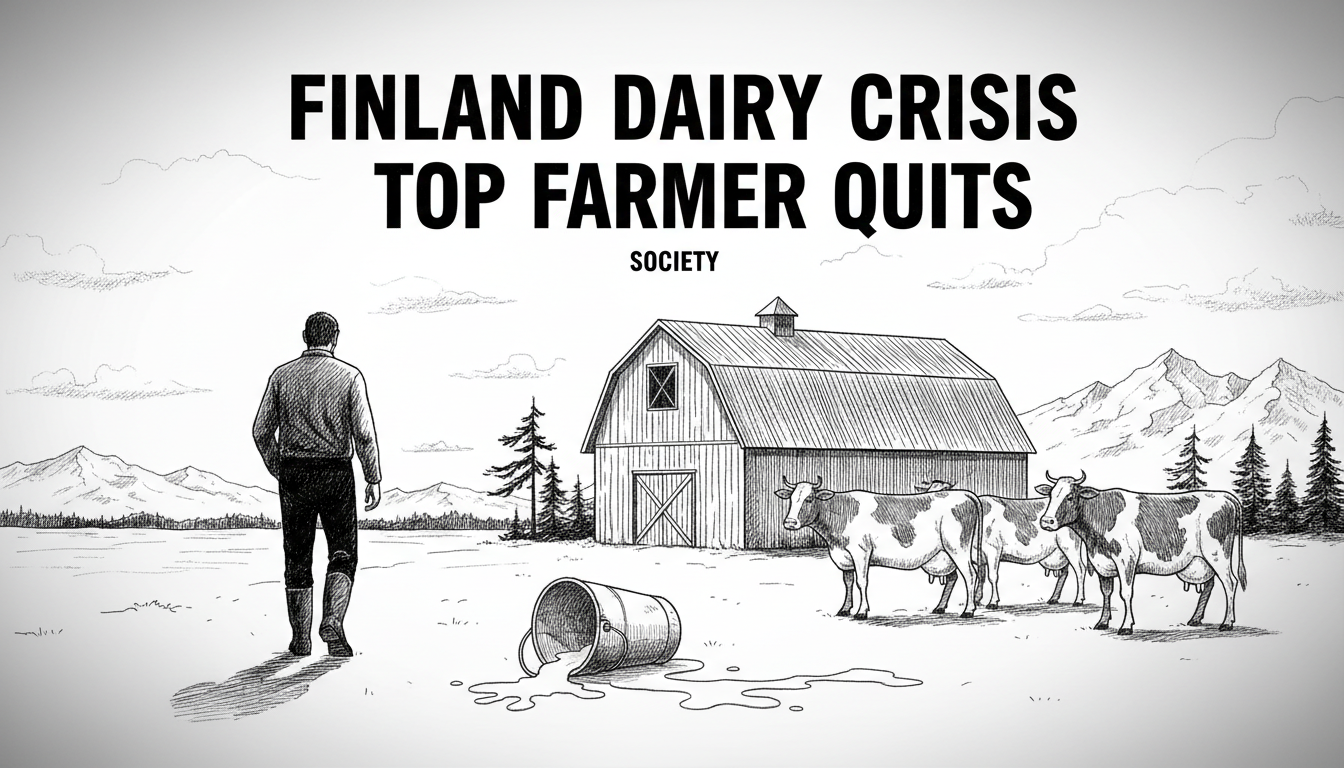
Finland’s regional champion dairy herd, a group of cows producing over 100,000 kilograms of milk each, will soon disappear. Their owner, Jarmo Argillander, is methodically shutting down his award-winning farm in Viitasaari, a quiet symbol of a deepening national crisis in agriculture.
Argillander’s operation on Luotolansaari island once milked 38 cows. Today, only 12 remain, all aging, with the youngest at five years old. He has stopped rearing replacement calves. This deliberate wind-down comes despite his cows consistently winning top honors in the Central Finland region for lifetime production. "You have to be quitting to get the first prize," Argillander notes with grim irony. His barn has housed six of these elite ‘satatonnari’ cows, each yielding over 100,000 liters of milk.
The Unraveling of a Dream
Argillander’s story contradicts the optimistic narrative presented to a generation. "In school, agriculture was portrayed as the industry of the future," he recalls, a sentiment once widely promoted to ensure national food security. Now, the practical and financial realities have overwritten that promise. The daily grind—milking at 5 AM and 4 PM, 365 days a year—is compounded by thin profit margins and a looming, isolated retirement. Without a successor and facing relentless economic pressure, he sees closure not as a choice but an inevitability. His farm is a microcosm of a trend sweeping the Nordic countryside, where consolidation pushes smaller, often highly skilled, operators out.
Systemic Pressures on Finnish Farmers
The challenges are multifaceted and entrenched. Finnish dairy farmers operate within the European Union's Common Agricultural Policy (CAP), which provides crucial subsidies but also subjects them to continental market forces and regulatory complexity. While direct payments keep many farms afloat, they often feel insufficient against rising operational costs for feed, energy, and equipment. Consumer trends are also shifting. The debate over livestock emissions and a growing demand for plant-based alternatives add social pressure to the economic strain.
“The situation for smaller dairy farms is exceptionally difficult,” explains a senior agricultural economist at the Natural Resources Institute Finland (Luke), who spoke on the condition of anonymity as they were not authorized to give direct comment. “Global price volatility, high domestic production costs, and the capital needed to modernize facilities create a perfect storm. For a farmer without a successor, the calculation becomes very personal.” The expert points out that farm closures are not merely business failures but represent a loss of deep, localized knowledge and genetic livestock excellence, as seen in Argillander’s herd.
The Government's Balancing Act
In Helsinki, the issue sits on the desks of the Ministry of Agriculture and Forestry. The government coalition, led by Prime Minister Petteri Orpo’s National Coalition Party, must balance fiscal responsibility with the strategic goal of maintaining a minimum level of domestic food production. Support mechanisms exist, including agricultural investment aids and environmental subsidies, but farmers often criticize them as bureaucratic and inadequate for the scale of the crisis. Policy discussions in the Eduskunta, Finland’s parliament, increasingly focus on ‘smart specialization’—encouraging farms to diversify into biogas production, agro-tourism, or specialized premium products.
However, for a 62-year-old farmer like Argillander, pivoting to a completely new business model is a daunting prospect. The mental toll is a frequently overlooked factor. The Finnish Institute for Health and Welfare has highlighted the higher risk of mental health issues and suicide among farmers dealing with financial distress and a loss of occupational identity. Closing a farm is not just shuttering a business; it is ending a way of life that has defined families for generations.
An Uncertain Future for the Landscape
The departure of farmers like Argillander alters more than just economic statistics. It changes the social fabric of rural municipalities like Viitasaari and the very look of the Finnish landscape. Well-managed pastureland, maintained by grazing animals, supports biodiversity. As farms close, fields may be abandoned to scrub forest or bought by larger entities, leading to more intensive cultivation on larger fields. This consolidation can increase efficiency but risks further depopulating rural areas and reducing the diversity of farm management styles. The distinctive patchwork of fields and forests, a cornerstone of the Finnish countryside, is under threat.
Some see a path forward in stronger producer cooperatives, like the giant Arla or Valio, leveraging their brand power to secure better prices and invest in new technologies. Others advocate for a more radical shift in consumer behavior, with citizens willing to pay a significant premium for locally produced, high-welfare dairy. The EU’s Green Deal and its Farm to Fork strategy also push agriculture toward greater sustainability, which could create new niche markets for farmers who can adapt.
A Final Milking Ahead
Back in Luotolansaari, Jarmo Argillander estimates he has about two years left. He will milk his remaining champion cows, like the prolific Lola, until they are no longer productive. Then, the barn will fall silent. The awards on his shelf will testify to a career of remarkable skill, now ending not with failure, but with exhaustion. His story forces a critical national question: Can Finland maintain a functioning, geographically dispersed agricultural sector, or is it resigning itself to being fed by an increasingly industrialized few and foreign imports? The closure of even the best farms suggests the current trajectory is unsustainable. The solution, if it exists, must bridge the gap between cold economic logic and the irreplaceable value of a skilled farmer tending his land.