
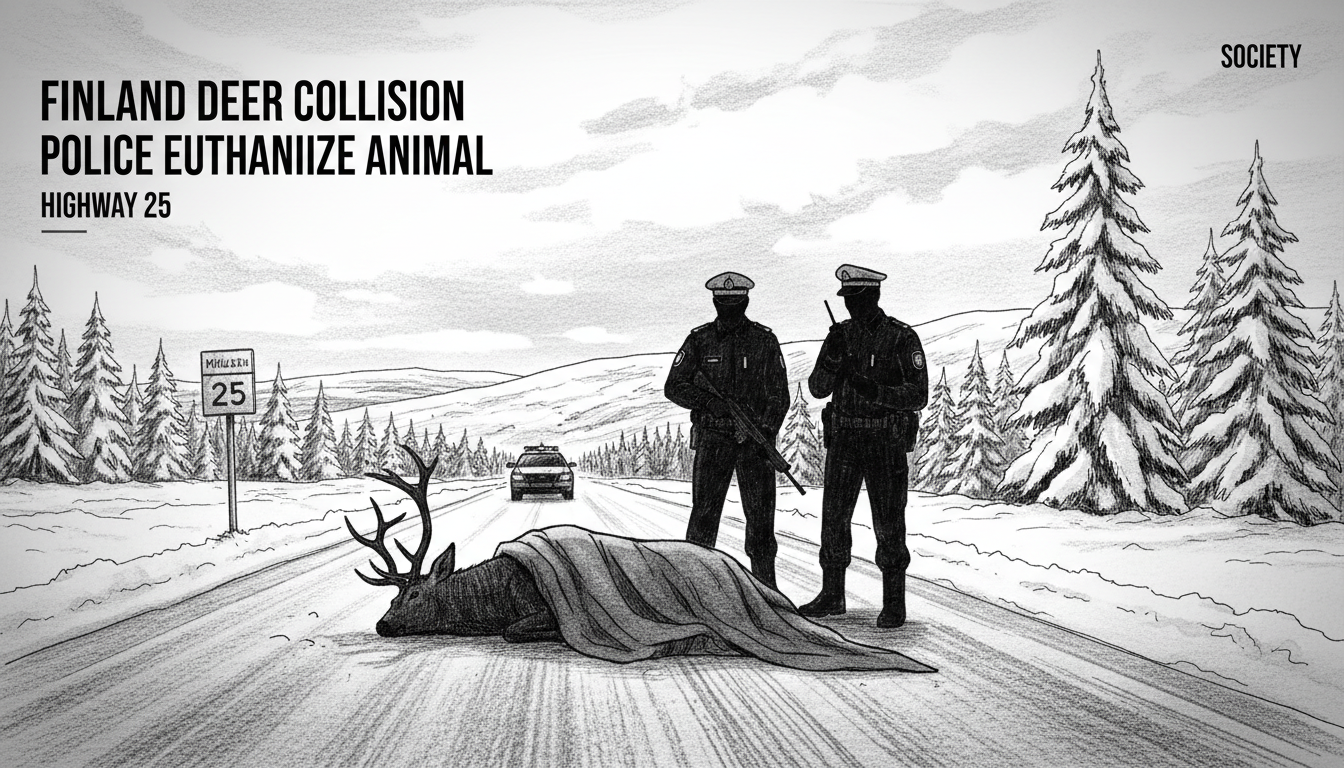
Finland deer accidents are a grimly familiar reality on the nation's roadways, as demonstrated by a recent incident on Highway 25 near Hyvinkää. On Tuesday afternoon, a vehicle struck a deer, leading to a swift response from emergency services and the police, who were required to euthanize the injured animal at the scene. The event, resulting in no human injuries, underscores a persistent challenge at the intersection of Finland's extensive forest ecosystems and its transport networks.
The Keski-Uusimaa Rescue Department received the alert at 4:34 PM regarding a minor traffic accident on Valtatie 25, heading from Hyvinkää towards Nurmijärvi just after a motorway overpass. Upon arrival, rescue personnel found no human casualties. The primary victim was the deer, which had sustained serious injuries from the impact. With no rescue operations needed for people, the scene was handed over to police officers, who performed the standard procedure of ending the animal's suffering. Traffic flow was reportedly unaffected.
This specific collision is a single data point in an annual tally that runs into the thousands across Finland. The Finnish Transport Infrastructure Agency (Väylävirasto) consistently records high numbers of animal-vehicle collisions, with white-tailed deer and the significantly larger elk, or moose, being the most common large animals involved. These incidents peak during autumn and winter, driven by animal migration, mating seasons, and reduced visibility during dawn, dusk, and long Nordic nights. Dense forests bordering roads, a classic feature of the Finnish landscape, create a constant interface where wildlife and high-speed travel meet.
A Standard Procedure with Profound Implications
The police role in euthanizing injured wildlife is a standard, if somber, duty across Finland. It is a responsibility born from animal welfare legislation aimed at preventing prolonged suffering. "When a large animal is severely injured in a collision, the most humane course of action is a swift end," explained a senior officer from the Central Uusimaa Police Department in a background interview. "Our officers are trained for this task. The priority is to ensure the animal does not endure unnecessary pain and to secure the road for traffic safety."
Finnish law mandates that drivers report collisions with large animals to the police. This serves multiple purposes: it triggers the appropriate response for the animal, allows for the collection of accurate data on collision hotspots, and is necessary for insurance claims related to vehicle damage. The aftermath of such accidents often leaves drivers shaken, facing significant repair costs and the psychological impact of the event, even when physically unharmed.
The Search for Solutions on Finnish Roads
Preventing these dangerous and often tragic encounters is a major focus for transport authorities and environmental groups. Road safety experts stress heightened driver awareness as the first line of defense. "Drivers must be extra vigilant in areas marked with wildlife warning signs, especially during high-risk seasons," said Liisa Toivonen, a road safety researcher at the VTT Technical Research Centre of Finland. "Reducing speed at dusk and dawn can dramatically increase reaction time."
Beyond driver behavior, infrastructural solutions are increasingly deployed. The Finnish Transport Infrastructure Agency invests in wildlife fencing along high-risk road segments, guiding animals toward dedicated crossing points like green bridges or underpasses. These measures are effective but costly, and their implementation is balanced against budget constraints and environmental impact assessments. Research continues into other deterrents, such as reflective warning systems and scent-based repellents.
Environmental organizations frame the issue within the broader context of habitat fragmentation. "Our expanding road network slices through forest habitats, forcing animals to cross dangerous barriers in their daily movements and seasonal migrations," noted Pekka Timonen from the Finnish Association for Nature Conservation. "While safety measures on roads are vital, a long-term conservation perspective requires us to think about ecological connectivity—ensuring wildlife can move through landscapes without confronting lethal obstacles."
The Economic and Ecological Cost of Collisions
The impact of wildlife collisions extends beyond the immediate tragedy. The economic costs are substantial, encompassing vehicle repair, emergency service responses, medical costs for human injuries in more serious crashes, and lost productivity. Collisions with elk, which can weigh over 500 kilograms, are particularly dangerous and frequently result in total vehicle loss and serious human trauma.
Ecologically, these accidents represent a source of mortality that can affect local wildlife populations, though for abundant species like white-tailed deer, it is not typically a conservation threat. The data collected from reported incidents, however, is crucial for monitoring population trends and understanding animal movement corridors. This information directly informs where and how mitigation infrastructure should be built.
For residents in areas like Hyvinkää and along Highway 25, the sight of wildlife near the road is common, and the sound of a collision is a feared one. Local social media groups and community boards often share warnings about recent deer or elk sightings on specific road stretches, creating an informal early-alert network. This community-level awareness complements official efforts to improve safety.
A Persistent Challenge for a Forest Nation
The incident on Highway 25 is a microcosm of a national issue. Finland's identity is deeply intertwined with its forests and their wildlife, yet the functionality of a modern society demands efficient road transport. This creates an inherent conflict. The government's current transport policy acknowledges this, with updated strategies emphasizing the integration of wildlife passages in all major road upgrade projects.
Parliamentary discussions have occasionally touched on stricter penalties for speeding in wildlife areas or increased funding for fencing projects, but these debates often hinge on budget allocations. The EU's biodiversity strategy, which emphasizes connectivity and reducing habitat fragmentation, also provides a policy framework that influences national infrastructure planning, pushing for more green infrastructure in transport projects co-funded by the EU.
As Finland continues to balance mobility with environmental stewardship, each collision serves as a stark reminder of the work left to do. The routine police response in Hyvinkää concludes a single sad event, but it also adds to the collective data and impetus for finding better solutions. The goal remains clear: to ensure the safety of both travelers and the wildlife that inhabits the forests through which Finland's roads inevitably pass. Can a nation defined by its forests build a transport network that truly coexists with them? The answer is still unfolding, one kilometer of fence and one cautious driver at a time.