
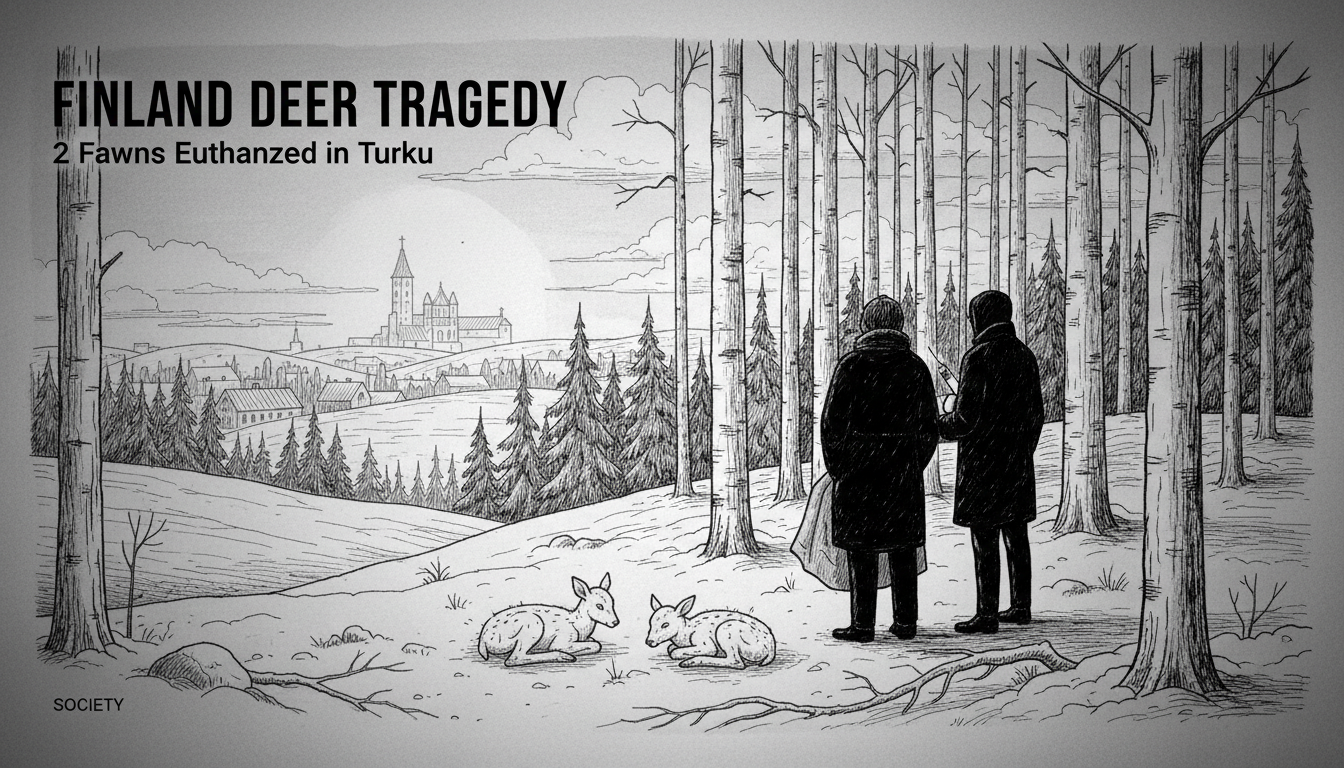
Finland's urban wildlife conflict reached a tragic conclusion in Turku on Monday morning when two lost deer fawns were euthanized by police. The young animals, which had wandered into the city center, were found injured after colliding with cars in the courtyards of Kerttulinkatu around 8 a.m. One fawn ended up stranded in the middle of the Hämeenkatu intersection, while the other remained trapped in an inner courtyard, unable to escape on its own. Faced with severely injured wild animals that could not be safely relocated, Southwest Finland Police made the decision to end their suffering at the scene.
A Grim Morning in the City Center
The incident unfolded in a densely built area of Turku, Finland's oldest city and former capital. Residents and morning commuters witnessed the distressing scene as police officers cordoned off sections of Kerttulinkatu and Hämeenkatu. The fawns, believed to be white-tailed deer (valkohäntäpeura), are a common sight in Finland's expansive forests but represent a profound anomaly in an urban setting. Their presence in the city core highlights a growing tension between Finland's natural landscapes and its developed areas. Police statements emphasized that all other options were considered before euthanasia was chosen as a last resort, a procedure permitted under Finnish law when an animal is critically injured and relocation poses an unacceptable risk to both the animal and the public.
The Legal and Ethical Framework for Wildlife Encounters
Finnish law governing wildlife emergencies is clear yet often difficult to execute in practice. The Police Act and animal welfare legislation grant officers the authority to euthanize an animal to prevent further suffering or eliminate an immediate danger. However, the decision is never taken lightly. "The primary goal is always the welfare of the animal and the safety of the public," a police spokesperson explained in their bulletin. "In this case, the injuries sustained from the collisions and the high-stress urban environment made capture and transport to a rehabilitation center impossible without causing greater harm." The incident raises complex questions about municipal preparedness. Unlike some Finnish cities with more frequent wildlife incursions, Turku's protocols for large, distressed wild animals in its historic center are rarely tested.
A National Pattern of Human-Wildlife Conflict
This tragedy is not an isolated event but part of a broader, increasing pattern across Finland and the Nordic region. Finland is home to an estimated 130,000 white-tailed deer, a population that has grown and expanded its range. While most common in southern and western Finland, these deer are increasingly venturing closer to human habitation, driven by habitat fragmentation, seasonal food searches, and, in the case of young animals, simple disorientation. Road accidents involving deer are a significant issue, particularly during dawn and dusk in spring and autumn. The Finnish Wildlife Agency collects annual data on these collisions, which number in the thousands, but incidents where animals penetrate deep into city centers remain relatively rare but memorable crises.
Wildlife biologists point to urban sprawl and the reduction of natural corridors as key factors. "Our cities are expanding into traditional wildlife territories, and green spaces within cities can act as attractants," notes Dr. Elina Saarelainen, a wildlife ecologist at the University of Turku. "For a young fawn, a series of gardens and parks can lead it from a forest edge right into a downtown square without it ever intending to be there. They become panicked, disoriented, and then the concrete jungle becomes a trap." This incident in Turku serves as a stark case study of this dynamic, where benign green pathways funnel animals into dangerous urban labyrinths.
The Emotional Toll and Public Response
The euthanasia of the fawns sparked an immediate emotional response from Turku residents who witnessed the event or learned of it through local news. Social media channels filled with expressions of sadness, anger, and sympathy. Many questioned whether more could have been done, such as calling in a veterinarian with sedatives or attempting to herd the animals toward a safer location. Animal welfare organizations acknowledged the public's grief while supporting the police's difficult decision given the specific circumstances. "It's a heartbreaking outcome that no one wants," said a representative from the Finnish Animal Welfare Society. "The focus must now be on prevention and improving response protocols. This includes public education on what to do when you see wildlife in distress and ensuring emergency services have access to specialized resources, even if they are rarely used."
This public reaction underscores a deep-seated Finnish cultural connection to nature, where wildlife is generally respected and cherished. The sight of forest animals in an urban setting evokes a sense of wonder that quickly turns to concern when the animal is in peril. The police, often tasked with this grim duty, face significant emotional strain as well. Their training focuses on public safety and law enforcement, not wildlife management, yet they are frequently the first and only responders available in a fast-unfolding urban wildlife crisis.
Seeking Solutions for Future Encounters
In the wake of the Turku fawn incident, conversations are turning toward prevention and improved crisis response. Experts suggest several potential measures cities like Turku could adopt. One is the strategic management of green corridors to include wildlife deterrents or one-way guidance systems that allow animals to exit urban areas. Another is the establishment of clear, city-specific protocols that involve a rapid-response network including police, animal control, and local veterinarians with wildlife experience. Some larger Finnish municipalities have lists of on-call experts who can assist with tranquilizer equipment, but such resources are not universal.
Technology may also offer partial solutions. In some countries, acoustic or optical deterrent devices are used at forest-urban boundaries to discourage deer entry. Public awareness campaigns can also play a crucial role, teaching citizens to keep their distance, not to feed wild animals (which encourages further incursion), and to immediately call emergency services (112 in Finland) with a precise location. The goal is to create a system where the next disoriented fawn has a chance at a different ending—one that leads it safely back to the forest, not a tragic conclusion on a city street.
The death of the two fawns in Turku is a somber reminder that Finland's celebrated coexistence with nature is not without its painful conflicts. As urban areas continue to grow, these encounters may become less of a rarity. The challenge for Finnish society is to evolve its systems and its city planning to protect both its citizens and the wild animals that, through no fault of their own, sometimes lose their way. The question now is whether this event will remain a singular tragedy or become a catalyst for change in how Finnish cities prepare for the wild visitors at their doors.