
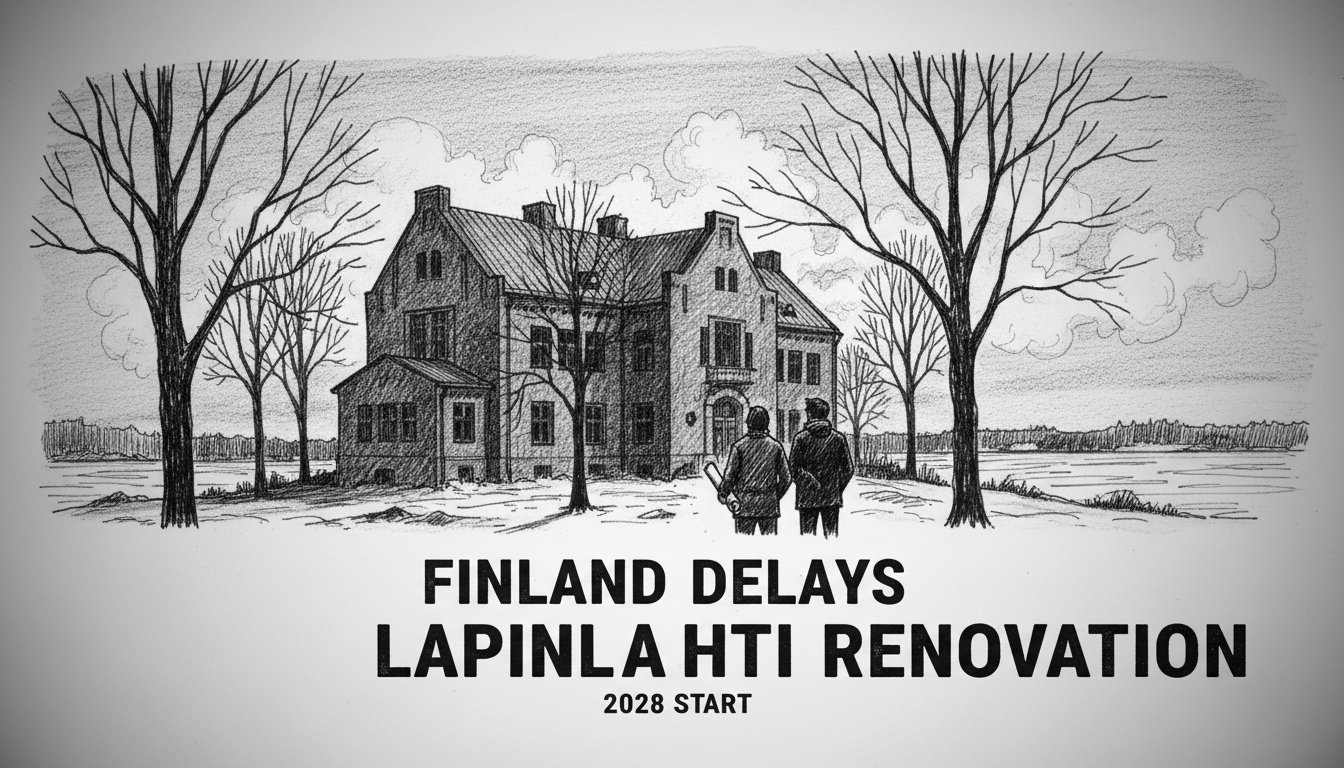
Finland's historic Lapinlahti hospital campus faces another multi-year delay, with comprehensive renovation now unlikely to begin until 2028. The City of Helsinki confirmed the setback after concluding it would retain ownership of the national romantic-style complex, abandoning a decade-long search for a private buyer. This pushes the start of major works back by over a year from the original 2026 target, prolonging the uncertainty for dozens of small entrepreneurs and cultural operators currently inhabiting the site.
The Lapinlahti area in Helsinki has awaited a full restoration for nearly two decades since psychiatric services ended in 2008. In the intervening years, the vacant buildings have organically transformed into a unique hub for community mental well-being, art, and culture. This temporary use has created a vibrant, if precarious, ecosystem. The city's new plan to fund and manage the renovation itself marks a significant policy shift in how it handles its substantial portfolio of heritage buildings.
‘The decision to keep Lapinlahti in city ownership was correct, but it inevitably means the timeline must be adjusted for proper planning and financing,’ said a city property director in a recent committee statement. The delay stems from the complexity of planning a historically sensitive renovation that meets modern building standards and future-use requirements. Officials emphasize that a careful, well-budgeted project is preferable to a rushed one that compromises the site's architectural integrity.
A Pivotal Shift in City Strategy
For ten years following the closure of the hospital, Helsinki actively sought a commercial buyer for the entire 19th-century campus. That strategy failed to yield a suitable proposal that guaranteed public access and preserved the site's cultural value. The September 2024 announcement that the city would retain ownership and execute the renovation itself was met with relief by tenant associations and heritage advocates. This move aligns with a broader municipal trend of taking direct responsibility for key cultural assets rather than privatizing them.
The financial implications are substantial. A full renovation of the extensive brick-built complex, designed by Carl Ludvig Engel, requires significant capital investment. The city must now allocate funds within its multi-annual budgets, a process subject to political approval in the City Council. This municipal funding model, while offering greater control, is inherently more susceptible to budgetary shifts and delays than a private development agreement would be.
The Current Life of a Limbo Landmark
While the machinery of city planning grinds slowly, the Lapinlahti campus is far from dormant. Over 40 small businesses, artists' studios, NGOs, and community groups operate within its walls. These include cafes, therapy centers, woodworking shops, and cultural associations that have formed a tight-knit community. This interim use has given the site a new identity, one that many hope will be preserved in some form post-renovation.
Tenants currently operate on short-term leases, a fact that breeds constant uncertainty. The latest delay to 2028 provides a clearer, albeit distant, horizon for planning. ‘We have built something meaningful here that supports well-being and the arts,’ remarked one long-term tenant who requested anonymity. ‘We need a renovation plan that acknowledges this existing social function, not just the bricks and mortar.’
The challenge for city planners is to balance heritage conservation with creating a sustainable, financially viable future for the campus. The goal is to develop a mixed-use model that likely includes public spaces, commercial tenancies, and cultural venues. Integrating the current community's input into the official plans will be a critical test for Helsinki's participatory planning processes.
EU Context and Heritage Funding
From a European perspective, the Lapinlahti situation highlights a common challenge across Nordic and EU member states: repurposing large-scale heritage infrastructure. Finland has access to EU structural funds for urban regeneration, and projects like Lapinlahti could potentially qualify for support under objectives related to cultural heritage and sustainable community development. However, national and municipal co-funding requirements remain a hurdle.
The delay may allow for more thorough grant applications to bodies like the European Regional Development Fund (ERDF). A successfully renovated Lapinlahti could serve as a case study in adaptive reuse, a priority within the European Green Deal's focus on circular economy principles in the building sector. Renovating existing structures is inherently more sustainable than demolition and new construction.
Political Scrutiny and Next Steps
The project's progress will be closely monitored by Helsinki's political parties, particularly those advocating for stronger cultural policy and heritage preservation. The delay will feature in upcoming city budget debates. Opponents may criticize the timeline as indicative of poor asset management, while supporters will argue that preserving national heritage for public use justifies the time and expense.
The immediate next step involves detailed architectural and engineering planning. City officials must commission surveys, finalize conservation guidelines, and develop precise cost estimates before any construction tender can be announced. This pre-construction phase is where the new 2027-2028 timeline will be put to the test. Any discovery of structural issues or contamination could prompt further adjustments.
For now, the unique community at Lapinlahti gets a temporary reprieve, but its long-term fate remains anchored to a city hall timeline that has already stretched across generations. The story of Lapinlahti is no longer just about restoring old hospital buildings; it is a test of whether modern Helsinki can thoughtfully steward its past to create a living, inclusive space for the future. Can the city bureaucracy move with enough urgency to support the organic community it now hosts, or will planning inertia ultimately reshape the site into something entirely new?