
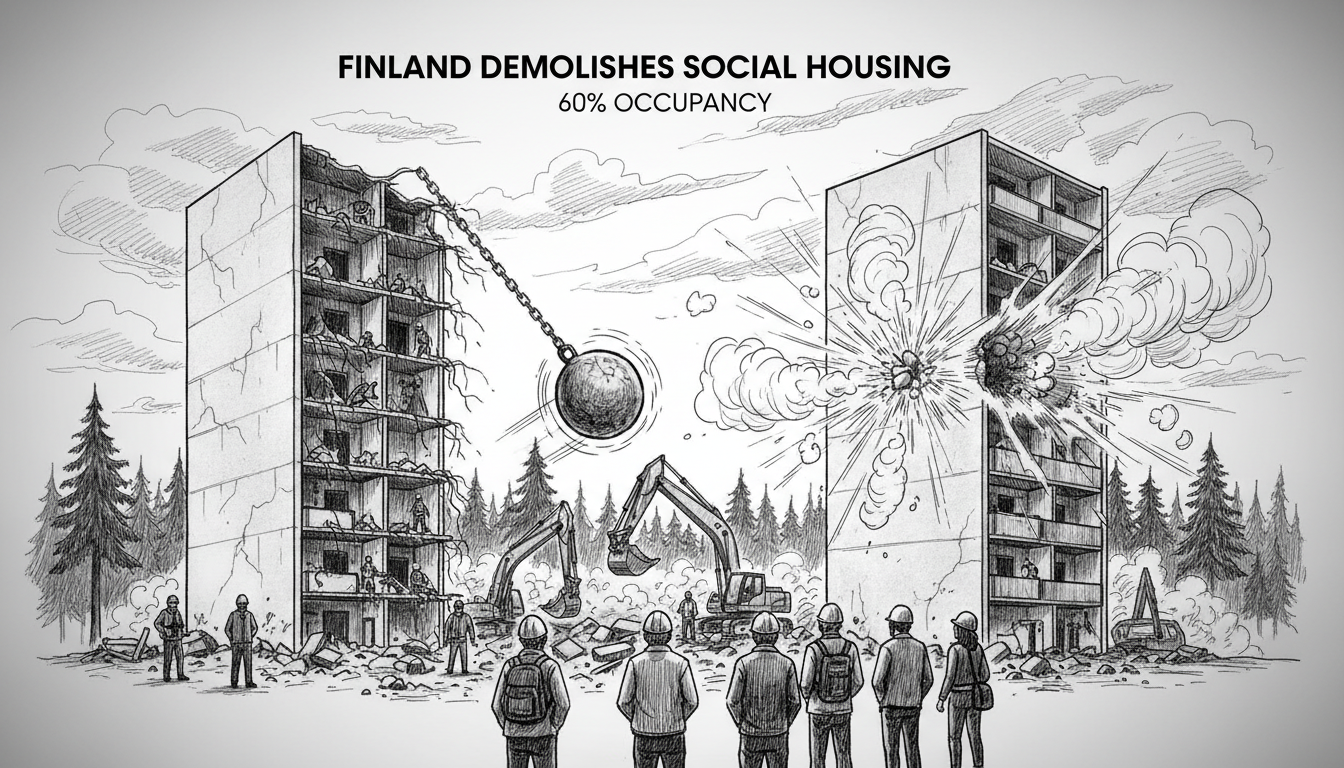
Finland's social housing crisis has reached a quiet street in Vuoksenniska, where Pirjo Villanen lost a night's sleep upon learning her home of decades is slated for demolition. The municipal housing company Imatran Vuokra-asunnot Oy has received initial approval to tear down two apartment buildings at Sinkkikatu 14 and Sarakuja 1, citing plummeting occupancy and crippling repair costs. This decision highlights a growing dilemma for Finnish municipalities: maintaining aging affordable housing stock or clearing the slate in shrinking regions.
Pirjo Villanen's world narrowed to the official letter in her hands. The document stated the concrete-and-brick building at Sarakuja 1, her home for over twenty years, would be demolished. "You hear about these things happening elsewhere, but you never think it will be your own front door," Villanen said, describing the moment her future became uncertain. Her story is not unique. Approximately forty households across the two buildings now face relocation, their community destined for the wrecking ball by the end of next year if the Imatra city council gives final approval.
The Economics of Empty Hallways
The core argument for demolition is starkly numerical. Both buildings currently operate at a mere 60% occupancy rate, a figure that has declined sharply in recent years. For a municipal housing company operating on thin margins, this translates to unsustainable economics. Vacant apartments generate no rent to offset heating, maintenance, and loan costs for the entire property. "The occupancy rate has plunged powerfully in recent years, and the sites have a lot of repair debt," stated Erik Forstén, CEO of Imatran Vuokra-asunnot Oy. He emphasized that major renovations would be needed very soon if demolition was not pursued.
The concept of 'repair debt' is central to this story. It refers to the accumulating cost of postponed maintenance and necessary upgrades to aging electrical, plumbing, and structural systems. For buildings constructed decades ago, this debt can run into millions of euros. Weighing the cost of a comprehensive renovation against the income from a partially occupied building often leads to a grim financial calculation. Demolition, while socially painful, can appear as the only fiscally responsible option for a municipally-owned company accountable to taxpayers.
A Regional Trend Beyond Imatra
Imatra's situation reflects a broader challenge in parts of Finland experiencing population decline or shift. The town, located in South Karelia near the Russian border, has seen its population gradually decrease. Young people often move to larger urban centers like Lappeenranta, Helsinki, or Tampere for education and employment, leaving behind an older demographic and a surplus of older housing stock. This migration pressures the viability of entire apartment buildings, especially those built during periods of rapid expansion that no longer match current demand.
Housing analysts point to a difficult balancing act for municipal companies. "Their core mission is to provide affordable housing, but they are not immune to market realities," explained Dr. Laura Heikkinen, a housing policy researcher at the University of Turku. "When a building's occupancy drops below a critical threshold, and it requires massive capital investment, the equation breaks. The funds for that renovation are essentially being subsidized by tenants in other, fuller buildings, which raises questions of fairness and long-term strategy." She notes that demolition is often a last resort, following attempts to attract tenants with minor repairs or adjusted rents.
The Human Cost of a Financial Decision
Behind the statistics of occupancy rates and repair debt are residents like Pirjo Villanen. For elderly or low-income tenants, a forced move is profoundly disruptive. Social networks built over years, familiarity with local services, and the simple comfort of a known environment are erased. The municipal housing company is obligated to offer tenants alternative accommodation, typically in other properties it manages. However, this may mean moving to a different neighborhood, possibly away from friends, familiar shops, and healthcare providers.
Tenants' associations in Finland often engage in negotiations with housing companies facing demolition proposals. Their focus is on securing fair compensation for moving costs, ensuring suitable replacement housing is available, and extending relocation timelines. In the Imatra case, the process is still in its early stages following the city board's approval. The final decision rests with the Imatra City Council, where local politicians must weigh the cold logic of a balance sheet against the tangible impact on their constituents' lives.
The Future of Finnish Social Housing
The demolition in Vuoksenniska prompts a larger conversation about the lifecycle of Finland's social housing infrastructure. Much of this stock was built in the 1960s, 70s, and 80s and is now reaching an age where major systems need replacement. Municipal companies nationwide are conducting vast inventories of their properties, assessing which can be renovated for modern energy efficiency and living standards, and which may be financially doomed.
Some municipalities are exploring alternatives to outright demolition. These include partial demolition and rebuilding, selling buildings to private developers with renovation conditions, or even transferring ownership to housing cooperatives formed by the tenants themselves. Each option carries its own financial and social complexities. The path chosen by Imatra—complete demolition—suggests the company sees no viable future for the land in its current form, potentially opening the area for new construction or green space at a later date.
As Pirjo Villanen packs boxes and her neighbors discuss their options, the quiet halls of Sarakuja 1 stand as a monument to a changing Finland. The nation's renowned commitment to social welfare and high-quality housing is now grappling with the arithmetic of decline in some regions. The demolition of these buildings is more than an urban renewal project; it is a physical manifestation of demographic change and the difficult choices required when a community contracts. The final vote in the Imatra City Council will close one chapter, but the story of how Finland manages its aging affordable housing portfolio is only just beginning.