
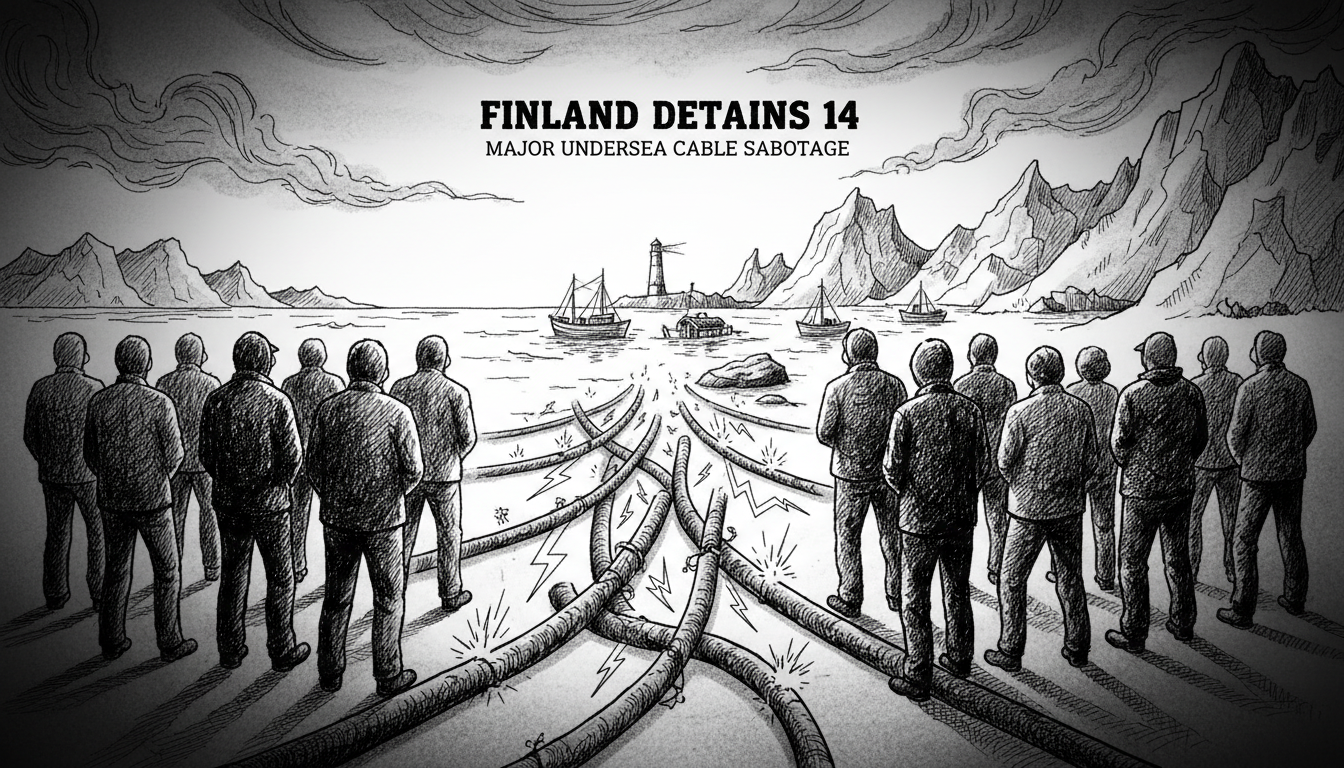
Finland’s police detained 14 crew members from a cargo ship suspected of damaging a critical undersea telecommunications cable belonging to operator Elisa on New Year’s Eve. The incident has triggered a major national security investigation and placed Finland’s vital tech infrastructure under an intense spotlight.
Authorities located and boarded the vessel, the Fitburg, which sails under the flag of Saint Vincent and the Grenadines. The ship’s anchor chain was reportedly deployed in the water at the time of the incident near the cable’s location. In a coordinated operation, the Finnish Border Guard and police escorted the 92-meter cargo ship to a secure anchorage off Porkkala, southwest of Helsinki, where it remains surrounded by official vessels.
Anchored in Suspicion
The Finnish National Bureau of Investigation is leading the probe, suspecting the crew of aggravated vandalism and interference with telecommunications. “We are investigating a crime against critical infrastructure. The suspicions are serious,” a police spokesperson said during a press conference at the Pasila Police Headquarters in Helsinki. The detained individuals are being questioned, while forensic experts examine the ship and its equipment for evidence linking it to the cable damage.
The cable damage was detected by Elisa’s network monitoring systems around 5 a.m. on December 31st. Elisa, one of Finland’s three major telecom operators with over 2.8 million mobile subscribers, reported a localized service disruption. The company’s technicians, working with authorities, confirmed physical damage to the cable. “Protecting our network is paramount. We are cooperating fully with the authorities in this investigation,” an Elisa representative stated.
A Vulnerable Network
This incident exposes the fragility of the subsea infrastructure that powers modern Finland. The Nordic nation, renowned for its digital society and booming tech sector, relies heavily on a web of undersea cables for internet connectivity, international finance, and data services. A single point of failure can have significant ripple effects.
“The Baltic Sea is becoming a crowded and tense strategic space. These cables are the soft underbelly of our digital economy and national security,” noted Dr. Laura Saarelma, a maritime security researcher at the University of Helsinki. “They are often just buried in shallow seabed sediments, making them susceptible to accidental—or intentional—damage from ship anchors or trawling gear.”
This is not an isolated concern. Over the past two years, multiple incidents involving Nord Stream gas pipelines and other undersea infrastructure in the Baltic Sea have raised alarms across Northern Europe. NATO has established a new critical undersea infrastructure protection cell, and Finland, as the alliance’s newest member, is expected to contribute actively to these efforts.
Geopolitics of the Baltic Sea
The detention of the Fitburg occurs against a backdrop of heightened regional tensions. The Baltic Sea is bordered by NATO members and Russia, with Kaliningrad to the south. Maritime traffic is dense, and the seafloor is a complex lattice of energy and data cables. While initial evidence points to potential anchor dragging, the geopolitical context ensures the incident will be scrutinized for possible malign intent.
“The flag of convenience, Saint Vincent and the Grenadines, complicates the jurisdictional picture, but Finland is asserting its right to investigate a crime affecting its territory and infrastructure,” explained maritime law professor Henrik Forsström. “The challenge will be establishing clear intent and causation, which requires meticulous technical analysis.”
The Finnish Border Guard has enhanced its maritime surveillance capabilities in recent years. Its patrol vessels and aircraft were instrumental in locating and intercepting the Fitburg. “Our readiness to respond to threats against critical infrastructure has been strengthened. This operation demonstrates effective inter-agency cooperation,” a Border Guard commander said.
Impact on Finland’s Tech Hub
For Finland’s technology sector, the event is a stark reminder of physical vulnerabilities. Helsinki’s thriving startup ecosystem, home to companies like Supercell and Wolt, and the Espoo-based hub housing Nokia’s headquarters and countless R&D centers, depends on reliable, high-speed data links. Major data centers operated by Google and others in Finland also connect to the global grid via these subsea cables.
“This isn't just about a temporary internet glitch. It’s about investor confidence and the operational integrity of a sector that contributes massively to our GDP,” said Mikael Ruotsi, a director at the Federation of Finnish Technology Industries. “We have world-class digital services, but they rest on physical infrastructure that needs equal protection.”
Industry experts suggest the incident will accelerate investments in network resilience. This includes more redundant cable paths, improved real-time monitoring of cable zones, and possibly stricter regulations for shipping in designated corridors. Elisa and its competitors are likely to review their protection strategies.
An International Investigation Unfolds
The investigation now enters a detailed phase. Technical divers and remote-operated vehicles (ROVs) will be needed to inspect the damaged cable on the seabed, comparing any scars or breaks to the Fitburg’s anchor. Investigators will also scrutinize the ship’s voyage data recorder, crew manifests, and recent ports of call.
International cooperation will be key. Finnish authorities are likely contacting counterparts in Saint Vincent and the Grenadines and may collaborate with neighboring Baltic states to trace the ship’s recent activities. The incident’s location in Finland’s territorial waters gives Helsinki clear investigative authority.
The 14 detained crew members, whose nationalities have not been disclosed, face potential serious charges. Under Finnish law, aggravated vandalism and interference with telecommunications can lead to substantial prison sentences, especially when critical infrastructure is targeted.
As the investigation continues, the Fitburg sits anchored under guard. Its detained crew and the damaged cable beneath the chilly Baltic waves have become central pieces in a puzzle that mixes crime, geopolitics, and the foundational security of one of the world’s most connected nations. The question for Finnish authorities and its allies is no longer just about what happened, but about how to prevent it from ever happening again.