
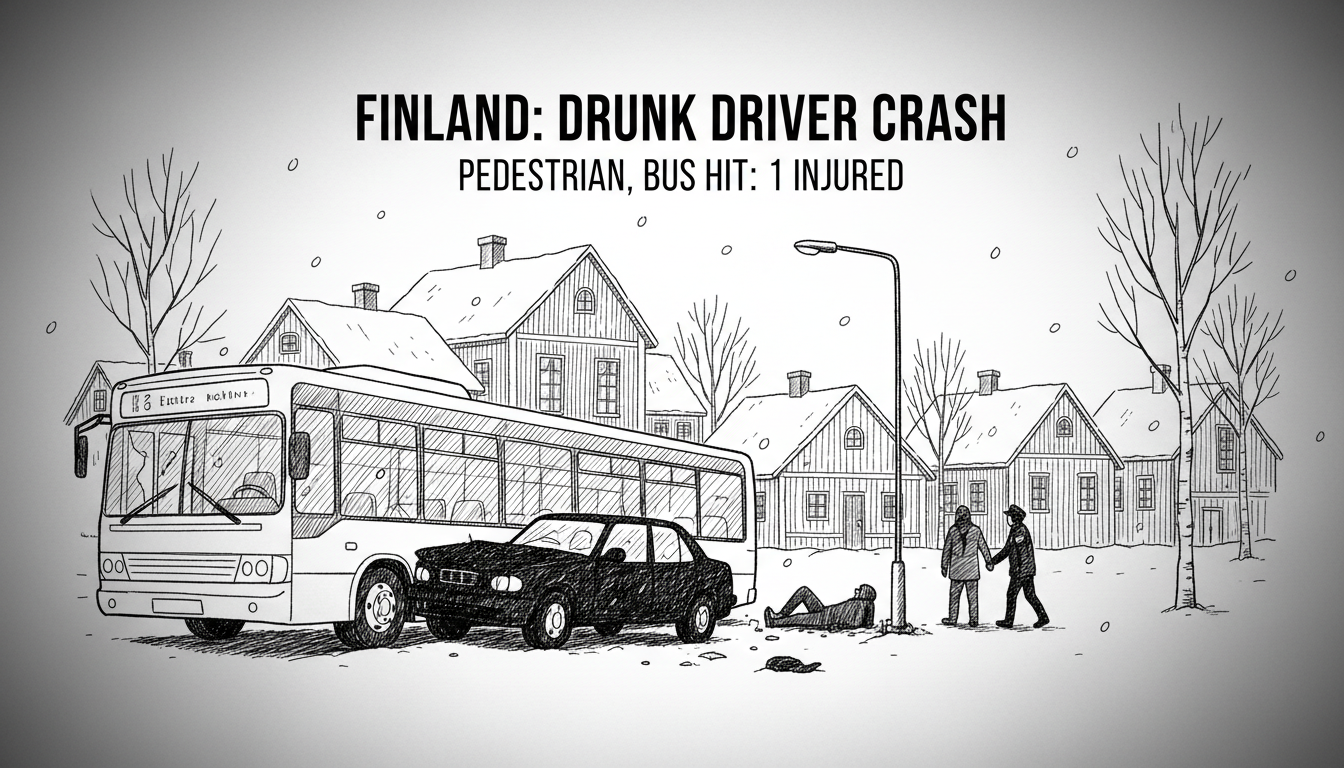
Finland's capital Helsinki was the scene of a serious traffic incident Tuesday morning when a suspected drunk driver struck a pedestrian before colliding with a city bus. The sequence of events in the Suutarila district has reignited public debate on road safety and the enforcement of Finland's strict laws against driving under the influence.
Police received emergency calls just before 8 a.m. reporting a collision on Siltakyläntie. According to preliminary information, a passenger car first hit a pedestrian walking along the road. The pedestrian sustained injuries in the impact but was not in life-threatening condition, according to authorities. The same car then continued a short distance to Suutarilantie, where it crashed into a public transport bus. Remarkably, no passengers on the bus were hurt in the second collision.
Helsinki police have taken the driver into custody and announced initial suspicions of aggravated drunk driving and aggravated endangerment of traffic safety. These are serious charges under Finnish law, reflecting the severity of the incident which endangered multiple lives in a residential area during the morning commute.
A Morning Commute Shattered
The quiet streets of Suutarila, a northeastern district of Helsinki known for its suburban homes and proximity to the Central Park, were abruptly transformed into a crime scene. The timing of the incident, during the morning rush when children head to school and workers commute, amplified the potential for tragedy. Eyewitness accounts described a scene of confusion and immediate response from nearby residents who rushed to aid the injured pedestrian before emergency services arrived.
Police cordoned off sections of both Siltakyläntie and Suutarilantie for several hours to conduct their investigation, causing significant traffic disruptions. Forensic teams documented skid marks and vehicle positions while investigators interviewed witnesses. The damaged bus, part of Helsinki's extensive public transport network operated by HSL, was towed from the scene for technical examination.
Finland's Strict Legal Framework for Drunk Driving
The preliminary suspicion of aggravated drunk driving, or törkeä rattijuopumus, indicates authorities believe the driver's blood alcohol content significantly exceeded legal limits. Finnish law defines aggravated drunk driving as having a blood alcohol concentration of at least 1.2 per mille, which is more than double the standard legal limit of 0.5 per mille for regular drunk driving charges.
Penalties for aggravated drunk driving are severe and can include substantial fines calculated based on the offender's daily income, mandatory license revocation for a minimum of one year, and even imprisonment. Sentences can range from several months to two years, particularly if the act leads to injury or demonstrates extreme recklessness. The additional suspicion of aggravated endangerment of traffic safety suggests prosecutors may argue the driver's actions showed a blatant disregard for public safety beyond simply being intoxicated.
This legal framework is among the strictest in Europe and reflects a decades-long societal consensus in Finland that driving under the influence is unacceptable. The country's approach combines harsh penalties with consistent enforcement and regular traffic controls, including both scheduled checkpoints and random stops.
National Context of Road Safety
This incident occurs against a backdrop of generally improving road safety in Finland. According to Statistics Finland, there were 210 road fatalities in 2022, continuing a long-term downward trend from over 1,000 deaths annually in the early 1970s. This improvement is attributed to the so-called "four pillars" of Finnish traffic safety: safer vehicles, better road infrastructure, effective legislation, and sustained public education campaigns.
However, each serious incident like the one in Suutarila serves as a stark reminder that the human factor—especially impaired driving—remains a critical vulnerability. Alcohol is still a contributing factor in a significant percentage of fatal accidents, despite cultural shifts and legal deterrence. Experts point out that while infrastructure and vehicle technology have advanced dramatically, eliminating risky human behavior remains an ongoing challenge.
Traffic safety researchers emphasize that Finland's zero-tolerance policy has been effective but requires constant reinforcement. "The social unacceptability of drunk driving in Finland didn't happen by accident," notes Dr. Eero Pärssinen, a transportation safety analyst at the University of Helsinki. "It was built through consistent policy, enforcement, and public messaging over generations. An incident like this tests that social norm and demonstrates why vigilance cannot relax."
The Aftermath and Ongoing Investigation
The injured pedestrian was transported to a Helsinki hospital for treatment. While their condition was reported as stable and not life-threatening, the physical and psychological trauma of such an event can be substantial and long-lasting. The driver, once medically cleared, was processed by police and is expected to face formal charges once the preliminary investigation concludes.
The investigation will now focus on several key areas: establishing the driver's precise blood alcohol level at the time of the collisions, reconstructing the vehicle's speed and path, examining the driver's prior record, and interviewing all available witnesses. The technical inspection of the car will check for mechanical faults, though the suspicion of intoxication makes such factors less likely to be primary causes.
Prosecutors will carefully build their case, as convictions for aggravated charges require meeting high evidentiary standards. The sequence of two separate collisions—first with a vulnerable road user and then with a large vehicle carrying multiple passengers—will likely factor heavily into arguments about the severity of the endangerment.
A Broader Conversation on Prevention
Beyond the legal proceedings, this event sparks discussion about prevention. Finnish authorities and organizations like Liikenneturva (The Finnish Road Safety Council) run continuous awareness campaigns, particularly during holiday seasons. They highlight not only the legal consequences but the profound moral responsibility drivers have.
Some advocates call for even broader use of technology, such as mandatory alcolock devices for repeat offenders or those convicted of aggravated offenses. These devices prevent a vehicle from starting if the driver's breath sample contains alcohol. Others emphasize the importance of community-level solutions, including better access to public transit at night and social pressure among peers to prevent intoxicated individuals from getting behind the wheel.
The incident in Suutarila also touches on urban design. While the district's roads are not considered particularly high-risk, any residential area with pedestrian traffic adjacent to moving vehicles presents potential conflict points. Urban planners increasingly advocate for designs that physically separate different types of traffic and naturally enforce lower speeds, a concept known as "self-explaining roads."
Looking Forward: Justice and Deterrence
As the case moves from police investigation to the prosecutorial phase, it will be watched closely by road safety advocates and the local community. The outcome will send a message about how seriously the Finnish justice system treats such violations of public trust and safety.
The fundamental question remains: in a society with strong laws and clear norms, what drives an individual to make the decision to drive while severely intoxicated, especially in a dense urban environment? Answering that is crucial for designing even more effective prevention strategies. For now, the people of Suutarila are left with the unsettling image of a routine Tuesday morning shattered by preventable danger, a powerful reminder that traffic safety is a daily responsibility shared by all.
The true test of Finland's acclaimed traffic safety culture is not just in its statistics, but in its response to each failure. This single driver's alleged actions have caused injury, disruption, and fear, challenging the community's sense of security. How the system responds—with thorough investigation, fair prosecution, and renewed commitment to prevention—will determine what lasting impact this Tuesday morning in Suutarila ultimately holds.