
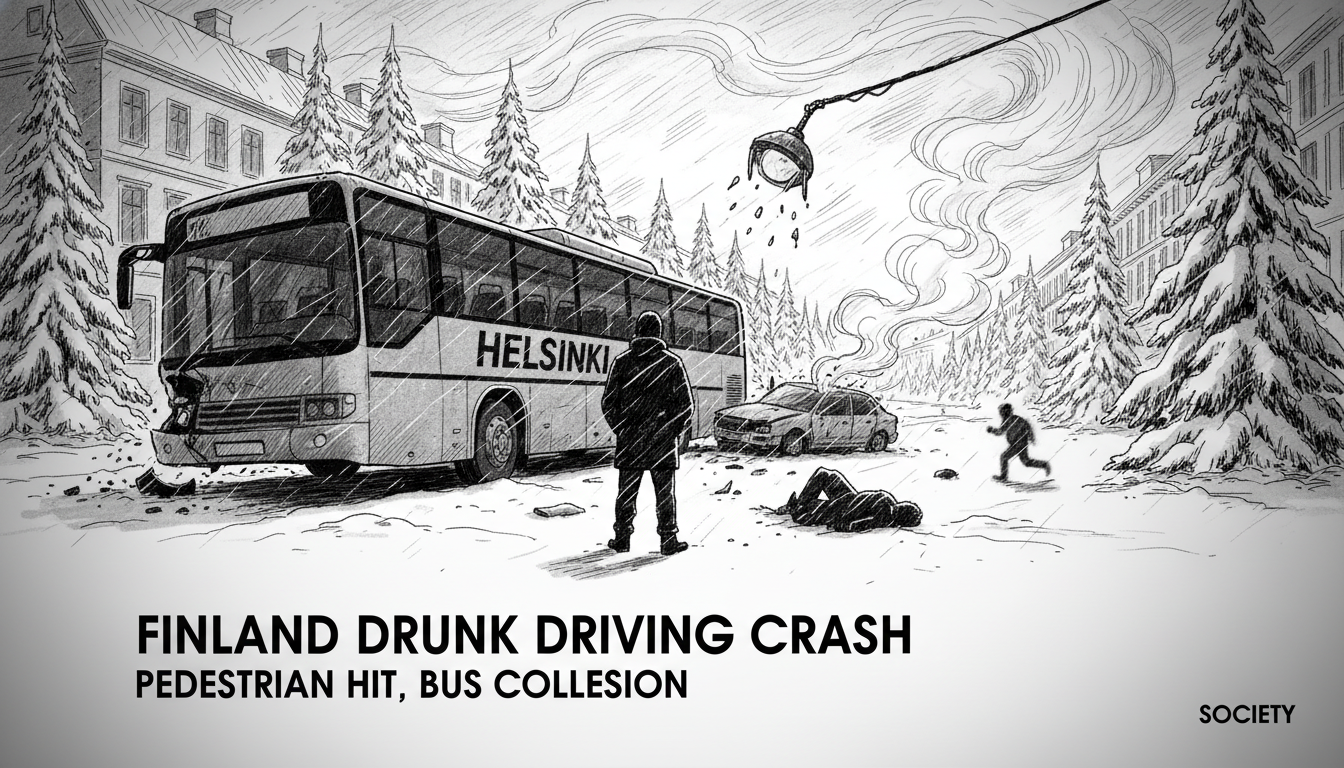
Finland drunk driving laws faced a severe test in Helsinki's Siltamäki district on a Tuesday morning. A suspected drunk driver first struck a pedestrian on Siltakyläntie before colliding with a city bus on nearby Suutarilantie minutes later. The pedestrian sustained injuries but is not in life-threatening condition, while the bus collision resulted in no personal injuries. Police arrested the driver and are investigating for aggravated drunk driving and aggravated endangerment of traffic safety, highlighting a persistent challenge for Finnish road safety.
A Morning of Chaos in Northeast Helsinki
The incident began around the morning rush hour in Siltamäki, a residential district in northeast Helsinki. According to preliminary police reports, a car traveling on Siltakyläntie hit a pedestrian crossing the street. The driver did not stop at the scene but continued driving. Shortly afterward, the same vehicle was involved in a collision with a Helsinki Regional Transport (HSL) bus on Suutarilantie in the adjacent Suutarila district. The sequence of events—a hit-and-run followed by a second collision—immediately raised alarms for responding officers. "The nature of the driving and the driver's behavior at the scene led to an immediate suspicion of intoxication," a Helsinki police spokesperson said in a statement. The driver was detained at the scene of the bus collision.
The Legal Framework: Törkeä Rattijuopumus
Finnish law draws a clear line between standard drunk driving (rattijuopumus) and aggravated drunk driving (törkeä rattijuopumus). The legal blood alcohol content (BAC) limit is 0.05%, but a BAC of 0.12% or higher typically triggers the aggravated charge. Circumstances like causing an accident, having minors in the vehicle, or significantly excessive speed can also lead to aggravated charges even with a lower BAC. The penalties are severe. A conviction for aggravated drunk driving almost always results in an unconditional prison sentence, typically several months, and a lengthy driving ban, often for several years. The suspect in the Siltamäki case is being investigated for this top-tier offense, given the multiple collisions and the hit-and-run element, which constitutes aggravated endangerment of traffic safety.
Statistics and the Persistent Problem
Despite Finland's strict legal framework and cultural aversion to drunk driving, it remains a significant cause of fatal accidents. Data from the Finnish Road Safety Council (Liikenneturva) shows that alcohol was a contributing factor in 17% of all fatal road accidents in 2022. While the number of offenses detected by police has fluctuated, it consistently numbers in the thousands annually. "The statistics show we have not solved this problem," says Dr. Laura Aalto, a criminologist at the University of Helsinki specializing in traffic crime. "The deterrent effect of legislation is strong, but it primarily affects law-abiding citizens. A hard core of offenders, often with underlying issues with substance abuse, continues to drive under the influence, causing disproportionate harm." Experts note that enforcement is rigorous, with frequent roadside checks, especially on weekends and holidays, but that total prevention is elusive.
Policy Responses and Prevention Tools
In response to repeat offenses, Finland has increasingly turned to technological solutions. The alcohol interlock program is a key tool. Courts can order the installation of these devices in the vehicles of convicted drunk drivers. The driver must provide a breath sample below the limit to start the car. "The interlock is one of our most effective post-conviction tools," explains Traffic Safety Expert Marko Järvinen. "It physically prevents re-offending during the ban period. The challenge is expanding its use to first-time offenders in severe cases, not just repeat offenders." Public awareness campaigns run by Liikenneturva also emphasize planning for a safe ride home before drinking begins. However, experts argue that societal focus must also address the root causes, including addiction services and mental health support, to break the cycle for habitual offenders.
The Aftermath and Broader Implications
The immediate aftermath of the Siltamäki crash saw street closures for investigation and disrupted bus services in Suutarila. For the injured pedestrian, recovery begins, while the bus passengers faced a sudden shock to their morning commute. The case will now proceed through the Finnish judicial system. The suspect will face a pretrial investigation, and the case will likely go to the Helsinki District Court (Helsingin käräjäoikeus). Given the evidence of multiple collisions, a conviction seems probable. The sentence will send a message about the consequences of such dangerous behavior. This incident, while isolated, feeds into the ongoing national conversation in the Eduskunta about traffic safety funding, enforcement resources, and whether penalties are sufficient. Some MPs from parties like the National Coalition and the Christian Democrats periodically call for even tougher sentences for aggravated DUI, though the current government coalition has not placed it on its immediate legislative agenda.
Finland's fight against drunk driving is a story of strict laws, consistent enforcement, and yet stubbornly recurring tragedies. The Siltamäki case is a stark reminder that legal frameworks and technology can only do so much. As the suspect awaits trial, the broader question remains: how does a society protect itself from the deliberate decision of an individual to drive while intoxicated, a decision that continues to shatter lives on otherwise quiet Helsinki streets?