
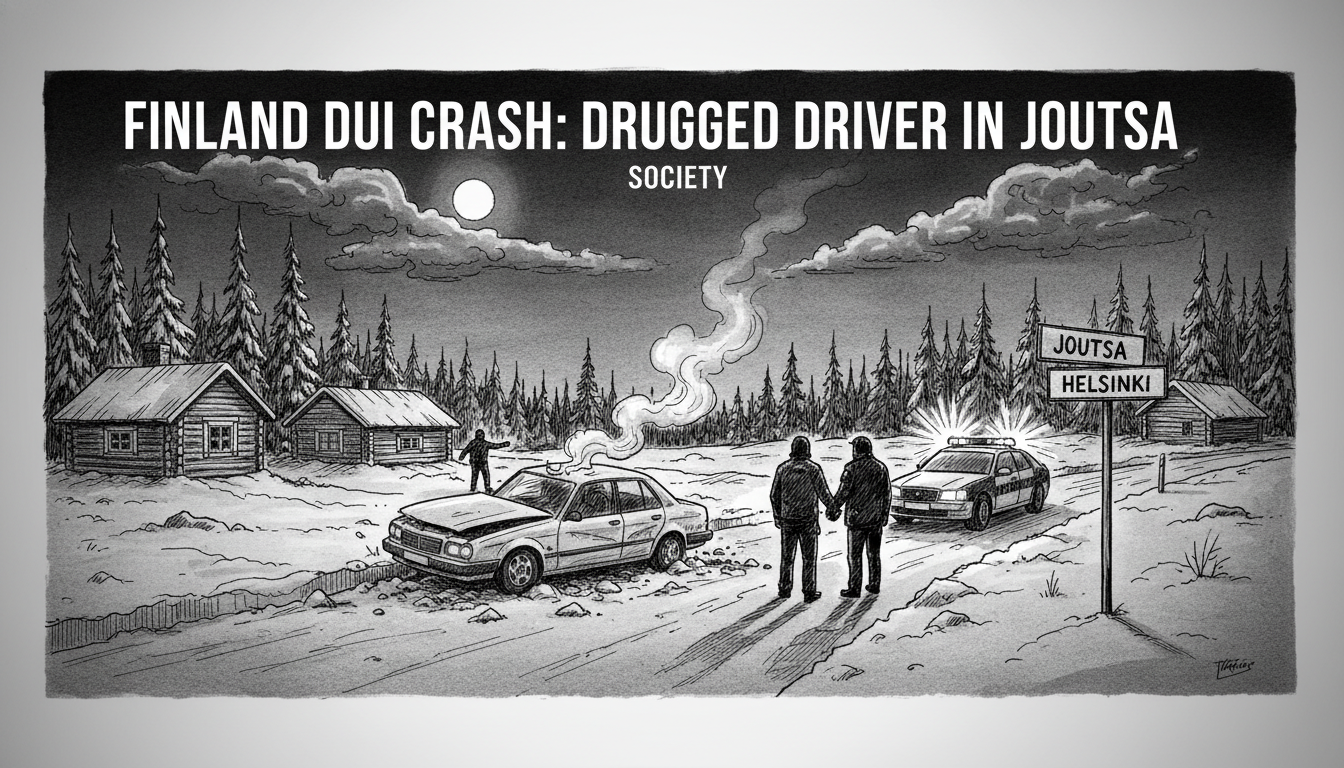
Finland’s strict stance on impaired driving was underscored this week as a court delivered a conditional prison sentence and fines for a driver who committed multiple violations under the influence of drugs and medication. The Keski-Suomen District Court ruled against a man for a dangerous series of traffic offenses committed in May 2023, which began in Lahti and ended with his car in a lake and the driver himself found in a tree in Joutsa. This case emerges against a backdrop of over 3,200 reported drug-driving incidents in Finland during 2022, highlighting an ongoing challenge for traffic safety authorities.
A Reckless Path from Lahti to Joutsa
Court documents detail a frightening sequence of events. The driver, operating a passenger car, was under the combined influence of narcotics and intoxicating prescription medicines. His journey from Lahti to the municipality of Joutsa was marked by repeated and escalating traffic crimes. He engaged in excessive speeding, executed overtaking maneuvers deemed dangerous by the court, and at times drove his vehicle on the wrong side of the road, directly into the path of oncoming traffic. This pattern of behavior created what prosecutors argued was a severe and prolonged risk to public safety on Finnish roads.
The immediate danger culminated in the vehicle leaving the roadway and submerging in a lake. In a bizarre twist to the incident, the driver was subsequently discovered not at the scene of the submerged car, but perched in a tree. The circumstances of how he arrived there were part of the court's deliberations. The case moved through the Finnish legal system for nearly a year before the recent verdict, demonstrating the procedural thoroughness applied even to cases where the defendant pleads guilty.
The Court's Verdict and Legal Framework
The Keski-Suomen District Court sentenced the man to a conditional prison term. This type of sentence means the individual will not serve immediate time behind bars provided they do not commit new crimes during a set probation period. The court also imposed significant financial penalties. The ruling aligns with standard sentencing practices for aggravated traffic endangerment under Finnish law, where the primary considerations are the degree of danger created and the driver's level of impairment.
Finland's legal framework for driving under the influence is unequivocal. The blood alcohol content (BAC) limit is set at 0.05%, one of the stricter standards in Europe. For drugs, the policy is one of zero tolerance; the presence of any illegal narcotic substance in a driver's system constitutes an offense. The law does not distinguish between illegal drugs and prescribed medication if the latter impairs driving ability. Drivers are legally responsible for ensuring they are fit to operate a vehicle, a point repeatedly emphasized in public safety campaigns from Liikenneturva, the Finnish Road Safety Council.
Expert Analysis on Drug-Impaired Driving
Traffic safety experts point to the particular dangers of drug-impaired driving. "The effects of narcotics and certain medications can be unpredictable and long-lasting," explains a senior researcher at a Finnish transport safety institute. "They severely impair cognitive functions crucial for driving: judgment, reaction time, and spatial awareness. A driver might feel capable, but their actual performance is dangerously compromised." This disconnect between perception and reality makes drug driving especially hazardous.
The case in Joutsa exemplifies a multi-substance scenario, which experts note is particularly high-risk. Combining different substances, including alcohol, prescription drugs, and illegal narcotics, can have synergistic effects that drastically multiply impairment. Finnish police have invested in advanced training for officers to recognize signs of drug impairment during traffic stops, beyond the standard breathalyzer tests for alcohol. These measures are part of a concerted national effort to improve detection and deterrence.
Finland's Broader Traffic Safety Context
This incident occurs within Finland's long-term strategy to achieve 'Vision Zero' – the goal of eliminating all traffic fatalities and serious injuries. While alcohol-related driving deaths have decreased significantly over decades, drug-impaired driving presents a persistent and evolving challenge. The 3,275 reported cases in 2022 represent only those incidents detected by police, suggesting the true figure could be higher.
The government, through the Ministry of Transport and Communications, continuously evaluates countermeasures. These include legislative reviews, funding for police enforcement technology, and nationwide awareness campaigns. The campaigns often target young male drivers, a demographic statistically overrepresented in serious DUI incidents. The message is consistent: driving under any influence is a serious crime with potentially catastrophic consequences, not just a traffic infraction.
Implications for Policy and Enforcement
The Joutsa verdict reinforces the judiciary's role in upholding traffic safety norms. Conditional sentences, while sometimes criticized by the public for being too lenient, are a standard tool for first-time offenders of this nature within the Finnish penal system. The focus is on deterrence and preventing recidivism without resorting to immediate incarceration. The attached fines also carry a substantial punitive and deterrent weight.
From a policy perspective, experts argue that enforcement must be coupled with education and healthcare interventions. "Addressing drug driving isn't just a law enforcement issue," notes a public health official in Helsinki. "It intersects with substance abuse services and mental health support. Preventing people from getting behind the wheel while impaired requires a multifaceted approach." Some proposals have included stricter monitoring of prescription medications known to affect driving and expanded access to treatment programs.
This single case in the heart of Finland's lake district serves as a stark microcosm of a national issue. It underscores the very real dangers that unfold when individuals disregard the fundamental responsibility of sober driving. As Finland continues its path toward safer roads, the legal system's response to such clear violations remains a critical pillar of that effort. The car in the lake is a potent symbol of a journey that should never have begun, and a reminder of the vigilance required from all road users.