
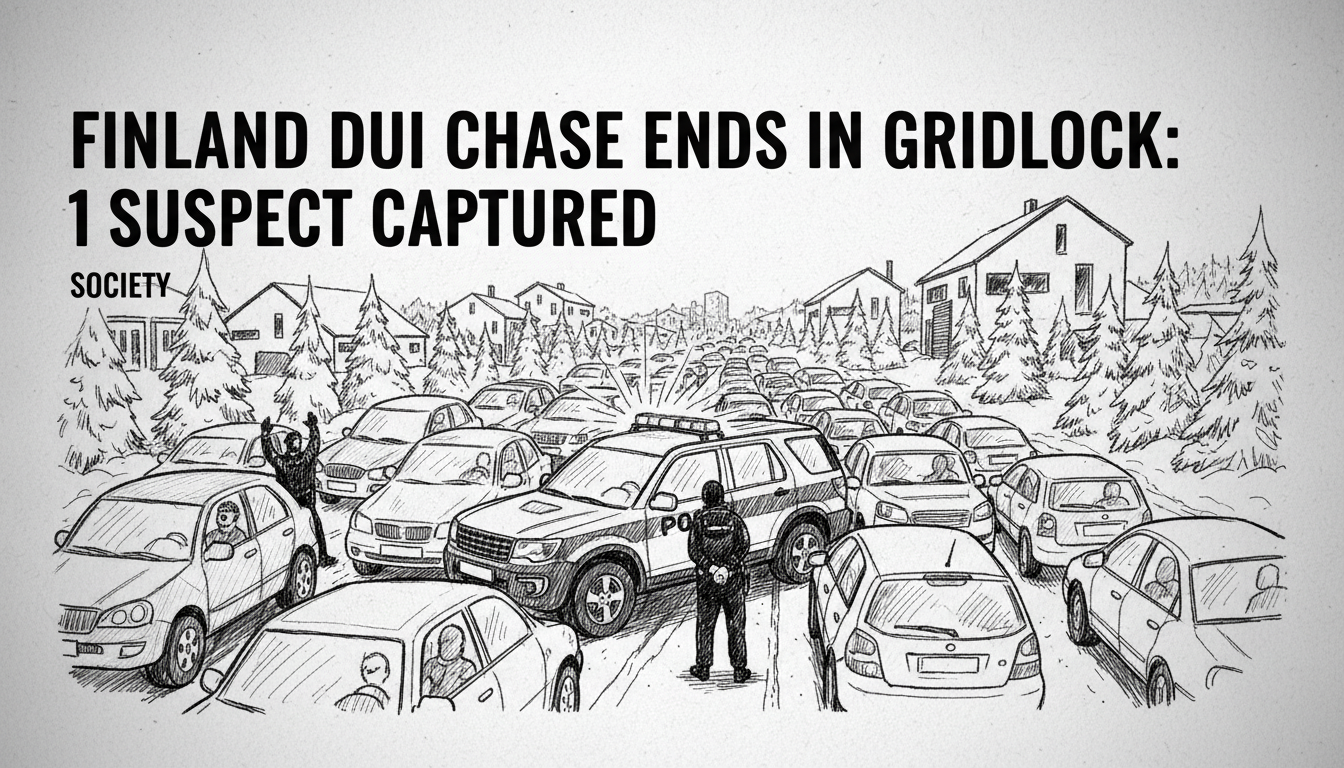
Finland’s police conduct over 1.2 million breathalyzer tests annually in their battle against drunk driving. One suspected offender's attempt to evade that system ended abruptly in a congested Jyväskylä street this week, with afternoon traffic becoming an inadvertent police ally.
A suspect is now in custody after a short police chase through central Finland, accused of aggravated endangerment of traffic. The incident underscores the persistent challenge of impaired driving despite the nation's strict laws and extensive enforcement measures.
Chaos on Keskikatu
The situation began on Thursday afternoon just before 2 PM. Police in the Central Finland region received an external tip about a possible drunk driver on Tourulantie in the Mäki-Matti district of Jyväskylä. Officers located and attempted to stop the vehicle, but the driver refused.
A pursuit ensued. It was brief. The driver’s flight path led to Keskikatu, a central artery in the city. There, heavy traffic congestion, a common feature of afternoon commuting, effectively boxed in the fleeing Ford.
Gridlock acted as a natural roadblock. Police quickly moved in and arrested the driver without further incident. No injuries were reported. The suspect faces preliminary investigation for törkeä liikenneturvallisuuden vaarantaminen, a serious charge of aggravated endangerment of traffic safety.
A Nation’s Strict Stance
This arrest is a single data point in Finland's systematic approach to combating rattijuopumus, or drunk driving. The legal limit is a low 0.05% blood alcohol content (BAC). Penalties escalate sharply beyond that threshold and for repeat offenders.
For context, the 1.2 million breath tests police administer each year lead to thousands of confirmed DUI cases. Enforcement is visible and consistent, from routine checkpoints to targeted patrols based on tips like the one received in Jyväskylä.
The charge of aggravated endangerment of traffic is particularly severe. It is not applied to every DUI case but is reserved for situations where the driver's conduct creates a significant and obvious danger to others.
Fleeing from police in a populated urban area would typically meet that criterion. If convicted, penalties can include imprisonment, not just fines and license revocation.
Balancing Pursuit and Public Safety
The Jyväskylä incident concluded without collateral damage. However, it highlights the calculated risks police must assess during any pursuit. Finnish police guidelines emphasize that the danger of the chase must not exceed the danger posed by the suspect.
“The primary principle is always the protection of life and health,” explains a veteran Finnish traffic police inspector who spoke on background. “A fleeing driver, especially one suspected of impairment, is an unpredictable hazard. The decision to pursue is never automatic. It is a continuous risk assessment.”
In this case, the pursuit was short and occurred during the day. The ending, forced by natural traffic flow, was arguably the best-case scenario. It allowed apprehension without a high-speed climax that risks crashes.
Public tips, as seen here, are a critical component of road safety. They act as a force multiplier for police, directing resources to suspicious activity. The system relies on public vigilance to function effectively.
Analysis: Deterrence and Its Limits
Finland’s DUI regime is among the strictest in Europe. The combination of low limits, high enforcement, and severe penalties is designed for maximum deterrence. Yet incidents like the chase in Jyväskylā prove the model is not foolproof.
Some drivers still choose to get behind the wheel after drinking. A subset of those will choose to run when confronted by blue lights. This creates moments of acute risk that policy can only partly mitigate.
Legal experts note that the system’s strength lies in its consistency and the high likelihood of getting caught. The social stigma attached to drunk driving in Finland is also a powerful deterrent. However, the individual decision-making of an impaired driver remains a wild card.
The police response showcases trained protocol. From receiving the tip to managing the chase and making the arrest, the action followed established procedures designed to resolve the situation with minimal public risk.
The use of traffic itself as a barrier was a fortunate outcome, not a tactic. It does, however, illustrate how urban environments can sometimes aid in safely concluding volatile situations.
The Road Ahead for the Suspect
The suspect now enters Finland’s judicial process. The police will forward their investigation to a prosecutor, who will consider formal charges. The evidence will include the officer's observations, the results of breath or blood tests, and the circumstances of the flight.
Given the allegation of aggravated endangerment, the case is likely to be treated seriously by the district prosecutor. A court will ultimately decide guilt and any sentence, which could range from a substantial day-fine to a conditional or even unconditional prison term, alongside a lengthy driving ban.
This case will add to the annual statistics, a small but stark reminder of the consequences of DUI. For the police in Central Finland, it represents a routine intervention that successfully neutralized a reported threat on the road.
For the public, it is a demonstration of the system in action—from a citizen’s tip to a swift police response, ending with an alleged offender in custody. The question remains: how many more of the 1.2 million tests this year will tell a similar story?