
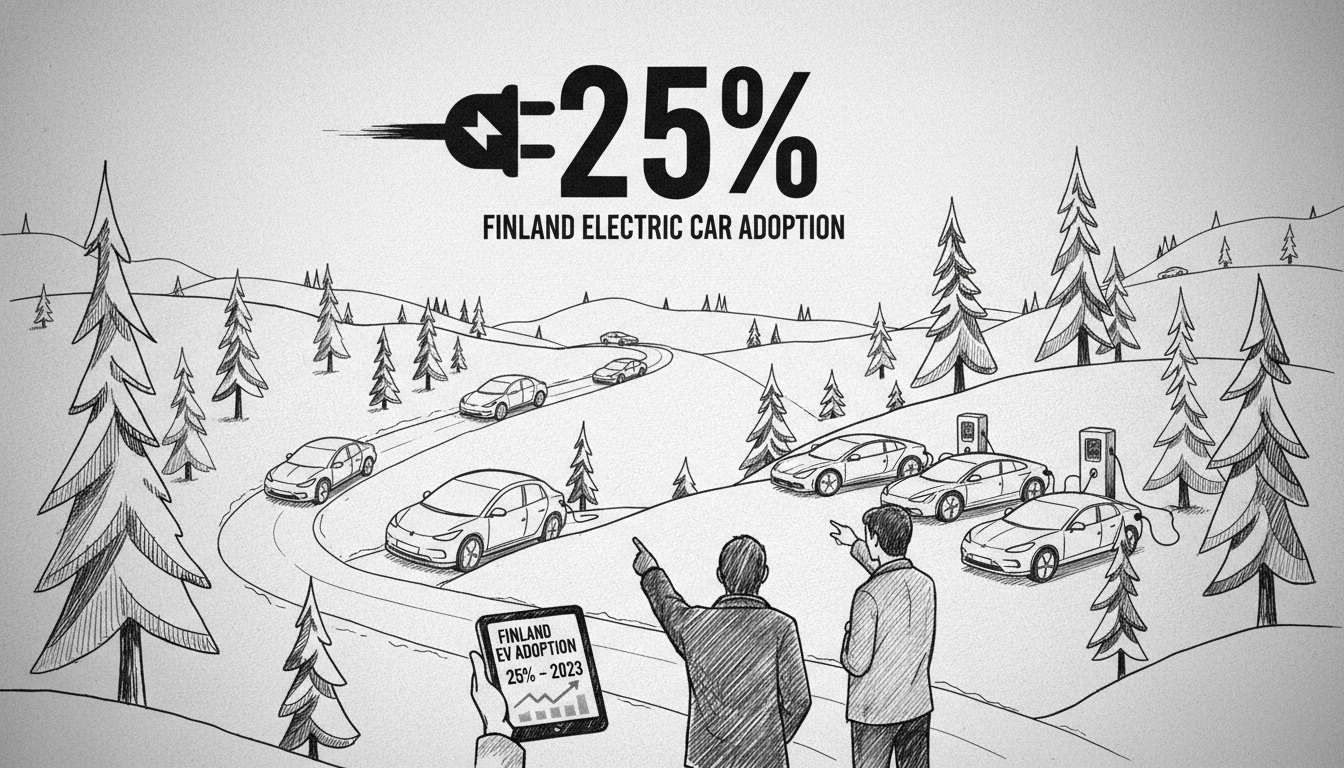
Finland's electric car adoption has surged past predictions, with battery electric vehicles capturing 25% of all new car registrations in 2023. This rapid shift is unfolding along the nation's highways and rural routes, challenging infrastructure and consumer habits in equal measure. The government's ambitious target to ban new combustion engine sales by 2030 now appears less a distant ambition and more an imminent reality.
The Road to Electrification
On a wet stretch of Highway 1 between Helsinki and Turku, the transformation is both visible and uneven. For contractor Ville Vierjoki, stopping at a service station in his old petrol Volvo, the future is clear but not yet personally practical. He prioritizes environmental values yet finds current electric vans unsuitable for his contracting work. His transition is piecemeal, beginning with small electric machinery, with a wheel loader next in line. This pragmatic, gradual approach typifies a significant segment of the Finnish market, where commercial utility often dictates the pace of change more than passenger car trends.
National policy is aggressively steering this change. The Finnish government offers direct purchase subsidies for both full electric vehicles and plug-in hybrids. Major cities are accelerating investments in public charging networks. These measures are core components of Finland's strategy to cut transport emissions and achieve climate neutrality, aligning with broader Nordic and EU green transition goals.
Charging Ahead: Policy and Infrastructure
The state's role has been decisive. Financial incentives lower the initial cost barrier, a critical factor for many consumers. Simultaneously, Helsinki, Turku, Tampere, and Oulu are expanding public charging points to alleviate range anxiety. However, the real test lies beyond city limits. Experts point to the vast rural and suburban landscapes where daily commutes are longer and home charging may not be universally available.
“The 25% figure for new registrations is a milestone few predicted this quickly,” says Professor of Transport Systems at Aalto University. “The key drivers are a confluence of improved vehicle affordability, stronger environmental awareness, and highly supportive government policy. But the next phase requires a different focus: dense, reliable charging infrastructure nationwide, particularly along corridors like the Helsinki-Turku route and in more remote areas.”
Cold Climate, Hot Market
Finland presents a unique proving ground for EV technology. Harsh winter conditions test battery range and performance, a concern often cited by potential buyers. Automakers and battery developers have responded with advances in thermal management systems. Real-world data from Finnish drivers is demonstrating that modern EVs, while affected by the cold, remain functional for most needs, especially with strategic planning around charging.
This growing consumer confidence is reflected in the statistics. The total number of registered electric cars in Finland has shown consistent, sharp annual growth. The trajectory suggests the 2030 phase-out target for new petrol and diesel sales is not just aspirational but achievable, contingent on continuous infrastructure investment.
Analysis: The Roadblocks Remain
Despite the encouraging statistics, analysts identify persistent hurdles. The secondary market for used electric vehicles is still developing, limiting options for budget-conscious consumers. For professionals like Vierjoki, the electric van and heavy-duty vehicle market lags behind passenger cars in terms of model variety, payload capacity, and cost-effectiveness. Grid capacity also requires strategic upgrades to handle concentrated demand in residential areas.
“The rapid adoption is positive, but it's currently uneven,” an energy sector analyst notes. “Urban professionals and two-car households are transitioning swiftly. The challenge is enabling the electrification of tradespeople, rural residents, and those in older apartment buildings without private parking. This requires tailored solutions, not just more of the same public chargers.”
The EU's regulatory environment acts as a powerful accelerator. Stricter emissions standards for manufacturers make producing combustion engine vehicles less viable, funneling more electric models into the Finnish market. This top-down pressure complements national incentives, creating a powerful push-pull effect on consumers.
The Path to 2030
The journey down Highway 1 symbolizes Finland's broader transition: a main artery seeing rapid change, while off-ramps lead to communities adapting at different speeds. The government's next policy steps will likely need to address these disparities. Potential measures could include targeted subsidies for commercial electric vehicles, incentives for housing associations to install charging points, and major public investments in fast-charging hubs along the entire national road network.
Public perception is shifting from viewing EVs as a niche choice to accepting them as the mainstream future. This cultural shift, backed by firm policy and improving technology, is the true engine behind the numbers. As Vierjoki's own equipment fleet gradually electrifies, his story mirrors the national one: a practical, step-by-step progression toward an inevitable destination.
Finland's experience shows that rapid EV adoption is possible in a challenging climate, but it demands more than just consumer enthusiasm. It requires a coordinated, sustained effort linking national ambition with local infrastructure and addressing the specific needs of every driver, from city commuters to rural contractors. The 25% mark is not the finish line, but a clear signpost that the country is on the right road.