
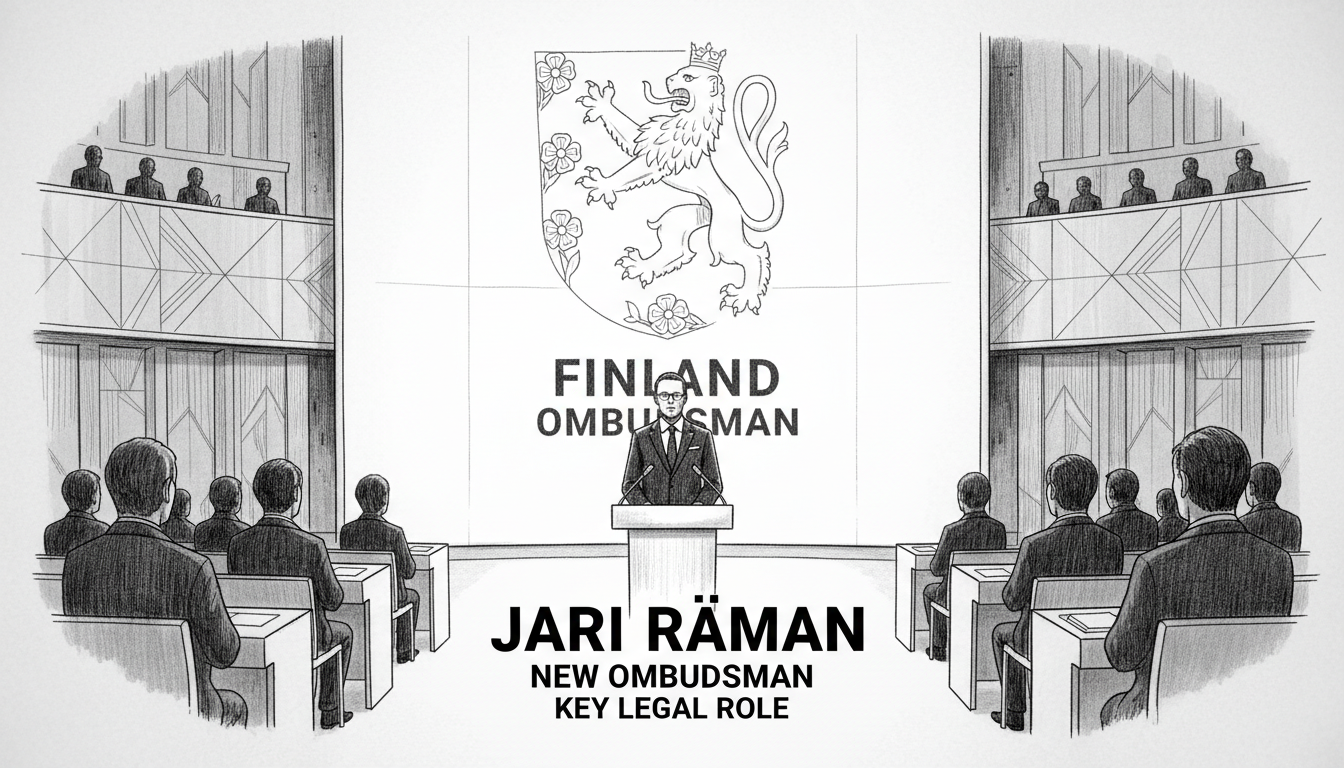
Finland's Parliament, the Eduskunta, has elected Dr. Jari Råman as the nation's new Parliamentary Ombudsman, placing a seasoned legal expert at the helm of one of the country's most important guardians of legality. Råman, who currently serves as the Head of Office within the Oikeusasiamiehen kanslia, will succeed Petri Jääskeläinen, whose 14-year tenure concludes at the end of December. The election, conducted by a vote of the full Parliament, underscores the critical independence of an office tasked with scrutinizing the actions of the entire Finnish state apparatus. Råman's appointment comes at a time of complex administrative challenges, from digital governance to the oversight of closed institutions.
A Guardian of Law and Citizen Rights
The Parliamentary Ombudsman, or Eduskunnan oikeusasiamies, operates as a cornerstone of the Finnish constitutional state. The office exists in a unique dual structure alongside the Chancellor of Justice, with both serving as the supreme overseers of governmental legality. While the Chancellor of Justice advises the government, the Parliamentary Ombudsman is directly accountable to the Eduskunta, reinforcing a clear separation from executive power. This independence is fundamental. The Ombudsman's primary tool is the investigation of complaints from citizens who believe a public authority has acted unlawfully or unjustly. However, the office also holds significant proactive powers, including the right to conduct inspections of any government agency or institution on its own initiative.
A particularly sensitive duty is the mandatory, regular inspection of closed institutions. The Ombudsman and deputies personally visit prisons, psychiatric hospitals, and immigration detention centers. These visits are a vital safeguard for individuals whose liberty has been restricted by the state. "The role is not merely reactive; it is a continuous audit of power," explains Professor Laura Ervo, a constitutional law expert at the University of Helsinki. "The Ombudsman's ability to walk into a prison unannounced and speak privately with inmates is a powerful deterrent against malpractice and a concrete manifestation of the rule of law."
From Insider to Overseer: The Profile of Jari Råman
Jari Råman's selection represents a choice for deep institutional knowledge and continuity. As the sitting Head of Office, he possesses an intimate understanding of the Ombudsman's operations, its case load, and its internal challenges. He holds a doctorate in law, providing the scholarly heft required for an office that often issues legally nuanced opinions that can shape administrative practice. His career path within the institution suggests a candidate respected for his managerial competence and legal acumen. The election by Parliament indicates broad cross-party support, which is essential for the perceived legitimacy of the Ombudsman's future rulings, especially those that may criticize government ministries.
Outgoing Ombudsman Petri Jääskeläinen leaves a substantial legacy. His 14-year term saw the office grapple with evolving issues like data protection, the rights of asylum seekers, and the legal implications of extensive social and healthcare reforms. Under his watch, the office maintained a high profile, regularly publishing findings and recommendations that spurred public debate and administrative changes. The transition to Råman is expected to be smooth, given his insider status, but it also presents an opportunity for the office to reassess its priorities in a rapidly changing society.
The Expanding Mandate in a Digital Age
The core mandate of the Ombudsman remains constant, but the landscape of public administration is transforming. One of the most significant modern challenges is the digitization of government services and the use of algorithms in decision-making. How does the Ombudsman supervise the legality of an automated decision made by a machine learning model? This question moves from theoretical to urgent as Finnish agencies increasingly adopt artificial intelligence. The new Ombudsman will need to develop inspection methodologies and legal frameworks to ensure that technological efficiency does not come at the cost of transparency, fairness, and the right to a human explanation.
Furthermore, Finland's active role in the European Union adds another layer of complexity. Many national administrative decisions are now made within the context of EU regulations and directives. The Ombudsman must therefore possess not only a mastery of Finnish administrative law but also a firm grasp of EU law and its application by national authorities. This includes areas from competition and state aid to environmental regulations and police cooperation. The office acts as a crucial link, ensuring that EU-derived powers are exercised lawfully at the national level, thus protecting citizens from potential overreach in a multi-tiered governance system.
A Watchdog for Everyday Finns
Beyond high constitutional theory, the Ombudsman's work has a direct, tangible impact on the lives of ordinary citizens. The office receives thousands of complaints annually, covering issues from social welfare benefit disputes and municipal planning decisions to police conduct and prison conditions. For an individual feeling powerless against a bureaucratic decision, the Ombudsman provides a free, accessible avenue for review. While the Ombudsman's decisions are not legally binding in the same way as a court ruling, they carry immense moral and political authority. Public authorities almost always comply with the Ombudsman's recommendations, knowing that a refusal could lead to a critical report to Parliament and damaging publicity.
This function is a key component of Finland's consistently high rankings in global governance and corruption perception indexes. It provides a safety valve for public discontent and a mechanism for continuous improvement in public administration. "The strength of the institution lies in its credibility," notes Professor Ervo. "Citizens must trust that the Ombudsman is truly independent and thorough. The Parliament's choice of a respected professional like Råman is a strong signal that this credibility remains the paramount concern."
The Road Ahead for the New Ombudsman
Jari Råman will assume his six-year term on January 1, 2025. His immediate in-tray will include overseeing the ongoing implementation of Finland's extensive social and healthcare reform (SOTE), a process fraught with legal and administrative complexities across new regional entities. The oversight of migration authorities and the reception system for asylum seekers will remain a sensitive and high-profile area. Furthermore, maintaining the rigor of inspections in closed institutions post-pandemic, where access may have been previously restricted, will be a priority to ensure no degradation of standards occurred.
The new Ombudsman must also navigate the political environment of the Eduskunta. While fiercely independent, the office relies on parliamentary support for its budget and, ultimately, for the political weight of its recommendations. Råman's challenge will be to maintain constructive dialogue with MPs across the spectrum without ever appearing beholden to the political agendas of the day. His success will be measured by the office's ability to call out illegality without fear or favor, whether the subject is a local municipal clerk or a minister in the Helsinki government district.
Finland's election of its new Parliamentary Ombudsman is more than a routine personnel change. It is a reaffirmation of a fundamental constitutional principle: that those who wield public power must themselves be subject to vigilant, independent scrutiny. As Jari Råman prepares to step from managing the office to leading it, the question for Finland is how this ancient office of the ombudsman will evolve to guard legality in an age of algorithms, complex EU integration, and enduring human rights challenges. The integrity of the Finnish state continues to depend on the answer.