
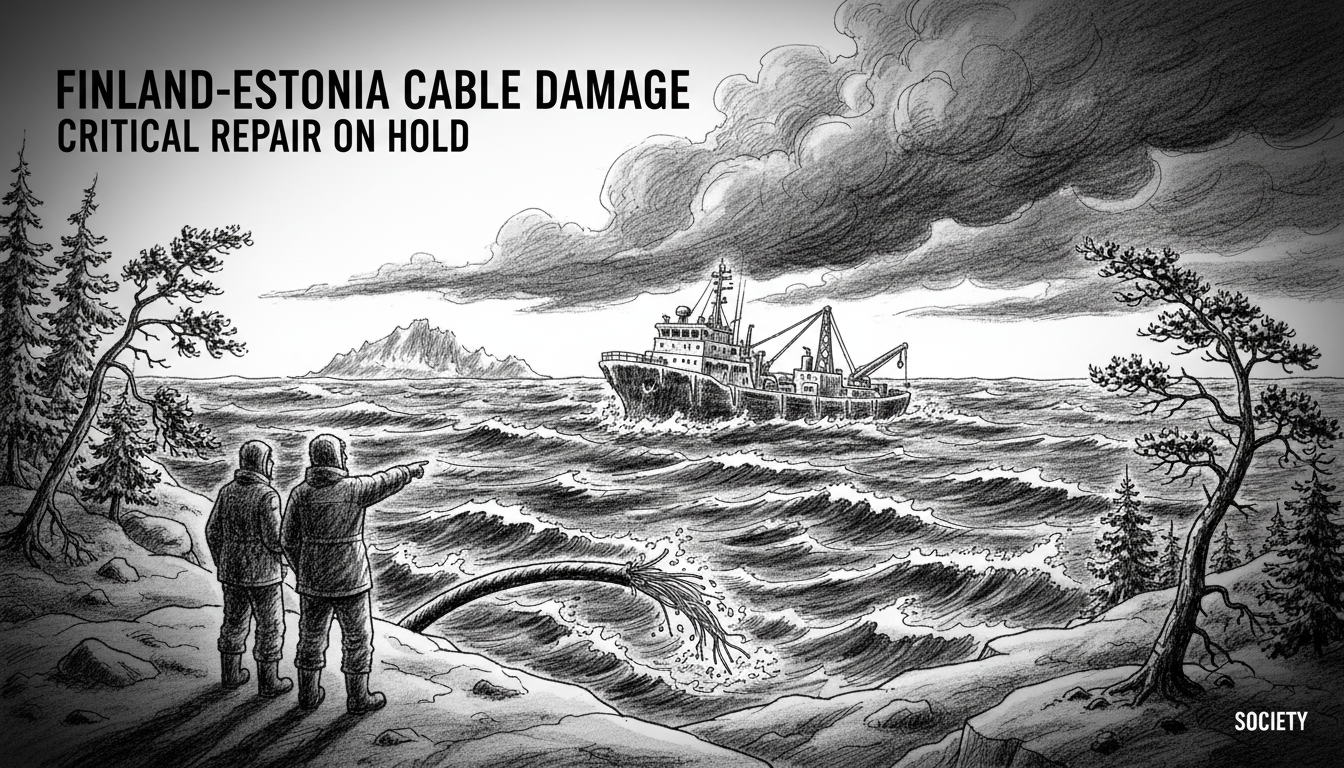
Finland's critical subsea data link to Estonia remains severed, its repair stalled by winter weather and ongoing investigations. The Elisa submarine cable, damaged on New Year's Eve in the Gulf of Finland, is still awaiting its repair vessel. This outage highlights the fragility of the digital infrastructure connecting the Nordic and Baltic tech sectors.
A Frozen Sea, A Broken Cable
Kim Tikkanen, Elisa's Head of Security, confirmed to Nordics Today that repair operations have not yet begun. "Weather conditions, among other factors, have affected the start of the repair work," Tikkanen stated. The Gulf of Finland in early January presents a formidable challenge. Sub-zero temperatures, freezing spray, ice formation, and limited daylight create a hostile environment for the precise work of locating and splicing a cable lying on the seabed. Furthermore, police have initiated an underwater site investigation around the cable, which must be completed before repair ships can move in.
The cable rupture on December 31 severed a primary data highway between Helsinki and Tallinn. While alternative terrestrial and subsea routes exist, the incident creates latency and redundancy risks for data traffic. Finnish police have indicated suspicion towards a cargo vessel as the potential cause, though the investigation is ongoing. The delay underscores a harsh reality: despite our hyper-connected world, mending its physical backbone is at the mercy of nature and procedure.
The Business Impact of a Silent Wire
For Finland's technology sector, reliable connectivity is non-negotiable. Helsinki's vibrant startup scene, from gaming giants like Supercell (valued over $10B) to fintech leaders, depends on low-latency links to global data centers and partners in the Baltics and beyond. "This isn't just about an internet cable," says Laura Jaatinen, a Helsinki-based telecommunications analyst. "It's about the real-time financial transactions, cloud gaming data, and R&D collaboration that fuels the Nordic-Baltic digital economy. Every millisecond of added latency has a cost."
The impact is particularly acute for the Finnish gaming industry, which employs over 3,700 people and generates billions in revenue. Modern game development is a globally distributed process, with assets and code synchronized across continents. Telecommunications companies like Elisa and Telia also rely on these international links for their own backbone services. While immediate, widespread internet blackouts have been avoided thanks to network rerouting, the reduced capacity is a stress test for regional digital resilience.
The Technical Mountain to Climb
Repairing a subsea cable is a maritime surgical procedure. First, a specialized cable-laying vessel must be dispatched. Companies like Alcatel Submarine Networks (part of Nokia) or SubCom operate a global fleet of these ships, but they are not sitting idle in Helsinki harbor. Mobilizing one takes time. Once on site, the ship uses grapnels to carefully haul the damaged ends to the surface. The exact location must be pinpointed using the cable's built-in optical time-domain reflectometry data.
In a controlled onboard laboratory, technicians slice open the armored casing, splice the hair-thin optical fibers, and seal the joint in a new protective housing. This requires calm seas. The vessel then gently lowers the repaired section back to the seabed. The entire operation for a single break can cost hundreds of thousands of euros and take over a week, weather permitting. For now, the Finnish Meteorological Institute's forecasts for the Gulf suggest the wait will continue.
A Geopolitically Sensitive Seabed
This incident occurs against a backdrop of heightened focus on subsea infrastructure security across the Baltic and North Seas. Following the 2022 Nord Stream pipeline explosions, NATO has established a Critical Undersea Infrastructure Coordination Cell. The Gulf of Finland is a busy maritime corridor with commercial shipping, energy infrastructure, and now, confirmed damage to a communications cable.
"The Baltic Sea is one of the most cable-dense areas in the world," notes Dr. Erik Steinsson, a researcher in infrastructure security at the University of Turku. "Anchors and fishing trawls cause the majority of accidental damage. But the strategic importance of this infrastructure means every incident is now scrutinized through a dual lens of accident and intent. The coordination Elisa mentions with authorities is now standard, layered procedure." This scrutiny inevitably slows the response, as law enforcement must secure evidence before engineers can fix the problem.
Looking Ahead: Redundancy and Resilience
The delayed repair of the Elisa cable is a stark reminder that the cloud has a very physical, vulnerable foundation. For Finland's tech companies, this event will likely accelerate discussions about diversifying data routes. Investments in additional cable systems, like the recently announced Nordic-Baltic submarine cable ring, may gain urgency.
Within the industry, there is a push for smarter monitoring. "The future is in real-time seabed surveillance," says Mikael Forsström, a project manager at Nokia's Espoo headquarters, which has a long history in subsea systems. "Integrating distributed acoustic sensing into cables themselves can detect anchor drags or unusual activity kilometers away, allowing for warnings before a cut occurs." For now, the region must rely on older technology: patience and the skill of specialized marine crews.
When the weather finally breaks and the police give the all-clear, a repair ship will undertake its careful mission. Until then, a critical piece of Finland's digital infrastructure lies broken on the dark, cold floor of the Gulf of Finland. The incident asks a pressing question: in an era of instant data, are we prepared for the slow, hard work of maintaining its pipes?