
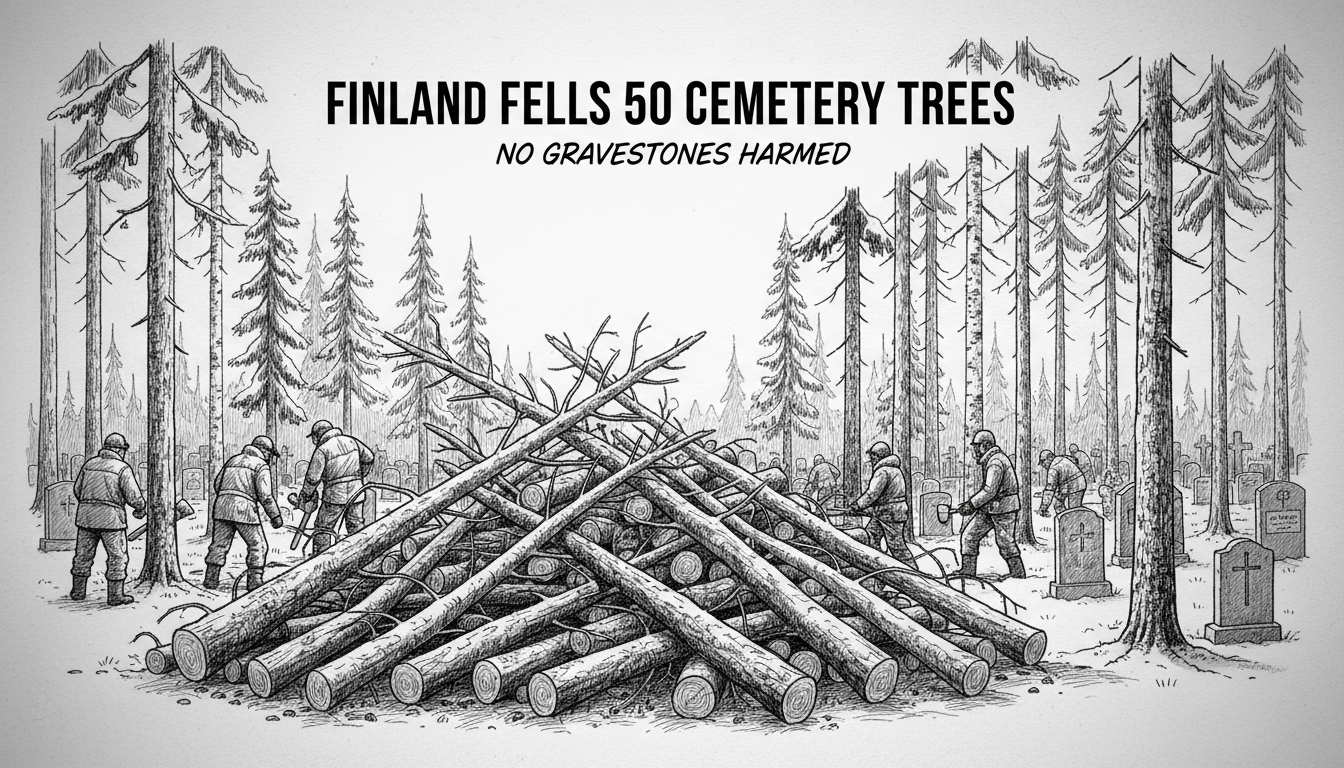
Jyväskylä’s historic Old Cemetery has removed 50 aging trees in a meticulously planned operation that preserved every fragile gravestone. The project, completed on schedule by the local parish, highlights the delicate balance between safety, heritage conservation, and natural stewardship in Finland's revered burial grounds.
A Surgical Operation Amidst History
The week-long operation, which concluded as planned, targeted approximately 50 old and decaying trees. Their condition posed a significant risk to visitors and the historic gravesites they shaded. "The work was carried out exactly according to plan," confirmed Liisa Kontunen, the work supervisor for the Jyväskylä Parish. Her statement underscores the precision required for such a sensitive task. The primary challenge was navigating heavy machinery and falling timber within a dense grid of centuries-old headstones, many made from soft sandstone or intricately carved. The zero-damage outcome is a testament to advanced planning and skilled execution, turning a potential controversy into a case study in careful cultural site management.
This operation was not merely landscaping; it was preventive conservation. In Finland, parish unions are legally responsible for maintaining cemetery safety under the Church Act and the Cemetery Decree. A falling limb or a toppling tree could irrevocably destroy a 19th-century monument, erasing local history and causing profound distress to descendants. The project in Jyväskylä follows a growing trend across Finnish cities like Helsinki and Turku, where similar assessments and managed removals are becoming routine. The driving force is increasingly extreme weather linked to climate change, with stronger winds and heavier snow loads testing the limits of aging arboreal populations.
The Science and Sensitivity of Cemetery Arboriculture
Experts in arboriculture stress that cemetery tree management is a unique discipline. "It's a three-dimensional puzzle with immense emotional weight," says one Helsinki-based arborist who has consulted on similar projects. "Every tree is assessed not just for its health, but for its root system's interaction with burial plots, its canopy's wind resistance, and its historical value to the site's character." The decision to remove a tree in such a setting is never taken lightly. Often, arborists use resistograph drills to measure internal decay without harming the tree's exterior, creating a detailed map of structural integrity.
The process in Jyväskylä likely followed a strict protocol: first, a comprehensive survey by a certified arborist flagged hazardous trees. Then, heritage officials would have reviewed the list to ensure no tree of notable historical or aesthetic importance was slated for removal without cause. Finally, the parish council, as the governing body, would have approved the plan and its budget. Public communication is also a critical, though often unseen, component. Parish newsletters and website announcements typically inform the community in advance to preempt concerns and demonstrate transparency in handling the collective patrimony.
EU Frameworks and National Heritage
While cemetery management is a local and national issue, it intersects with broader European Union priorities. Finland's commitment to preserving cultural heritage sites dovetails with EU programs like Creative Europe, which co-funds conservation projects. Furthermore, sustainable management of urban green spaces—including cemeteries—aligns with the EU’s Biodiversity Strategy for 2030 and its Green City Accord. The careful removal of hazardous trees promotes public safety while allowing for strategic replanting with more suitable, resilient native species, contributing to urban biodiversity goals.
In the Nordic context, cemeteries are often viewed as multifunctional green spaces for contemplation and quiet recreation, not merely as burial grounds. This cultural attitude increases the duty of care for those managing them. Sweden's famous Skogskyrkogården (The Woodland Cemetery) in Stockholm, a UNESCO World Heritage site, employs similar continuous forest management to preserve its iconic aesthetic while ensuring safety. The operation in Jyväskylä, though smaller in scale, operates within the same philosophical tradition: active, informed stewardship is required to protect timeless places of peace.
The Future of Finland's Historic Burial Grounds
The successful completion of this project in Jyväskylä sets a benchmark for other municipalities. The key takeaway is that proactive, planned management is far superior to emergency responses after a storm has caused destruction. The financial calculus supports this; budgeted removal is more cost-effective than urgent storm damage clearance coupled with expensive monument restoration. For parish finance committees, this is a compelling argument for allocating funds to regular tree surveys and maintenance cycles.
Looking ahead, the challenge will intensify. Many of Finland's old cemetery trees were planted in the 19th and early 20th centuries and are now entering a period of natural decline. Climate change accelerates this process, introducing new pests and diseases. The work in Jyväskylä is therefore not a one-off, but part of a continuous, evolving practice. Future projects may increasingly involve soil remediation around graves to protect stonework from root systems, and the selective planting of new trees chosen for their longevity and smaller stature.
The silent, stone-dotted landscape of Jyväskylä's Old Cemetery is now safer for those who wander its paths. The project proves that with meticulous care, the needs of the living, the memory of the departed, and the respect for nature and history can coexist. It raises a poignant question for communities across the Nordic region: how do we best care for these sacred archives of green and stone, ensuring they endure for centuries to come?