
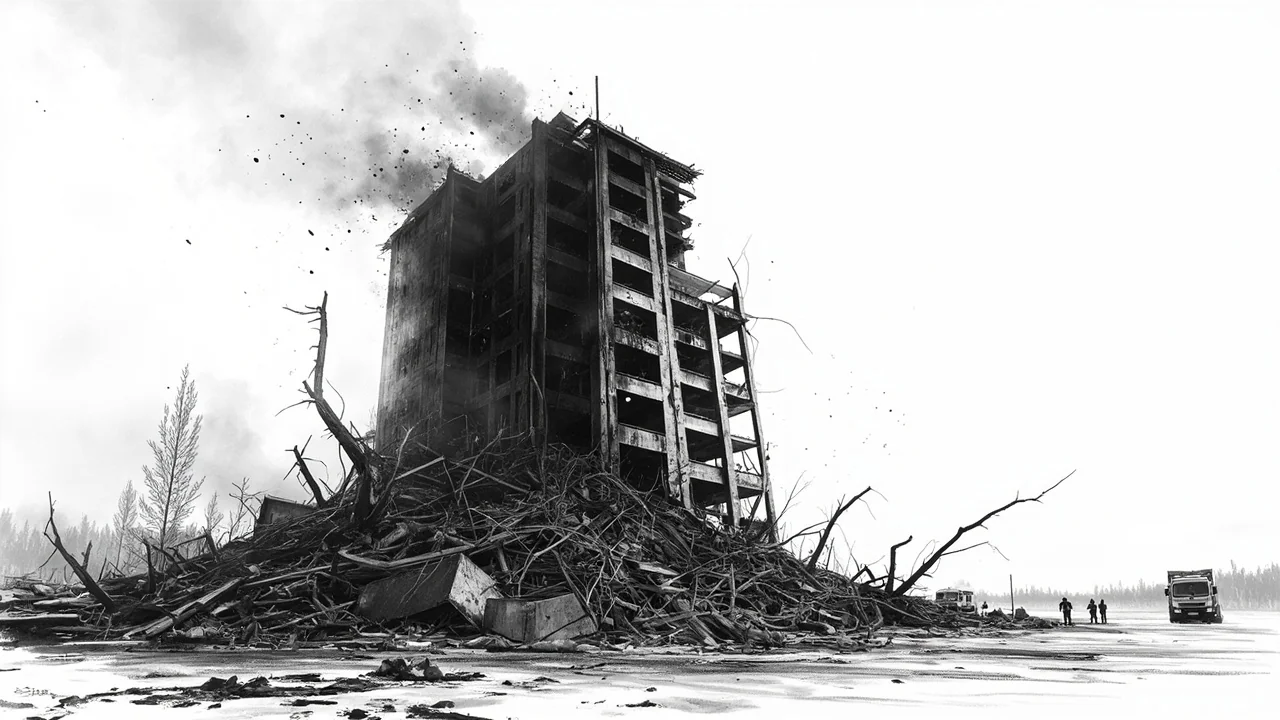
Finland's Kymenlaakso rescue service received an urgent alarm for a major building fire at 14:42 on Sunday afternoon. Flames erupted in a 1,600-square-meter commercial and repair shop building on Kaupinkatu street in Kouvola, with a waste container adjacent to the wall igniting first before the fire spread to the structure itself. No injuries were reported in the incident, which required a significant response from emergency crews to contain the blaze and prevent further damage.
Kymenlaakso's on-duty chief, Asko Rouhiainen, directed the operation where firefighters extinguished the flames and partially dismantled the building's wall. This controlled demolition was a critical preventative measure to check that the fire had not spread deeper into the structure's framework. "The cause of the waste container ignition is unclear for the time being, but the fire investigation has been started," Rouhiainen stated, adding, "There isn't any clear reason for it yet."
The absence of casualties transforms this event from a potential human tragedy into a significant property incident and a case study for municipal safety protocols. For the city of Kouvola, a key logistics hub in southeastern Finland, the fire disrupts local commerce and raises immediate questions about storage safety and urban fire risks in mixed-use commercial areas.
Emergency Response and Containment Strategy
The rapid response by the Kymenlaakso Rescue Department highlights Finland's structured approach to emergency management. The decision to dismantle part of the wall was not merely about extinguishment but about proactive risk mitigation. Finnish rescue services operate under principles that prioritize preventing hidden fire spread within cavities or insulation, a common challenge in older commercial buildings. This methodical, physical inspection post-extinguishment is a standard but crucial step, ensuring no smoldering embers remain to re-ignite hours later.
Rouhiainen's brief but precise public statements follow standard Finnish crisis communication protocols: confirm facts, outline actions taken, state what is unknown, and announce the next steps (an investigation). This transparency manages public concern while avoiding speculation. The 1,600-square-meter scale of the building necessitated a substantial deployment of personnel and equipment, though specific unit numbers were not disclosed in the initial report.
The Investigation and Unanswered Questions
The launched investigation will follow procedures outlined by the Finnish Rescue Act (Pelastuslaki). Investigators will seek to determine the ignition source of the waste container. Key lines of inquiry will include electrical faults, improper disposal of flammable materials, or external factors. The container's proximity to the building wall became the critical vector, allowing flames to quickly latch onto the structure's exterior, potentially involving cladding or insulation materials.
This phase moves the incident from the emergency response domain to the analytical and preventative sphere. The findings will be reported to local building safety authorities and could influence municipal guidelines on waste storage distances from structures, especially in commercial zones. While large-scale building fires are relatively rare in Finland due to strict construction codes, incidents involving auxiliary elements like waste containers present a recurring, manageable risk.
Context of Finnish Fire Safety and Urban Planning
Finland maintains one of Europe's most comprehensive fire safety regimes, built upon rigorous building codes, regular inspections, and a professional volunteer firefighter network. This incident, while serious, occurs within a system designed to minimize catastrophic outcomes. The fact that no one was injured speaks to the likely timing of the fire on a Sunday afternoon in a commercial building, but also to effective alarm systems and the building's compliance with evacuation standards.
For Kouvola, a city that has undergone significant structural economic changes, the integrity of its commercial real estate is vital. Fires in repair shops pose unique hazards due to the potential presence of fuels, oils, and solvents. The investigation will need to ascertain if any such materials were stored in or near the implicated container, which would dramatically increase the fire's intensity and spread speed.
The event also touches on broader themes of urban maintenance. Waste management, while routine, is a frontline fire prevention issue. Municipalities dictate rules for container placement and material segregation, but compliance and enforcement are constant challenges. This fire will prompt a review of these practices in Kouvola's commercial district.
Analysis: From Local Incident to National Policy Considerations
As a political correspondent, viewing this through a policy lens reveals interconnected layers. While not a parliamentary matter, local incidents often inform national policy discussions. The Ministry of the Interior, which oversees rescue services, consistently uses case data to update training and guidelines. A report on this fire will eventually contribute to that national dataset, potentially influencing future amendments to safety decrees.
Furthermore, Finland's commitment to its carbon neutrality goals intertwines with building safety. Newer, energy-efficient insulation materials must also meet stringent fire resistance standards. An investigation into how the fire spread on the wall may provide practical data for material scientists and regulators balancing insulation performance with fire safety—a technical but critical aspect of Finland's green transition in the construction sector.
The efficient response underscores the value of Finland's regional rescue service model, where resources are pooled across municipalities for major incidents. This model, often debated during budget negotiations in the Eduskunta, proves its worth in real-time events outside the largest metropolitan areas. It demonstrates the practical outcome of political decisions on emergency service funding and structure.
Looking Ahead: Recovery and Prevention
The immediate aftermath focuses on securing the structure, completing the investigation, and initiating insurance and repair processes for the business owners affected. The long-term impact lies in the lessons learned. The Finnish National Rescue Association (SPEK) may incorporate findings into its public awareness campaigns, particularly targeting commercial enterprises regarding waste storage risks.
For the residents and business community of Kouvola, the incident is a disruptive but contained event. It reinforces the importance of visible safety protocols. It also showcases the professional competence of the regional rescue services, a public institution that operates with high public trust in Finland.
Ultimately, this fire on Kaupinkatu is a reminder that urban safety is a continuous practice. It hinges on individual responsibility in waste disposal, business compliance with regulations, municipal enforcement, and the ever-ready proficiency of rescue professionals. The successful containment with no loss of life is the positive outcome, but the unanswered "why" of the waste container's ignition is the question that now drives the preventative work, ensuring such alarms remain less frequent.