
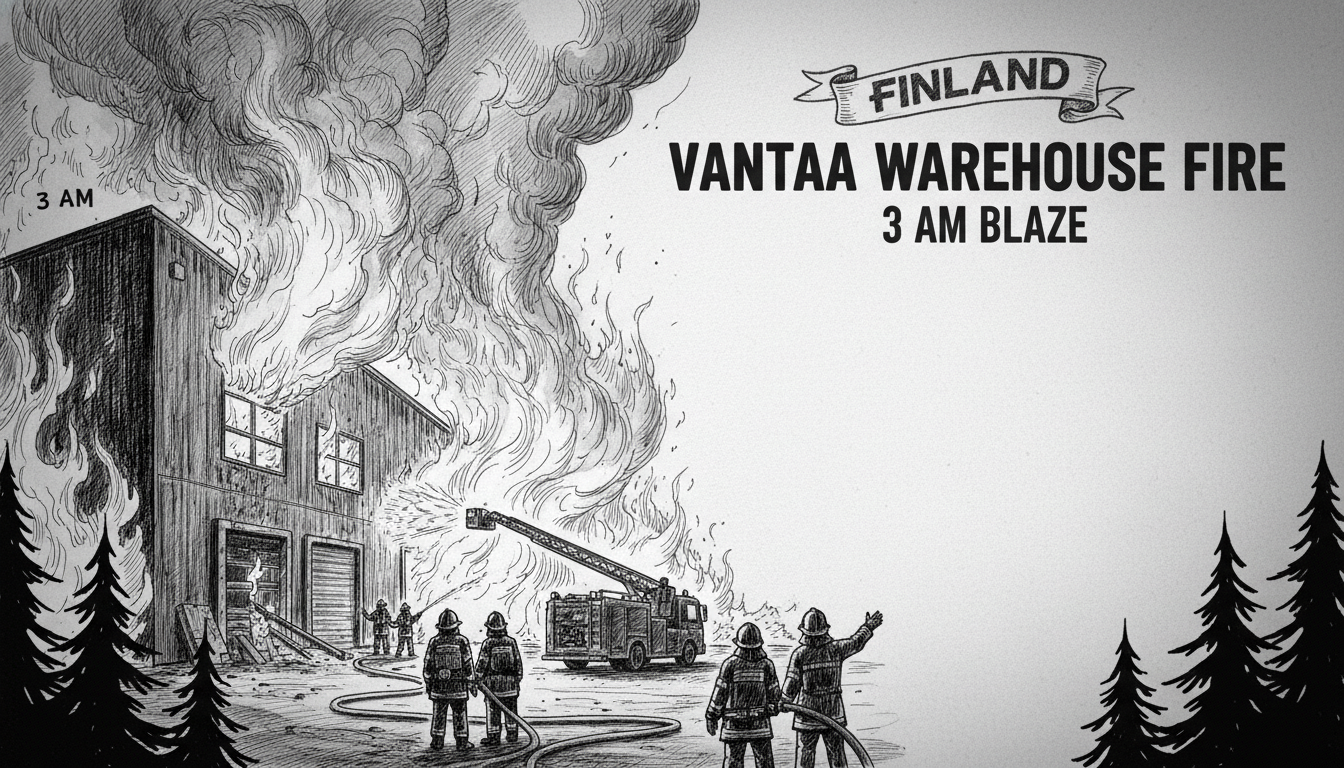
Finland fire crews battled a major blaze at an unoccupied warehouse in Vantaa in the early hours of Tuesday morning. The alarm reached the Central Uusimaa Rescue Department at 3:00 AM local time, with the fire already fully developed when the first units arrived at the scene on Lammintie, near the Hämeenlinnanväylä highway. The wooden warehouse, estimated to be around 100 square meters, was engulfed in flames. Firefighters remained on site past 5:00 AM, working to fully extinguish the fire and prevent its spread to the surrounding terrain. The cause of the fire is currently unknown, and officials report no danger or disruption to traffic.
A Familiar Scene for Finnish Firefighters
While dramatic, the scene in Vantaa represents a recurring challenge for Finland's emergency services. Finland experiences a higher rate of fires per capita than its Nordic neighbors Sweden and Norway. These incidents range from forest fires and residential blazes to industrial and warehouse fires like the one in Vantaa. The country's extensive forests, cold climate driving high electrical and heating usage, and a significant stock of older wooden buildings all contribute to this risk profile. The rapid response by the Central Uusimaa Rescue Department is standard for Finland's well-equipped and professional fire services, which are organized on a regional basis. Their immediate priority is containment, especially with a wooden structure that can easily throw embers and ignite surrounding areas.
“When we arrived, the fire was in its full development phase in a 100-square-meter log building,” the Central Uusimaa Rescue Department's on-duty fire chief said in a statement. “The focus was on extinguishment and preventing ground fires.” The fact that the warehouse was reported as unoccupied is a small mercy, eliminating the immediate risk to human life that defines the most tragic fire responses. However, an empty building presents its own mysteries and challenges, often delaying the discovery of a blaze and allowing it to gain significant hold before detection.
The Persistent Challenge of Unoccupied Buildings
Fires in vacant structures are a significant concern for fire safety experts and municipal authorities across Finland. Without regular human activity, early signs of fire like smoke or unusual smells often go unnoticed. These buildings can also become targets for vandalism or arson, or develop dangerous electrical faults without maintenance. Determining the cause in such cases can be particularly difficult for fire investigators, as evidence is often more severely damaged and there are no witnesses to the initial stages. The Vantaa warehouse fire's cause is, as officially stated, “in the dark.”
“Every fire has an origin and a cause,” explains a veteran Finnish fire safety engineer, speaking on the condition of anonymity as they are not directly involved in this investigation. “In an unoccupied building, the list of possible ignition sources narrows, but so does the opportunity for early detection. It underscores the critical need for property owners, even of empty lots, to maintain basic security and safety measures. Something sparked this fire, and finding out what is crucial for prevention.” The investigation will likely examine electrical systems, potential human activity in the area, and any recent work on the property.
Finland's Fire Safety Framework and Response
Finland's approach to fire safety is proactive, built on strict building codes, public education, and a robust rescue service. The Building Code of Finland includes comprehensive fire safety regulations regarding materials, compartmentalization, and escape routes. For warehouses and industrial buildings, specific rules govern storage, hazardous materials, and fire suppression systems. Whether this particular older warehouse was equipped with sprinklers or modern alarms is not yet known. The response structure is efficient; the Central Uusimaa Rescue Department serves multiple municipalities, pooling resources for major incidents exactly like this one.
The effective containment, preventing the fire from spreading to nearby forests or other structures, highlights this operational proficiency. Finland's often rugged and remote geography makes firefighting logistics complex, but decades of experience with both urban and wildland fires have honed response protocols. The incident also occurs within a broader national context where fire safety is periodically scrutinized, especially after major tragedies. Each significant fire, even without casualties, provides data and lessons that feed back into training, equipment procurement, and regulatory reviews.
Economic and Environmental Aftermath
Beyond the immediate danger, a fire like this carries secondary consequences. While traffic on the vital Hämeenlinnanväylä was reportedly unaffected, local air quality likely suffered due to smoke and particulate matter from the burning wooden structure. The environmental impact of runoff water contaminated with ash and burned materials must also be managed by the rescue department to protect soil and groundwater. For the property owner, the total loss of a 100-square-meter building represents a significant financial hit, raising questions about insurance, liability, and future use of the land.
From a community perspective in Vantaa, such fires can spark concerns about public safety and the management of derelict or unused properties. They are visible, alarming events that prompt residents to question what is happening in their neighborhoods. Local officials may face inquiries about property standards and monitoring. The charred shell of the warehouse will stand as a stark reminder of the destructive power of fire until it is cleared, a process that itself must be handled carefully.
Looking Ahead: Investigation and Prevention
The path forward from the early morning blaze is now one of investigation and analysis. Fire investigators will sift through the cooling debris, looking for clues to pinpoint the origin and cause. Their findings are vital. If the cause was accidental, such as a fault in old wiring, it may inform inspections of similar vacant properties. If evidence points to human intervention, whether intentional or through trespassing, it shifts the focus to security and crime prevention. The data from this fire will become a statistic in annual reports, helping shape national understanding of fire risks.
For the international audience observing Nordic societies often lauded for their safety and order, this incident is a reminder that no country is immune from such random, destructive events. Finland's systems are tested regularly by its environment and infrastructure. The true measure of resilience is not the absence of fires, but the capacity to respond effectively, limit damage, and learn from each incident. The firefighters of Central Uusimaa executed the first part of that equation in the dark hours of Tuesday morning. The work of understanding why it happened now begins, with the goal of ensuring it does not happen again in the same way.