
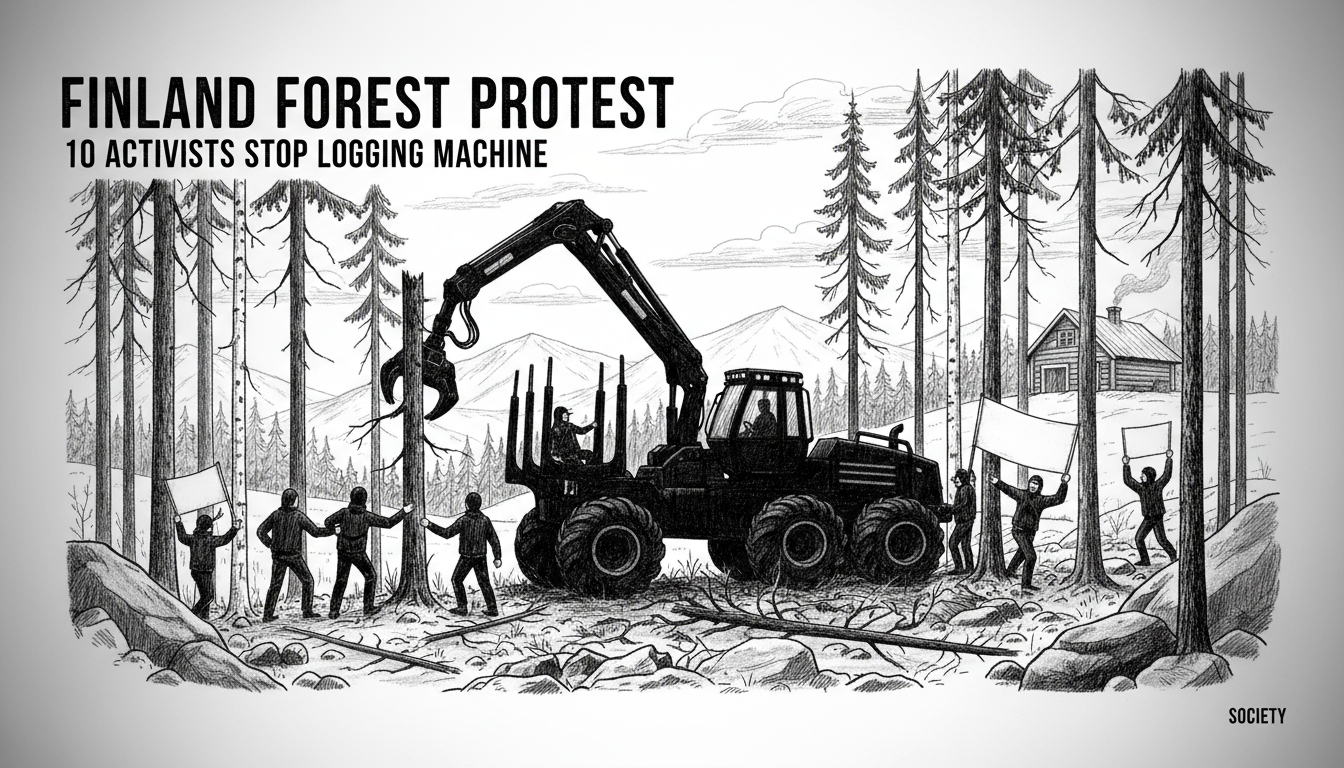
Finland forest logging protests escalated Monday morning when a group of local activists physically halted a timber harvester in Härkövuori, Muurame. Approximately ten residents, using lights and direct action, stopped the machine's operator from continuing work in a forest area they are demanding be preserved.
"We stopped the logging in this area for today," said Tuulia Toivanen from the local activist group Keski-Suomen metsäväki. "We went to the site in the morning with lights, which made the machine operator stop. After a discussion, the machine did not continue cutting."
The protest highlights a growing tension in a nation where forests cover over 75% of the land and the forest industry remains a cornerstone of the economy, accounting for roughly one-fifth of the country's export revenue. Yet, at the local level, communities are increasingly pushing back against logging plans they feel threaten valuable natural and recreational areas.
A Local Stand for a 'Precious' Forest
The targeted area in Härkövuori is described by activists as a small but significant woodland for the municipality's residents. While not an expansive old-growth forest, its value lies in its local importance for recreation, biodiversity, and community identity. This protest represents a microcosm of a national debate: how to balance large-scale industrial forestry with the preservation of smaller, locally cherished ecosystems.
Finland's forest management model is often hailed internationally for its sustainability and high regeneration rates. However, critics argue that the focus on timber production and clear-cutting methods can degrade biodiversity and carbon sequestration potential, especially in forests that hold particular ecological or social value. The conflict in Muurame is less about the principle of forestry and more about the fate of a specific, beloved patch of woods.
"It's a small area, but for the locals, it's that much more precious," Toivanen noted, encapsulating the core of the dispute. The action was not aimed at shutting down the industry but at forcing a conversation about the fate of this particular tract of land.
The Rising Wave of Finnish Forest Activism
Direct action to halt logging machinery, while less common than in some other European countries, has been gaining traction in Finland. Groups like Metsäpysäyttäjät (Forest Stoppers) and Elokapina (the Finnish branch of Extinction Rebellion) have employed similar tactics, often focusing on forests with high conservation value or cultural significance to the Sámi people in the north.
The Muurame protest differs slightly; it was organized by local residents rather than a national group, underscoring a grassroots, community-level mobilization. This suggests that environmental concerns over forestry are moving beyond traditional activist circles and into mainstream local politics and civic action.
Dr. Liisa Tyrväinen, a research professor at the Natural Resources Institute Finland (Luke), who studies the social and health benefits of forests, provides context. "The debate is shifting," she explains in an interview. "For decades, the discussion was dominated by timber yield and economic output. Now, we see a much stronger emphasis on the other ecosystem services: carbon storage, biodiversity habitats, and the immense recreational and mental well-being benefits forests provide to people. Local communities are now vocal stakeholders demanding their values be included in land-use decisions."
The Economic Backbone Meets New Pressures
The Finnish forest industry is a technological powerhouse, with companies like Stora Enso, UPM, and Metsä Group leading in bioeconomy innovation. The sector employs tens of thousands directly and supports entire regional economies. It has also invested heavily in sustainability certifications and promoting the renewable nature of wood.
However, the industry faces dual pressures. From the global market, there is demand for more sustainable and traceable products. From within Finland, there is growing public scrutiny and a political push for stricter conservation targets, particularly to halt biodiversity loss. The European Union's biodiversity strategy, which includes targets for strictly protecting forests, also influences national policy.
This creates a complex landscape for forestry companies and the state-owned forest management enterprise, Metsähallitus. They must navigate increasing regulatory requirements while managing public relations and sometimes confronting direct action on logging sites.
The Path Forward: Dialogue or Conflict?
The immediate outcome in Muurame was a temporary pause. The longer-term result remains uncertain. Will the logging plans be permanently revised, or will the machines return with a police escort? The situation tests local democracy and conflict resolution mechanisms.
Professor Jussi Lehtonen from the University of Helsinki's Department of Forest Sciences suggests that such conflicts point to a need for more transparent and participatory planning processes. "The traditional top-down planning model is straining," Lehtonen states. "Early and meaningful engagement with local communities, mapping not just timber but all forest values, can help identify these conflict areas before they reach the crisis point of people standing in front of machines. It's more challenging but necessary for social license."
Finland is at a crossroads familiar to many resource-rich nations. Its economic history is built on the forest, but its future demands a more nuanced relationship with it. The protest in Muurame is a small event with large symbolic weight. It asks a fundamental question: in a country of vast forests, who decides the fate of a single, precious woodlot, and what values are prioritized in that decision?
The lights that stopped the harvester in Härkövuori illuminate a deeper national conversation about value, sustainability, and community voice in the age of ecological crisis. The resolution of this local dispute may offer clues to how Finland will manage its greatest natural resource in the decades to come.