
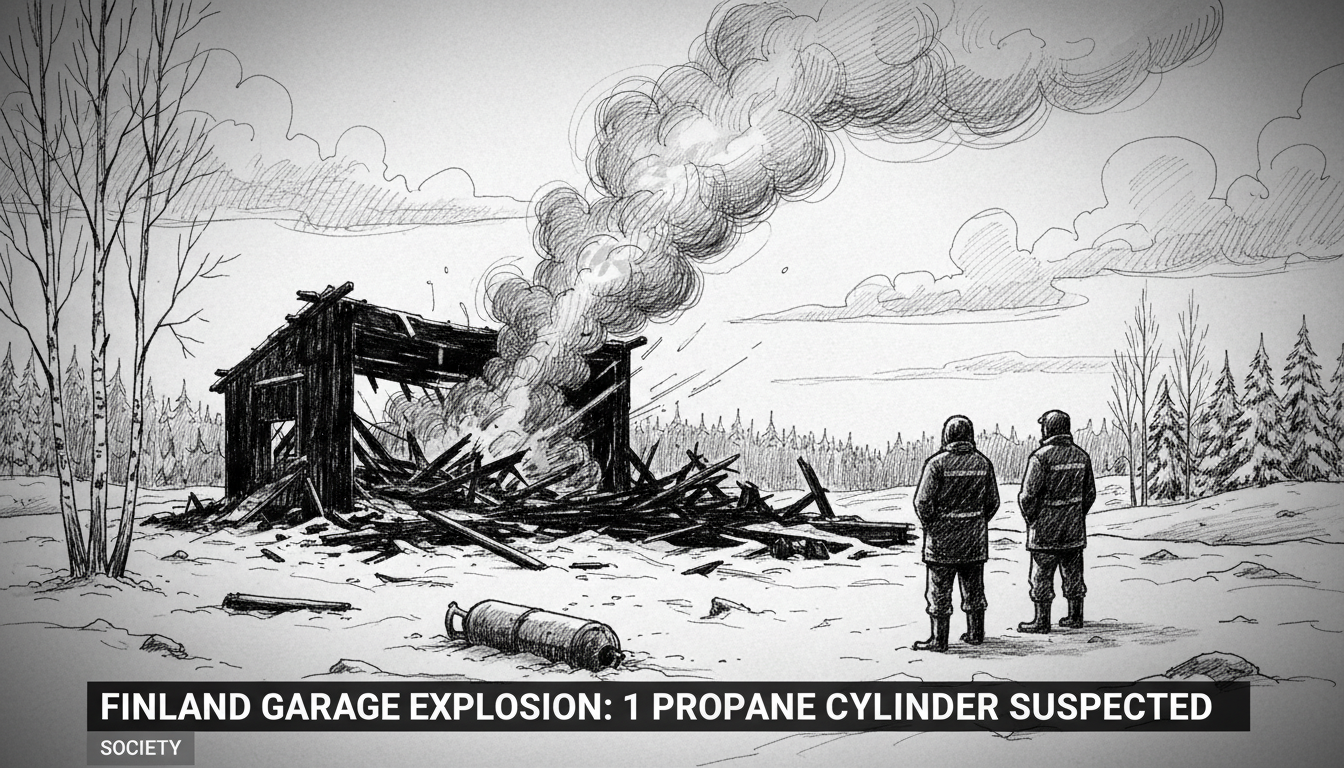
Finland's Lapinlahti garage explosion was likely caused by a single leaking propane gas cylinder, according to a police investigation update. The Saturday blast on Ahvenkuja street collapsed the structure attached to a detached house and scattered debris across multiple neighboring properties. Authorities have definitively ruled out criminal explosives or a malfunction in the building's technical systems as potential causes, focusing the inquiry on accidental gas ignition.
"We suspect that the only cause of the Lapinlahti garage explosion on Saturday could be a liquefied petroleum gas cylinder that was in the garage," police stated. Investigators theorize gas may have leaked from the cylinder into the enclosed space, where it potentially ignited from a spark generated by an electrical appliance. The resulting explosion in the confined area led to the garage's catastrophic structural failure.
The Scene on Ahvenkuja
Residents reported a powerful bang in the early afternoon that shook the quiet neighborhood. The force was sufficient to reduce the garage to rubble and propel fragments of wood, metal, and insulation onto adjacent yards. Emergency services, including police and rescue units from the North Savo region, responded swiftly to the scene. No injuries were reported, a fact authorities described as fortunate given the violence of the detonation. The incident caused significant property damage but did not result in a major fire, allowing investigators to begin their work promptly.
Forensic technicians and police experts conducted a thorough examination of the wreckage over subsequent days. Their initial priority was to exclude the involvement of illicit explosives, a standard procedure for any unexplained blast in Finland. Once that avenue was closed, attention turned to the home's systems and contents. "The involvement of explosives in the events has been ruled out," police confirmed. "Building technology also did not cause the explosion."
The Focus on Propane Safety
With other causes eliminated, the investigation zeroed in on a common household item: a liquefied petroleum gas (LPG) cylinder, known in Finnish as 'nestekaasu'. These containers, often holding propane or butane, are frequently used in Finnish homes for portable grills, camping stoves, or temporary heating in sheds and garages. Finland enforces strict technical safety regulations (TSR) governing the storage, handling, and inspection of such pressure vessels. The regulations mandate regular inspections and set clear standards for valves, hoses, and storage conditions to prevent corrosion and leaks.
"A complete certainty about the cause of the explosion may not necessarily be determined," police cautioned, indicating the precise ignition sequence might remain unclear. However, the evidence strongly points to a gas accumulation. In a sealed garage, even a small, slow leak from a faulty valve or perished hose can allow flammable gas to build up to a dangerous concentration. A single spark from a refrigerator compressor kicking in, a light switch, or a power tool could then trigger a devastating explosion.
Expert Analysis on Confined Space Risks
Safety experts emphasize that the enclosed nature of a garage creates a uniquely hazardous environment for gas leaks. "Ventilation is the critical factor often overlooked," explains a Finnish safety inspector familiar with technical regulations, who spoke on the condition of anonymity as they were not directly involved in the case. "A garage is not a living space. People store gas cylinders there, perhaps with a grill, thinking it's safe. But without constant, adequate airflow, any leak becomes a trapped, invisible cloud waiting for an ignition source."
Experts highlight several common failure points: worn rubber connecting hoses that can crack, brass fittings that may not be fully tightened after cylinder replacement, and valves that can degrade over time. Cylinders themselves are robust, but the ancillary equipment is often the weak link. The Finnish Safety and Chemicals Agency (Tukes) provides guidelines stating that LPG cylinders should be stored upright, outdoors in a well-ventilated area, and away from heat sources and building openings like doors and windows.
Regulatory Framework and Public Awareness
Finland's approach to technical safety is comprehensive, built on EU-wide directives and enhanced by national legislation. The regulations cover the entire lifecycle of a gas cylinder, from production and testing to transportation and end-use. Retailers and distributors have obligations to ensure cylinders are within their inspection period. However, ultimate responsibility for safe storage and use in a private home rests with the consumer.
This incident in Lapinlahti serves as a stark reminder of that responsibility. While industrial accidents are rare due to stringent workplace controls, domestic settings present a greater challenge for authorities. Public awareness campaigns run by rescue services (Pelastuslaitos) routinely cover fire safety but may not specifically highlight the explosive potential of common gas cylinders in sheds and garages. The Lapinlahti explosion, with its dramatic outcome and fortunate lack of injuries, could catalyze a renewed focus on this specific household risk.
The Aftermath and Broader Implications
The homeowner now faces a major repair and insurance assessment process. For the community, the event was a shocking disruption that revealed a latent danger in a commonplace object. For policymakers and safety officials, it is a data point that may inform future guidance. Similar incidents, though uncommon, have occurred in Finland and across the Nordic region, often during summer months when portable gas equipment sees frequent use.
The police investigation is now largely complete from a criminal standpoint, as foul play has been excluded. The remaining work involves finalizing the technical report to conclusively document the probable gas-related cause. This report will be crucial for insurance purposes and for any potential review of safety guidelines. The case underscores a universal safety principle: the most significant risks are sometimes hidden in plain sight, in the mundane objects of everyday life.
Could a routine check of a hose or valve have prevented this destruction? The question now hangs over the debris in Lapinlahti, a prompt for homeowners across Finland to reconsider what they store in their own enclosed spaces. As the clean-up continues, the lasting impact of this explosion may be a heightened, collective awareness of the powerful force contained within a seemingly innocuous blue metal cylinder.