
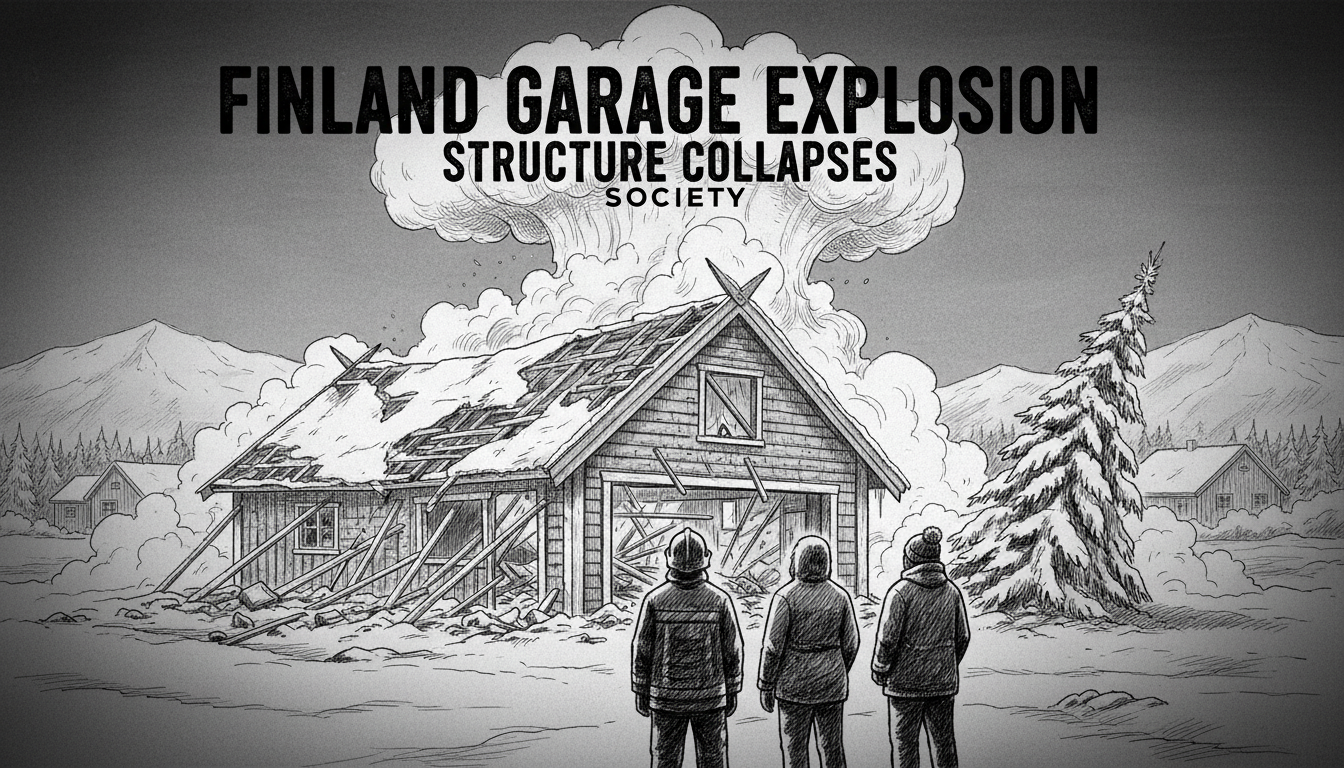
Finland's North Savo region recorded a rare residential explosion on Saturday when a garage detonated in the municipality of Lapinlahti. The blast, which occurred at 1:28 PM on Ahvenkuja street, caused the detached wooden garage to collapse entirely. Remarkably, no injuries were reported in an incident that local fire officials say could have been far worse.
"The resident was not present at the time of the explosion," said Ville Tuovinen, the on-duty fire chief for the North Savo Rescue Department. Tuovinen confirmed that a subsequent small fire was extinguished by a neighbor using a portable fire extinguisher before emergency services arrived. Multiple rescue units were dispatched to the scene following the initial alert, with crews remaining on site for over an hour to secure the area and begin preliminary investigations.
The cause of the explosion is currently unknown and under investigation by authorities. Incidents of this severity in residential areas are uncommon in Finland, a nation with stringent building codes and safety regulations governing the storage of flammable materials like fuel, gas canisters, or chemicals typically found in a garage.
A Close Call in Rural Lapinlahti
The explosion occurred in a typical Finnish omakotitalo, or detached house, in a quiet residential area. Lapinlahti is a rural municipality of about 10,000 residents, located roughly 70 kilometers north of Kuopio. The region is characterized by forestry, agriculture, and scattered settlements, where detached homes with separate garages or sheds are the norm.
The quick action of a neighbor in dousing the initial flames is being credited with preventing a more serious disaster. "The fact that a neighbor was able to intervene immediately with a fire extinguisher likely prevented the fire from spreading to the main dwelling or other properties," said safety expert Jari Lemettinen, a former chief inspector with the Finnish Safety and Chemicals Agency (Tukes).
Lemettinen emphasized that most Finnish households keep basic firefighting equipment, a practice encouraged by rescue services. This community-level preparedness often mitigates damage before professional crews can arrive, especially in rural areas where response times may be longer.
Investigating the Blast's Origin
Determining the source of the explosion will be a primary focus for investigators. Common culprits in such scenarios include propane tanks (commonly used for grills or heating), gasoline fumes, aerosol cans, or improperly stored chemicals. Finland's cold climate means many garages double as storage and workshop spaces, potentially housing a variety of volatile substances.
"The investigation will be methodical," explained Chief Tuovinen. "We examine the debris, speak to witnesses, and work to reconstruct the events leading to the ignition. Our goal is to understand what happened to prevent a recurrence." The police may also be involved if the investigation points toward criminal negligence or unlawful activity, though there is no indication of that at this early stage.
Finnish law regulates the storage of flammable liquids and gases. For instance, only limited quantities of gasoline can be stored in residential outbuildings, and certain types of industrial chemicals are prohibited altogether. Compliance is generally high, but accidents can still occur due to human error or equipment failure.
Finland's Safety Record in Focus
While dramatic, such explosions are statistical anomalies in Finland. The country maintains one of Europe's lowest rates of fatal fire accidents, a record attributed to strict building codes, widespread smoke alarm coverage, and a strong public safety culture. Residential structures are often built with fire-resistant materials, and electrical systems are subject to rigorous inspection standards.
This incident, however, serves as a stark reminder of the latent risks in everyday environments. "A garage is one of the most hazardous rooms in a home," noted Lemettinen. "It combines potential ignition sources from tools and vehicles with stored fuels and chemicals. Regular checks of gas connections, proper ventilation, and safe storage are critical."
Local authorities in Lapinlahti will likely use this event to reiterate community safety advisories. Rescue departments frequently run public awareness campaigns on topics like safe chemical storage and the importance of maintaining working fire extinguishers.
Aftermath and Community Response
The resident of the property, who was not home during the blast, now faces significant property damage. The collapsed garage represents a total loss, and the structural integrity of the adjoining house may need assessment. The psychological impact of such a sudden, violent event on one's property should not be underestimated, even in the absence of physical injury.
Community response in tight-knit municipalities like Lapinlahti often involves neighborly support. The act of the neighbor who rushed to extinguish the fire exemplifies this communal resilience. The incident will doubtless be a topic of discussion, prompting others in the area to review their own safety practices.
For the North Savo Rescue Department, the response highlights the value of their distributed resources. Maintaining a rapid response capability across a large, sparsely populated region is a constant challenge. Successful outcomes, even in property damage events, validate their training and deployment strategies.
A Warning Without Casualties
The Lapinlahti garage explosion ultimately stands as a potent warning delivered without human cost. It underscores how quickly routine can turn to emergency. The unknown cause presents a puzzle for investigators, one that the broader public will watch with interest, knowing their own garages might contain similar risks.
As the investigation proceeds, the key takeaways for Finnish homeowners are clear. The importance of neighborly vigilance cannot be overstated. The value of a simple, readily available fire extinguisher is proven once again. And the principles of safe storage, often viewed as bureaucratic formalities, are vital layers of personal and community defense.
Finnish society's generally safe track record is built on learning from rare events like this one. The final report on Ahvenkuja street's collapsed garage will contribute to that ongoing process, ensuring that this close call remains just that—a scare that reinforces safety rather than a tragedy that defines it.