
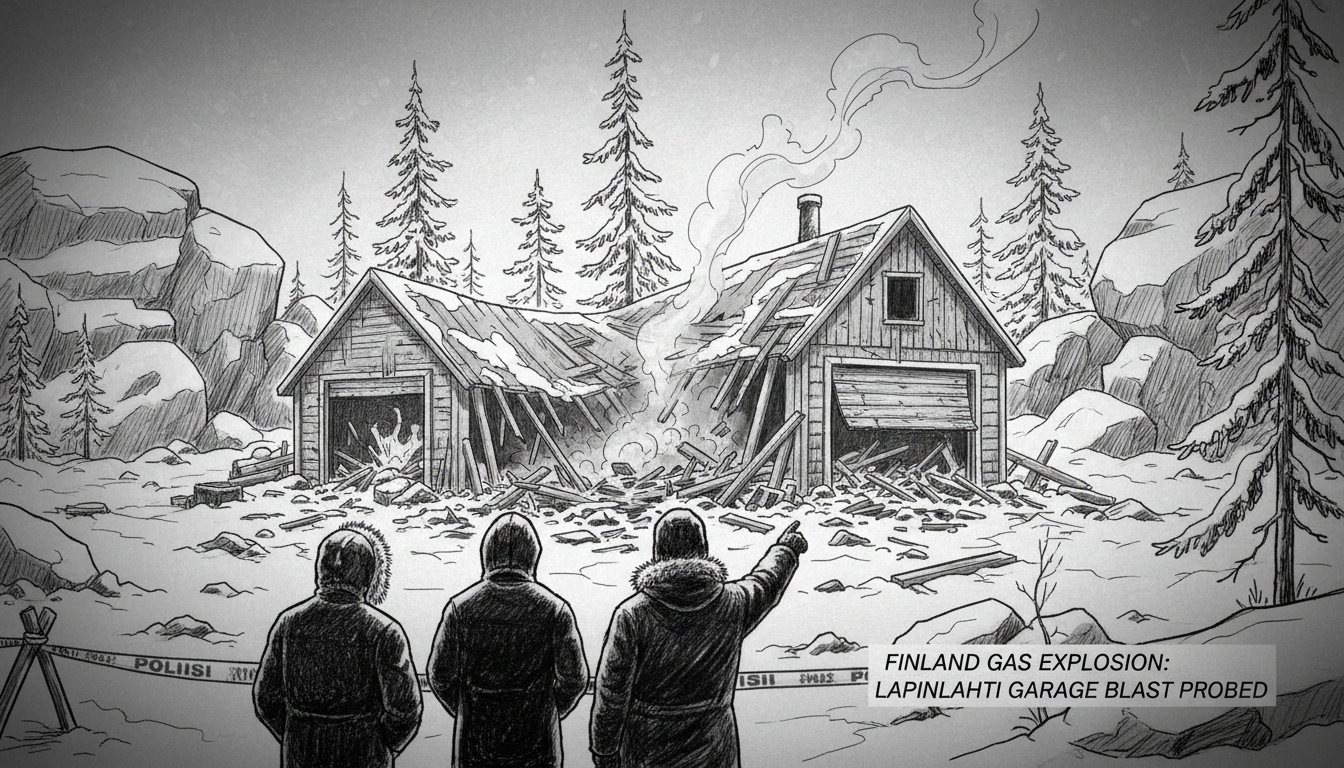
Finland's North Savo region witnessed a dramatic but fortunate escape when a powerful explosion ripped through a residential garage in Lapinlahti on Saturday. Police now suspect a leaking liquefied petroleum gas (LPG) cylinder, ignited by a spark from an electrical device, caused the blast that sent the structure's double doors flying onto a neighboring property. No injuries were reported in the incident, which has shifted focus to the common yet potentially hazardous use of gas cylinders in Finnish homes.
A Sudden Blast in a Quiet Community
The explosion occurred in a garage attached to a detached house in the municipality of Lapinlahti, a community of roughly 10,000 people. The force was substantial, detaching the garage's large double doors and propelling them across property lines. Emergency services, including police and rescue personnel, responded swiftly to the scene. Their initial assessment confirmed the absence of casualties, a fact authorities later highlighted as remarkably fortunate given the violence of the explosion. The immediate area was secured, and an investigation into the precise cause began.
Preliminary findings point squarely at a technical accident rather than any malicious intent. "The police and rescue department have ruled out the involvement of explosives in the events, and building technology could not have caused the explosion," investigators stated, narrowing the field of possible causes. The current working theory centers on a standard LPG cylinder, commonly used for grilling, heating, or workshop tools, which may have developed a leak.
The Mechanics of a Preventable Disaster
Investigators outlined a likely chain of events. They believe propane or butane gas leaked from the cylinder into the enclosed space of the garage. Without adequate ventilation, the flammable gas accumulated, creating an invisible, volatile mixture with the air. A single spark from an electrical device—which could be anything from a refrigerator compressor kicking in to a light switch being flipped—then provided the necessary ignition source. In a confined space, the resulting combustion happens almost instantaneously and with explosive force, creating a pressure wave capable of causing severe structural damage.
"A complete certainty about the cause of the explosion may not be obtained," police cautiously noted, indicating that while the gas cylinder is the prime suspect, definitive proof can be elusive in such incidents. Further technical examinations of the cylinder and the scene are ongoing. This sequence underscores a critical safety message familiar to experts but sometimes overlooked in everyday life: proper storage and handling of LPG are non-negotiable.
LPG in Finland: A Staple with Inherent Risks
Liquefied petroleum gas is deeply integrated into Finnish life, particularly in rural and suburban areas not connected to the main natural gas grid. Its uses are diverse, powering patio heaters, barbecues, camping stoves, and even some vehicle conversions. For workshops and garages, portable LPG cylinders often fuel heaters or specific tools. Its widespread availability and utility, however, come with a responsibility to understand its properties. LPG is heavier than air, meaning leaking gas will sink and pool in low-lying, enclosed areas like cellars, boat hulls, or garage floors, waiting for an ignition source.
Finnish safety regulations governing the storage, transportation, and use of LPG are stringent, developed precisely because of its flammable and explosive nature. These rules cover cylinder certification, connection equipment, and guidelines for use. Yet, as this incident illustrates, the final link in the safety chain is always the individual user. A worn hose, a faulty regulator, or a cylinder stored incorrectly indoors can compromise all the built-in engineering safeguards.
Expert Warnings and Safety Protocols
Safety experts consistently emphasize several key rules to prevent such accidents. First is ventilation. LPG cylinders should ideally be used and stored outdoors. If they must be temporarily indoors for use—such as with a portable heater—constant and ample ventilation is absolutely crucial to prevent gas buildup. Second is leak prevention and detection. Regular inspection of hoses, seals, and valves for wear and tear is essential. The familiar "soapy water" test, where a soap solution is applied to connections to check for forming bubbles that indicate a leak, is a simple and effective DIY method.
Third is the control of ignition sources. Any area where LPG is used or stored must be kept free from obvious spark risks. This includes open flames, cigarettes, and electrical equipment that is not specifically rated for use in explosive atmospheres. Experts also advise never to store spare cylinders in basements, garages attached to living spaces, or other enclosed areas without dedicated, permanent ventilation. The Lapinlahti event serves as a textbook case of what can happen when these protocols fail: a contained leak, an enclosed space, and an incidental spark.
A Narrow Escape and a Community Reminder
The most significant takeaway from the Lapinlahti explosion is the sheer luck that no one was hurt. Had the explosion occurred while someone was retrieving an item from the garage, or had the debris flown in a different direction, the outcome could have been tragic. The incident transforms from a mere news item into a potent community safety reminder. It highlights that the potential for serious domestic accidents exists in common household items, reinforcing the need for ongoing public awareness campaigns about gas safety.
For residents in Lapinlahti and beyond, the sound of the blast is a wake-up call. It prompts questions about how and where they store their own gas cylinders, the condition of their equipment, and their awareness of what to do if they smell gas—which is to evacuate immediately, avoid creating sparks, and call emergency services from a safe distance. While police continue their technical investigation, the broader investigation for the public is a personal one: a check of their own practices against known safety standards.
The Path Forward from the Blast Site
As the investigation proceeds, the focus will remain on confirming the technical cause. However, the broader conversation has already shifted to prevention. Can safety information regarding LPG, which is often provided when purchasing equipment or cylinders, be made more prominent and effective? Is there a role for local rescue services to offer more community outreach on this specific risk? The incident proves that even with robust regulations, human factor and routine complacency can create dangerous gaps.
The Lapinlahti garage will be repaired, and the doors replaced. But the memory of the explosion will linger as a case study in near-miss disaster. It underscores a universal principle of safety: the most dangerous threats are sometimes the ones we live with comfortably every day, until a spark changes everything. The final report from authorities will provide details, but the lasting lesson is clear—vigilance with flammable materials is not optional, it is the essential barrier between a close call and a catastrophe.