
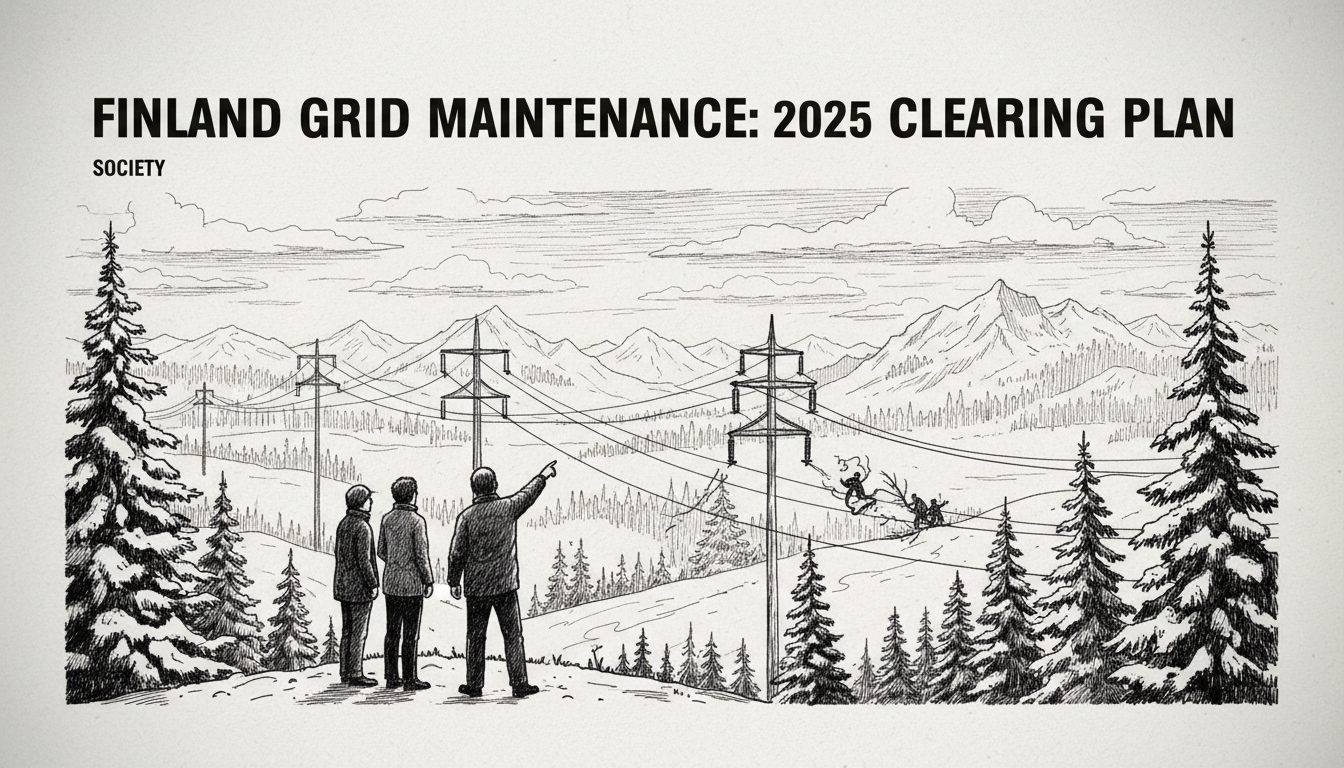
What does it take to keep Finland's electricity flowing when winter storms rage through its endless forests? Finland's 150,000-kilometer distribution grid requires clearing vegetation from thousands of hectares annually to prevent widespread blackouts. Kymenlaakson Sähköverkko Oy (Ksoy) has now announced a significant vegetation management operation scheduled for late 2025, targeting key municipalities in the Kymenlaakso region. This routine yet critical work underscores the relentless effort needed to maintain power stability in a nation where nature constantly tests infrastructure limits.
Ksoy, the regional grid operator, will conduct 'alustaraivaus' or ground clearing under power lines in Hollola, Orimattila, Myrskylä, and parts of Lapinjärvi and Elimäki. Operations are set to begin in December 2025, weather permitting, and continue throughout 2026. The contractor Puu ja Kaato Oy will handle the logging and removal work. Importantly, Ksoy assures customers that this maintenance will not cause power distribution interruptions or require any action on their part.
The Invisible Infrastructure Battle
Finland's electricity grid is a sprawling network traversing dense boreal forests. Every year, heavy snowfall, ice storms, and strong winds bring trees down onto power lines, causing outages that can isolate communities and halt industry. The Finnish Energy Authority mandates regular vegetation clearance around power lines to mitigate these risks. This legal framework ensures grid operators like Ksoy proactively manage forest growth within designated safety corridors. Failure to do so can result in fines and, more critically, vulnerable infrastructure during extreme weather events familiar to every Finn.
The upcoming clearing in Kymenlaakso is a standard part of this cycle. It focuses on the area directly beneath power lines, removing trees and shrubs that could encroach on conductors. While seemingly mundane, this work is a frontline defense against disruption. Historical data shows that a majority of weather-related outages in Finland originate from vegetation contact with lines. The 2025-2026 schedule aligns with typical planning horizons, allowing contractors to mobilize equipment and coordinate with landowners.
Engineering Reliability in a Harsh Climate
Experts frame vegetation management as a cost-effective investment in grid resilience. "Proactive clearing is far cheaper than emergency repairs after a storm," explains a grid reliability specialist familiar with Nordic conditions. "It reduces outage frequency, duration, and associated economic losses." In Finland, where temperatures can plummet below -30°C, a reliable power supply is not just about convenience—it is about survival and economic continuity.
This maintenance also supports Finland's broader energy transition. As the country integrates more wind and solar power, a stable grid is essential for balancing intermittent renewable sources. Furthermore, increasing electrification of transport and heating raises overall electricity demand, making grid reliability even more paramount. The work in Kymenlaakso, therefore, fits into a national strategy to future-proof energy infrastructure. It receives implicit support across the political spectrum in Helsinki, from the National Coalition Party to the Social Democrats, all recognizing energy security as a non-negotiable priority.
Local Execution with National Implications
Ksoy's contract with Puu ja Kaato Oy highlights the localized nature of grid upkeep. The contractor will employ forestry machinery and crews to clear designated swathes of land. All removed wood is typically processed as biofuel or timber, contributing to Finland's circular bioeconomy. Residents in the affected municipalities will see activity in forested areas near power lines but should experience no direct impact on their electricity service.
From a policy perspective, such projects align with EU directives on critical infrastructure protection and the internal energy market. Finland often cites its rigorous grid maintenance as a model for forested regions across the Nordics and Baltic states. The Eduskunta, Finland's parliament, periodically reviews energy legislation to ensure maintenance standards keep pace with climate change, which is intensifying storm patterns. The 2025 clearing plan is a tangible result of these ongoing policy commitments.
Beyond the Chainsaws: A Strategic Necessity
While the clearing operation is scheduled for late 2025, planning is already underway. Ksoy must navigate environmental regulations, landowner agreements, and biodiversity considerations. In some areas, selective clearing is practiced to preserve ecological value while ensuring safety. This balance reflects Finland's dual commitment to industrial modernity and environmental stewardship.
The financial allocation for such projects is embedded in grid operators' regulated asset bases, with costs reflected in network charges. Customers ultimately fund this reliability, but the alternative—more frequent and prolonged blackouts—is universally deemed unacceptable. As one Finnish energy minister recently noted in a parliamentary debate, "We are not just maintaining lines; we are maintaining trust in our society's basic functions."
A Continuous Vigilance
Finland's approach to grid maintenance is characterized by continuous vigilance rather than dramatic interventions. The Kymenlaakso clearing plan is one thread in a larger tapestry of upkeep happening across the country every year. It represents a pragmatic, unglamorous, but utterly essential component of national infrastructure.
As Finland looks toward a future of increased electrification and renewable energy, the humble task of clearing trees under power lines remains a cornerstone of energy security. The 2025 operation in Kymenlaakso is a reminder that in the Nordic world, resilience is often built not through grand innovations, but through meticulous, year-after-year stewardship of the systems that power modern life. Will other nations with similar forested landscapes take note of this sustained commitment?