
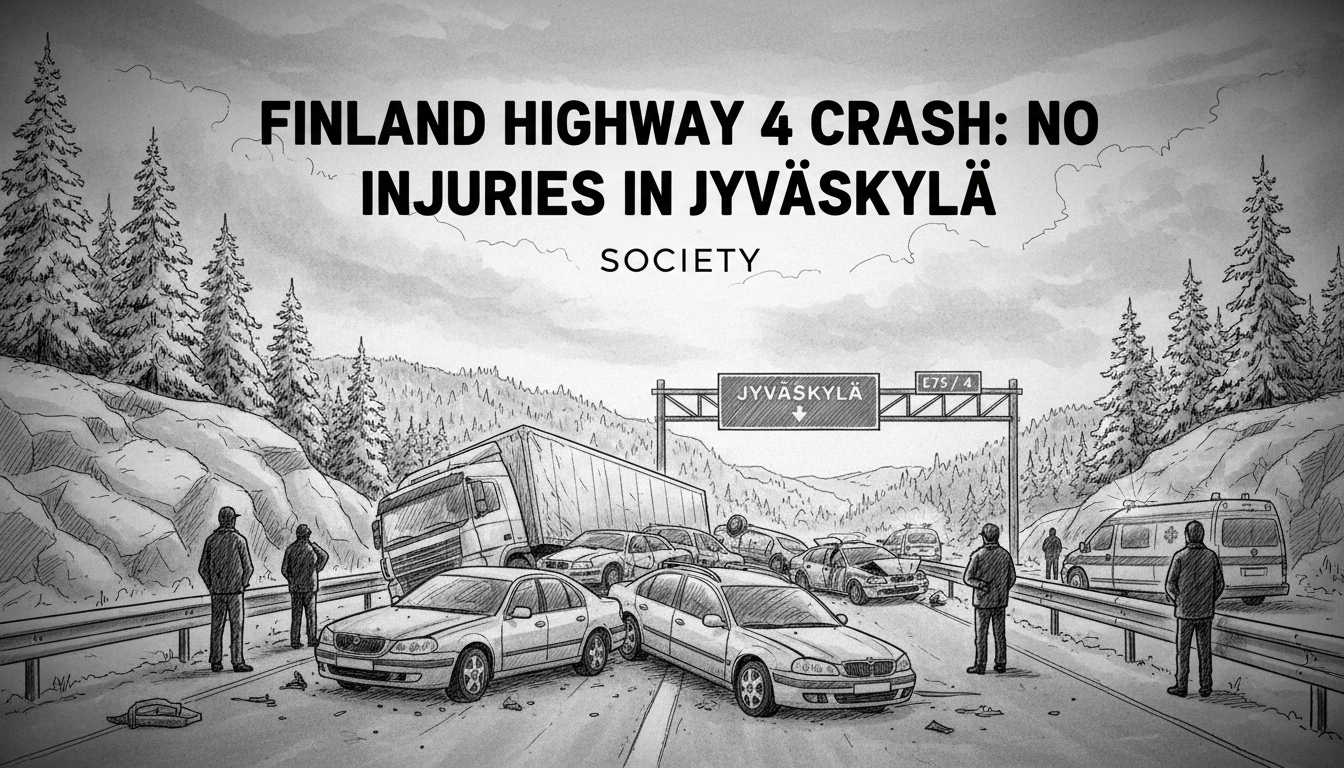
Finland traffic accident statistics gained a minor data point on Thursday afternoon with a rear-end collision on Highway 4 near Jyväskylä. Two cars traveling northbound from Southern Finland collided in a roundabout at Kanavuori in the Vaajakoski district. The Keski-Suomen rescue department confirmed no personal injuries resulted from the crash, and both vehicles remained drivable. By 3:00 PM, traffic flow on the crucial E75 European route had returned to normal, leaving only a brief disruption and a stark reminder of Finland's ongoing road safety challenges.
This incident, while minor, occurred on one of Finland's most significant and heavily trafficked arteries. Highway 4, designated as European route E75, stretches over 1,295 kilometers from Helsinki to Utsjoki in Lapland. It serves as the nation's longitudinal spine, connecting the southern capital region with central hubs like Jyväskylä, Oulu, and Rovaniemi before reaching the northernmost reaches of Finnish Lapland. The roundabout at Kanavuori, where the collision took place, is a familiar junction for thousands of daily commuters and long-haul drivers navigating between Jyväskylä and its surrounding suburbs.
A Close Call on a Critical Corridor
Initial reports from rescue officials described a straightforward rear-end collision. The two vehicles were entering the roundabout when the trailing car failed to maintain a safe distance or adequately slow down, leading to impact. The fact that both cars could be driven from the scene indicates relatively low speed, a fortunate circumstance that likely prevented injuries. This type of accident is among the most common on Finnish roads, often attributed to momentary inattention, misjudgment of speed, or following too closely.
"Roundabouts are designed to improve safety by slowing traffic and eliminating high-speed crossing conflicts, but they require drivers to be alert and anticipate the flow," explained a senior traffic safety consultant with the Finnish Transport and Communications Agency, Trafi. "The transition from a high-speed highway like E75 into a roundabout is a critical point. Drivers must actively decelerate, observe right-of-way, and be prepared for vehicles ahead to slow or stop. A lapse in focus for just a few seconds is all it takes."
Finland's Road Safety Landscape in Focus
The Jyväskylä incident, though non-fatal, brings Finland's broader road safety performance into sharp relief. In 2023, 343 people lost their lives in road traffic accidents across the country. A concerning 42% of those fatal accidents occurred on main roads like Highway 4. While Finland consistently ranks among the safer countries for road travel in global comparisons, these figures represent a persistent challenge for authorities. Each minor crash, like the one in Vaajakoski, serves as a potential precursor to more serious outcomes under slightly different conditions.
National and EU-level policies continuously shape Finland's approach to road safety. The Finnish government's current road safety strategy, aligned with the EU's "Vision Zero" ambition to eliminate road deaths and serious injuries, focuses on infrastructure, vehicle technology, and driver behavior. On highways like E75, this includes ongoing projects to add median barriers, improve lighting and signage, and modify dangerous intersections. The roundabout at Kanavuori itself is an example of such infrastructure, intended to be safer than a traditional signalized or priority intersection.
The Human Factor in a High-Tech Era
Despite advanced infrastructure, the human element remains the most unpredictable variable. Experts point to driver distraction, fatigue, and failure to adapt to conditions as perennial issues. The stretch of Highway 4 approaching Jyväskylä from the south is a typical Finnish highway scenario: long, relatively straight sections that can lead to complacency, followed by sudden demands for increased attention near urban areas.
"Modern cars are quieter, more comfortable, and better insulated, which can insulate the driver from a sense of speed and urgency," the Trafi consultant noted. "When you combine that with the monotony of a long drive, the cognitive load required for a task like navigating a roundabout can be underestimated. It's not just about skill; it's about sustained engagement."
Finnish driving education, renowned for its rigor, emphasizes hazard perception and anticipation. New drivers undergo extensive training on slippery surfaces at special facilities, preparing them for the country's harsh winter conditions. However, reinforcing safe habits among experienced drivers remains an ongoing effort. Public awareness campaigns by Trafi and organizations like the Finnish Road Safety Council (Liikenneturva) frequently highlight the dangers of tailgating and inattention.
Infrastructure and Enforcement: A Dual Approach
The Finnish government and local municipalities employ a dual strategy of engineering and enforcement to mitigate risks. Police conduct regular speed and safety control campaigns on major routes, including Highway 4. Automated speed cameras are deployed at known high-risk locations. Meanwhile, the Finnish Transport Infrastructure Agency (FTIA) is tasked with continuously evaluating and upgrading road networks.
For the E75 corridor, several major development projects are planned or underway to increase capacity and safety. These include bypasses around smaller towns to divert through-traffic and the expansion of certain sections to four lanes. The goal is to reduce conflict points and minimize interactions between high-speed long-distance travel and local access roads. Every roundabout, intersection, and merge lane is scrutinized through a safety lens, often using collision data from non-injury incidents to identify patterns that could lead to future tragedies.
A Near-Miss as a National Lesson
The Kanavuori roundabout collision is a textbook example of a high-frequency, low-severity event that safety analysts study closely. The absence of injuries is a positive outcome, but the event itself is a failure of the road safety system. It represents a moment where the layers of protection—driver alertness, vehicle spacing, road design, and signage—were breached. In a slightly different scenario, with higher speeds, poorer weather, or a motorcycle or cyclist involved, the headlines could have been tragically different.
Finland's ambitious target is to halve the number of road deaths and serious injuries by 2030 from the 2020 level. Achieving this requires learning from every incident. Non-injury crashes provide valuable, low-cost lessons. They highlight specific locations where driver behavior consistently falters, signaling where additional measures—be it enhanced signage, altered road markings, or even redesign—might be necessary.
As traffic flowed normally again through Vaajakoski on Thursday afternoon, the temporary disruption faded from memory for most. For traffic planners and safety advocates, however, the record of the event enters a vast database. It becomes one more point on a map, one more instance informing the slow, meticulous, and vital work of making Finland's long, dark roads safer for everyone. The ultimate question remains: how many near-misses must occur before human behavior consistently aligns with the safety built into the infrastructure itself?