
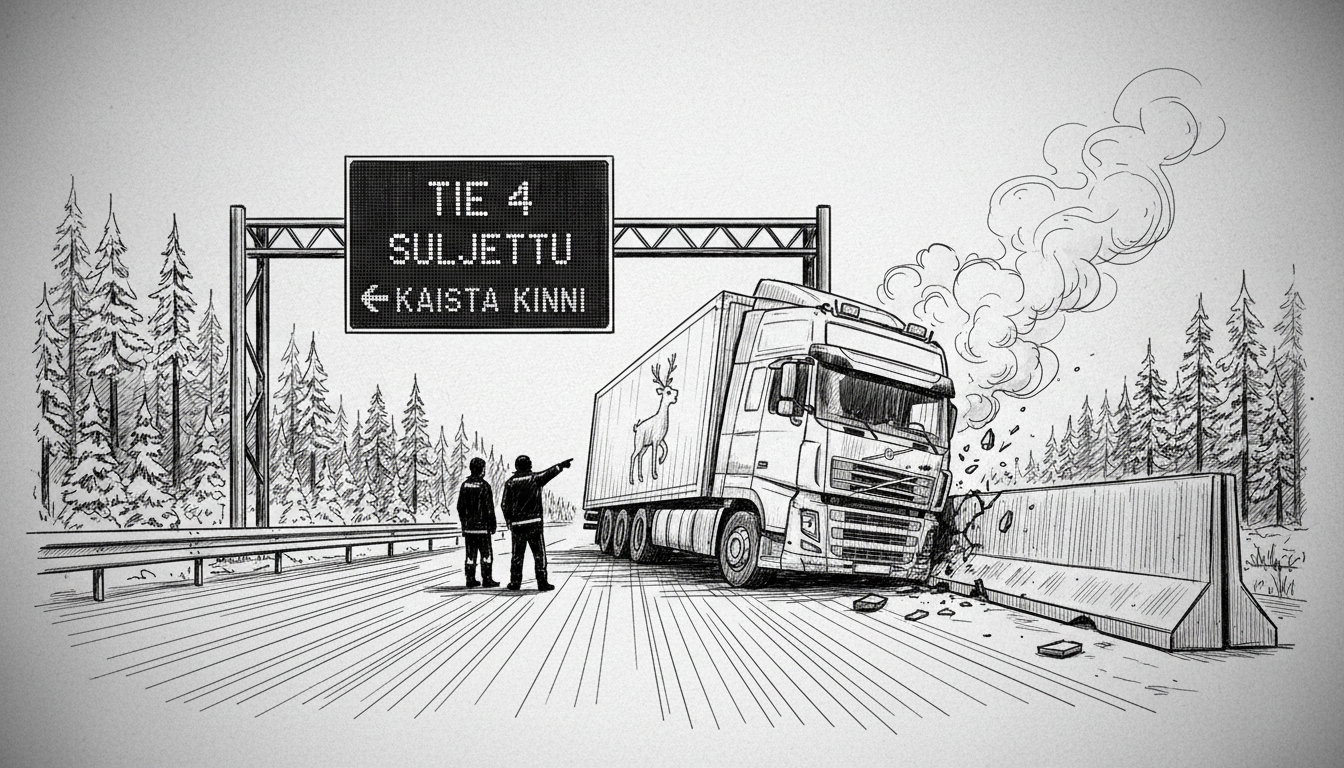
Finland's vital Highway 4 faced significant disruption Tuesday morning after a northbound truck collided with the central barrier near Äänekoski. The emergency call came in just after 10 AM, with initial reports confirming one lane was blocked due to the crash. The Finnish rescue service stated no personal injuries occurred in the incident, which happened on the stretch between the southern and northern interchanges of Konginkangas.
This single-vehicle accident on the E75 route, a critical artery for national and European freight, highlights the persistent challenges of maintaining traffic flow and safety on Finland's long-haul corridors. While avoiding casualties is a positive outcome, such incidents trigger immediate logistical headaches and prompt deeper questions about road safety protocols.
A Critical Artery Temporarily Severed
Highway 4, designated as European route E75, is Finland's longitudinal backbone. It runs over 1,295 kilometers from Helsinki to Utsjoki in the far north, connecting the country's economic hubs with its remote regions. The section near Äänekoski, in the Central Finland region, is a well-traveled segment for both commercial and passenger vehicles. The Finnish Transport Infrastructure Agency (Väylävirasto) was quickly tasked with managing the traffic fallout and assessing damage to the barrier.
"Our primary information indicates one driving lane is out of service due to the collision with the barrier," a representative from the Central Finland Rescue Department said in their initial statement. The immediate operational focus was on securing the scene, preventing secondary accidents, and initiating clearance. For hours following the crash, motorists faced delays and were advised to seek alternative routes or prepare for slow-moving traffic past the incident site.
The Broader Context of Finnish Road Safety
While this particular crash resulted in no injuries, it occurs against a backdrop of ongoing national efforts to improve road safety. Finland recorded 334 road traffic fatalities in 2023, a number authorities are constantly working to reduce. Heavy goods vehicles, like the truck involved in this Äänekoski incident, were part of 13% of all injury-causing accidents in Finland last year. This statistic underscores the disproportionate impact a single truck incident can have, both in terms of potential severity and the scale of disruption.
Traffic safety experts consistently point to a combination of factors in such accidents. "On long, straight stretches of highway like much of the E75, driver fatigue can become a significant risk factor," notes a Helsinki-based transport safety researcher who preferred not to be named. "Combine that with variable winter conditions, including sudden ice patches or reduced visibility, and the margin for error shrinks dramatically. Maintaining safe following distances and ensuring vehicle roadworthiness, especially tire quality, are not just recommendations—they are essential defenses."
Economic and Logistical Ripple Effects
The closure of a lane on Highway 4 is not merely a local traffic nuisance. This route is a major conduit for freight moving from the Port of Helsinki and other southern hubs to northern Finland and into Norway. Delays caused by accidents disrupt just-in-time supply chains, increase fuel costs for idling trucks, and create bottlenecks that can take hours to fully resolve. The Finnish Road Administration's real-time traffic services become crucial tools for logistics companies in these moments, allowing for dynamic rerouting.
For the region of Äänekoski and Konginkangas, such accidents are a reminder of their place on a major transit corridor. The village of Konginkangas, with its interchanges, serves as a key point of access and egress. Incidents here directly affect local commuters and businesses that rely on the predictable flow of goods and customers. The efficiency of the response by rescue services and road authorities is therefore closely watched by the local community.
Infrastructure and Prevention Strategies
This crash into a central barrier also brings infrastructure design into focus. Modern safety barriers are engineered to absorb impact and redirect vehicles, preventing cross-over collisions which are often more severe. The fact this truck was contained likely prevented a more serious multi-vehicle incident. The Väylävirasto will inspect the damaged section to determine if repair or replacement is needed and to evaluate if the barrier performed to specification.
Prevention, however, remains the ultimate goal. National campaigns emphasize driver awareness, particularly regarding fatigue on long journeys. For professional truck drivers, strict EU-regulated driving and rest times are legally enforced, though monitoring remains a challenge. Technological aids like lane departure warnings and automatic emergency braking are becoming more common in new truck fleets and could mitigate similar incidents in the future.
A Near Miss with Lessons to Offer
The Äänekoski incident concluded as a best-case scenario within a bad situation: significant property damage and traffic disruption, but no human cost. It serves as a tangible case study for safety advocates and transport planners. Each such event provides data on crash dynamics, response times, and the economic impact of corridor closures.
As Finland continues to invest in its transport network, balancing the need for efficient freight movement with unwavering safety standards is a constant parliamentary and ministerial discussion point in Helsinki. The near-miss on Highway 4 this Tuesday is a stark reminder that on a road connecting the Baltic to the Arctic, vigilance cannot take a break. The question for authorities and transport companies alike is how to convert the lessons from this disruption into systemic improvements that prevent the next one.