
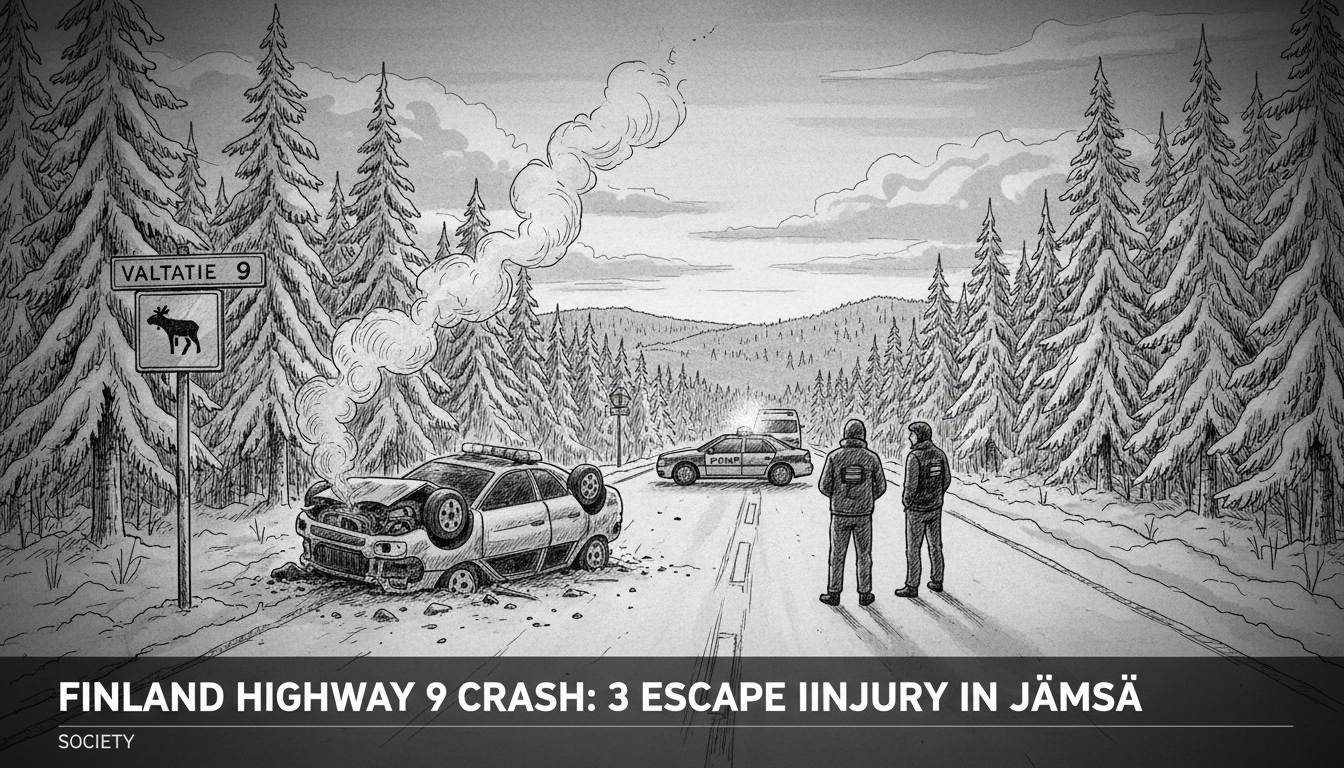
Finland car accident reports from Jämsä detail a non-injury crash on a major national artery. A passenger car spun and collided with a guardrail on Tampereentie, also known as Highway 9, on Monday evening. Three occupants emerged physically unharmed. The incident, reported to emergency services at 18:22, required police and rescue units to manage traffic flow on the busy highway's passing lane.
A Close Call on a Critical Corridor
While the outcome was fortunate, the location underscores the incident's potential for greater disruption. Tampereentie is not just a local road; it is Highway 9, a principal route connecting Finland's western coast to the eastern interior. It links major cities including Turku, Tampere, Jyväskylä, Kuopio, and Joensuu. This highway is a vital channel for national logistics, commercial transport, and daily commuter traffic. An accident causing lane closures or significant debris can create ripple effects, delaying freight and travelers across a wide region.
“Every incident on a main highway like this has a cost beyond the immediate scene,” explains a Finnish road safety analyst familiar with traffic management. “The response itself—deploying emergency vehicles, setting up traffic control—creates a bottleneck. For a logistics company moving goods from the port of Turku to a factory in Kuopio, even an hour's delay has financial implications. The fact no one was injured is the best news, but the system still felt the impact.”
The Unseen Costs of Minor Collisions
Finland's transport authorities monitor these events closely, as they provide data on risk patterns. A single-vehicle loss of control, resulting in a guardrail impact, is a common report, especially during seasonal transitions. Autumn in Finland brings shorter days, frequent rain, frost, and the first snowfalls—all factors that dramatically alter road conditions. Drivers adjusting to reduced grip are a primary focus for safety campaigns.
“We often see a spike in these types of incidents in October and November,” the analyst notes. “It’s a period where road conditions can change hourly, but driver behavior sometimes lags. A road that was merely wet at lunchtime can be icy by dusk. The guardrail did its job in Jämsä—it prevented a potentially more serious departure from the roadway—but it’s a warning sign. It signals a loss of control that, under slightly different circumstances, could have been severe.”
The economic argument for road safety is powerful in a country dependent on efficient transport. Finland’s infrastructure must withstand long, harsh winters, and maintenance is a constant, costly effort. Each guardrail strike, while preferable to a worse outcome, represents damage to public infrastructure that requires assessment and repair, diverting resources from other projects.
Winter Readiness: A National Imperative
This incident occurs as Finland enters the critical period for winter tire changeover. Finnish law mandates winter tires from December 1st to the end of February, but experts and authorities universally recommend their use from October through April, depending on conditions. The right tires are not just a legal checkbox; they are the most significant factor in vehicle control on snow and ice.
Beyond equipment, adjusting driving style is non-negotiable. Increased following distances, smoother steering and braking inputs, and heightened awareness of shaded areas where black ice forms are essential skills. For commercial fleets, this often means mandatory training for drivers. The three individuals in the Jämsä incident benefited from the fundamental safety systems of their vehicle and the roadside hardware. Their experience serves as a timely, real-world reminder for all road users.
“The takeaway is never to become complacent,” says the analyst. “A non-injury crash is often dismissed as ‘nothing happened.’ But it is a very clear signal that something did happen—control was lost. Investigating that ‘why’ personally—was it speed for conditions, a distraction, tire quality?—is how we prevent the next one from having a different headline.”
Infrastructure and Response: The Safety Net
The effective response by Jämsä's emergency services highlights another layer of Finland's road safety ecosystem. A swift, coordinated reaction prevents secondary incidents—a major risk when traffic suddenly slows or stops on a high-speed highway. Finnish rescue and police units train extensively for these scenarios, aiming to secure scenes rapidly, assist those involved, and restore normal traffic flow with minimal delay.
Guardrails, like the one struck in this accident, are a final piece of the physical safety infrastructure. Their design and placement are calculated to redirect a vehicle, absorb impact energy, and prevent it from crossing into oncoming traffic or leaving the roadway entirely. They are a last line of defense, and their widespread deployment on highways like Tampereentie is a testament to a safety philosophy that prioritizes harm reduction even when driver error occurs.
A Near-Miss as a Nationwide Reminder
As darkness falls earlier and temperatures dip, Finland's driving environment becomes more demanding. The Jämsä incident is a microcosm of a nationwide seasonal shift. It is a story with the best possible outcome given the circumstances: property damage without physical harm. Yet, it carries a weighty message for the thousands of drivers and transport companies who depend on Highway 9 and similar routes.
The resilience of Finland's society and economy is tied to mobility. Ensuring that mobility is safe, especially during the challenging winter months, is a shared responsibility. It falls on individual drivers to prepare their vehicles and adjust their habits. It falls on companies to enforce safe practices for their fleets. And it relies on the continuous work of traffic planners, infrastructure maintainers, and emergency responders who build and activate the safety net. This single Monday evening crash in Jämsä, now closed as a case file, is a small but clear data point in that vast and ongoing effort. Will its primary legacy be a repaired guardrail, or a broader moment of caution for drivers across the country?