
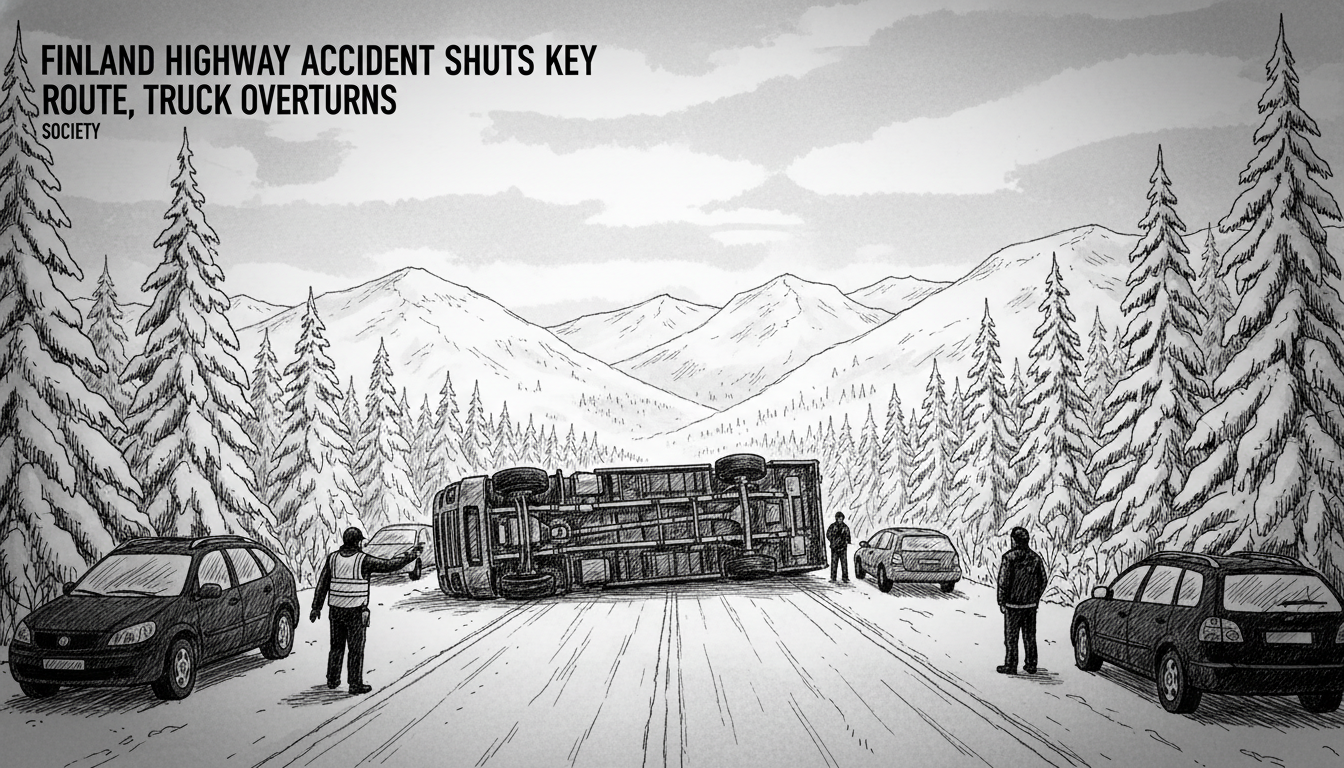
Finland's crucial Highway 4 was blocked near Viitasaari early Monday after a freight truck carrying a load of window panes veered off the road and into a ditch. The accident occurred shortly before 4:00 AM, triggering a complex recovery operation expected to cause significant traffic disruptions along the main north-south artery. The incident underscores the fragility of Finland's long-distance transport network, especially on key European routes like the E75, which Highway 4 forms a part of in Finland.
Dawn Accident on a Vital Artery
The truck, traveling on the section of Highway 4 that runs through the Central Finland municipality of Viitasaari, left the roadway for reasons still under investigation by local police. No other vehicles were involved, and initial reports indicate the driver survived the crash. The cargo of fragile window glass complicates the recovery, requiring careful clearing to avoid further hazards on the roadside. Emergency services, including tow operators and traffic management units, were quickly dispatched to the remote scene to begin the lengthy process of righting the heavy vehicle and clearing the wreckage.
This stretch of road is a critical link for freight moving between the Helsinki region and northern Finland. Any closure creates immediate logistical challenges for the transport industry. The Finnish Transport Infrastructure Agency (Väylävirasto) is coordinating the recovery, prioritizing safety but also aiming to restore traffic flow as swiftly as possible. Drivers were immediately advised to seek alternative routes, with warnings that delays would be substantial throughout the morning commute and potentially longer.
The Ripple Effects of a Single Crash
Accidents involving heavy goods vehicles on primary highways like Nelostie have disproportionate consequences. Beyond the immediate safety response, they test the resilience of regional traffic planning. Central Finland's road network offers limited high-capacity alternatives to Highway 4, meaning diversions often channel vehicles onto smaller regional roads not designed for high volumes of through-traffic. This increases travel times significantly and can elevate accident risks on unfamiliar, narrower routes for diverted drivers.
Professor Heikki Liimatainen, a specialist in transport systems at Tampere University, notes the broader economic impact. "A major blockage on Highway 4, even for a few hours, disrupts just-in-time supply chains for industries and retail," he explained in an interview. "The costs ripple through the economy, from delayed manufacturing components to spoiled perishable goods in other trucks stuck in the backlog. It highlights our dependency on a very limited number of north-south corridors."
The early morning timing of this crash, while minimizing initial exposure to peak passenger traffic, complicates the logistics of the recovery itself. Specialized heavy lifting equipment must be transported to the site, which can take hours from major urban centers. Daylight is a critical factor for safe recovery operations, meaning work likely intensified after sunrise, extending the closure period into the heart of the business day.
A Systemic Challenge for Finnish Logistics
This incident is not an isolated one. Finland's geography, with its long distances and concentrated population centers in the south, makes its main highways like the number 4, 5, and 7 exceptionally vital. They are lifelines for communities and commerce in the less densely populated regions. Each accident prompts an evaluation of road safety measures, driver fatigue policies, and infrastructure hardening. The European E-road network, designed to facilitate international transport, channels heavy transnational trucking onto these same Finnish roads, increasing wear and traffic density.
From a policy perspective, the Finnish government and the Eduskunta have continuously debated investment in parallel transport routes and rail freight capacity to alleviate pressure on these key highways. The current government's transport policy program includes maintenance and safety upgrades for existing highways, but major new parallel infrastructure projects face budgetary and environmental hurdles. This accident near Viitasaari will likely be cited in upcoming parliamentary discussions about allocating funds for road safety improvements and bypass constructions around critical towns.
Furthermore, the Finnish Centre for Transport Safety (Trafi) consistently emphasizes the role of driver conditions. Long, monotonous stretches of highway, especially during the night, are a known risk factor. While EU regulations govern driving hours and rest periods for professional drivers, enforcement and the physical reality of Finland's long hauls remain a constant challenge for logistics companies and authorities alike.
Looking Beyond the Immediate Cleanup
As recovery crews worked to clear the scene near Viitasaari, the incident served as a stark reminder. Finland's economic connectivity and regional cohesion rely heavily on the uninterrupted operation of just a few critical roads. Each accident is a stress test for the entire system, revealing both the efficiency of emergency response and the inherent vulnerabilities of a nation with such a demanding geography. The successful and safe clearing of the crash site is the immediate goal, but the longer-term conversation about diversifying transport corridors and enhancing active safety systems on these highways continues unabated in Helsinki's policy circles. The question remains: how can Finland better future-proof its essential arterial routes against the inevitable disruptions caused by accidents, weather, and increasing traffic volumes?