
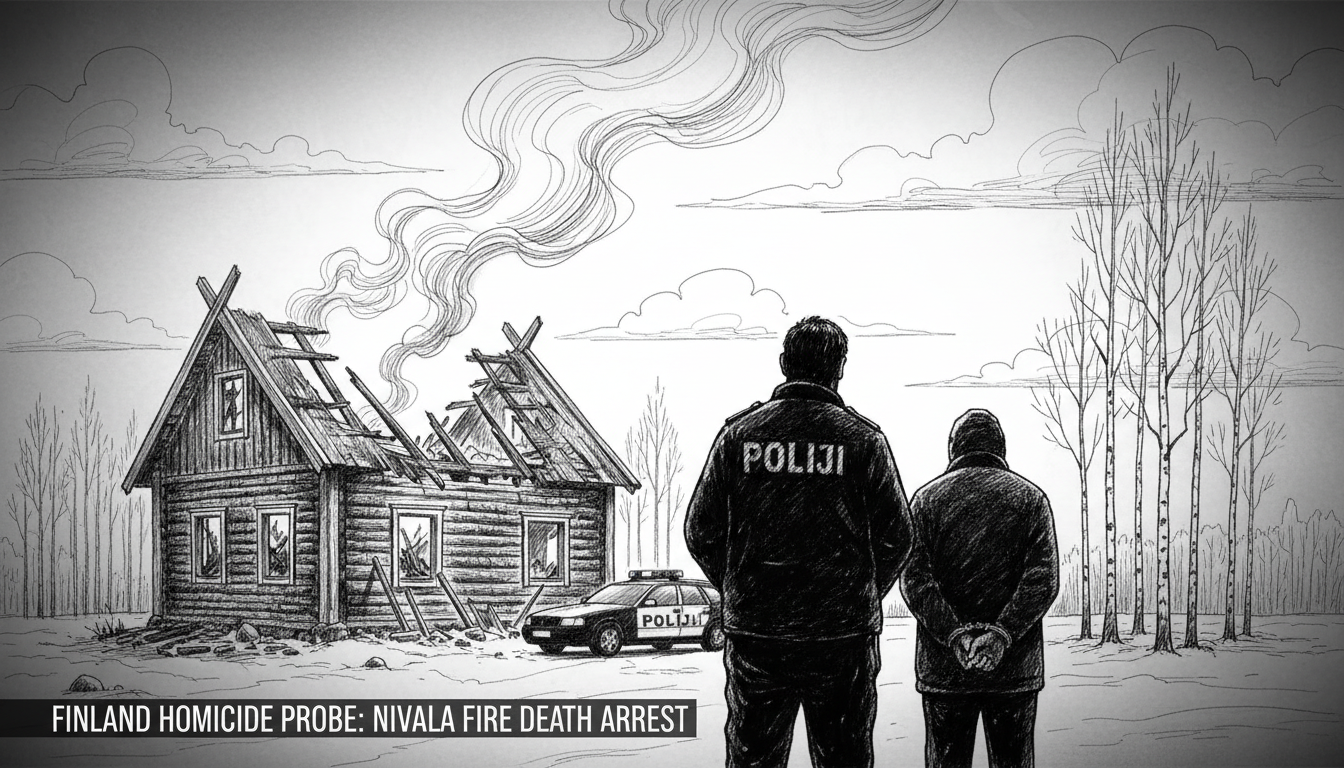
Finland's Oulu Police Department has launched a homicide investigation following a fatal house fire in the town of Nivala last Friday. Authorities arrested a man born in the 1960s on suspicion of murder after forensic work over the weekend shifted the case from a tragic accident to a potential violent crime. The incident, occurring in a typically quiet rural municipality, has sent shockwaves through the local community and prompted a detailed examination of violent crime patterns in Finland's northern regions.
Flames engulfed the residential building on Friday afternoon, with emergency services arriving to find the structure already fully ablaze. Firefighters discovered one deceased individual inside the burned-out home. While initial reports pointed toward a accidental fire, police investigators spent the weekend meticulously processing the scene. By Sunday, their findings led them to conclude there were grounds to suspect homicide, fundamentally altering the nature of the inquiry.
A Quiet Community Confronts a Violent Crime
Nivala, a municipality of approximately 10,000 residents in the North Ostrobothnia region, is an area known for its agriculture and peaceful character. Violent crimes, particularly homicides, are statistically rare in such Finnish rural communities. The arrest of a local man in connection with the fire death represents a profound disruption to the community's sense of security. Local police have released limited information, citing the ongoing preliminary investigation, but confirmed the suspect is a Finnish national from the Nivala area.
“The police have taken a man born in the 1960s into custody on suspicion of homicide,” the Oulu Police Department stated in its official release. The statement emphasized that the investigation is active and no further details regarding motive or the relationship between the suspect and the victim are currently being disclosed. This careful approach is standard in Finnish criminal procedure, designed to protect the integrity of the investigation and the rights of all involved.
Forensic Science and the Path to Suspicion
The pivot from a fire investigation to a homicide probe hinges on forensic evidence collected at the scene. Determining the cause and origin of a fire, especially one that causes significant structural damage, requires expert analysis. Fire investigation units, often working alongside criminal police, look for indicators of accelerants, ignition points inconsistent with accidental causes, and evidence of forced entry or struggle prior to the blaze.
Criminologists note that such cases are complex. “A thorough forensic investigation is absolutely critical in a case like this,” explains Dr. Lasse Kivivuori, a leading criminologist at the University of Helsinki. “The fire itself destroys evidence, but it can also create patterns that reveal criminal intent. Investigators must reconstruct the events leading to the fire to distinguish between a tragic accident and a deliberate act of violence. The decision to arrest indicates they have found compelling evidence pointing toward the latter.”
This scientific, methodical approach is a hallmark of Finland's police work. The country's low annual homicide rate, which consistently sits between 1 and 2 incidents per 100,000 inhabitants, allows for significant resources to be dedicated to each serious case. The Nivala investigation will likely involve technical experts from the National Bureau of Investigation (Keskusrikospoliisi) to support the Oulu police district.
Contextualizing Violence in a Low-Crime Society
Finland's overall crime rate is low by international standards, but incidents of severe violence do occur, often linked to specific risk factors. While random violent crime is exceedingly rare, police and researchers identify domestic disputes, long-standing personal conflicts, and substance abuse as recurring contexts for homicides. These patterns hold true in both urban and rural settings, though the absolute numbers in the countryside are smaller.
The North Ostrobothnia region, where Nivala is located, does not stand out as a high-crime area within Finland. However, experts caution against overgeneralizing the safety of rural areas. “The statistical risk of being a victim of violent crime is lower in rural municipalities,” says Dr. Kivivuori. “But no community is immune. Isolated incidents can happen anywhere, and they are often more deeply felt in tight-knit communities where everyone knows each other. The social impact in Nivala will be significant and lasting.”
Finnish homicide investigations typically see high clearance rates, with police successfully identifying a suspect in the vast majority of cases. The swift arrest in Nivala suggests detectives moved quickly on credible evidence or witness accounts. The suspect will now be interrogated by investigators, and a district court will rule on a prosecutor's request for pre-trial detention within a few days of the arrest, as required by Finnish law.
The Legal Process Ahead
The suspect is currently in police custody. Under Finnish law, he can be held for a maximum of four days without a court order. Prosecutors must now prepare a detention hearing request, presenting evidence to a judge to justify keeping the individual in custody pending formal charges. The criteria include the severity of the suspected crime, the risk of flight, and the potential for interfering with the investigation.
If the court orders detention, the formal pre-trial investigation will intensify. This phase can take several months, during which police will gather all available evidence, interview witnesses, and consult forensic reports. The final decision on whether to prosecute will be made by a district prosecutor based on the completed investigation file. Only if the evidence is deemed sufficient will the case proceed to trial.
The victim's identity has not been publicly released, a common practice in Finland until immediate family members have been notified. The cause of death will be definitively established by a forensic pathologist during an autopsy, a standard procedure in all suspicious deaths. This autopsy will be pivotal, determining whether the victim died from smoke inhalation, burns, or trauma before the fire started.
A Community Seeks Answers
For the residents of Nivala, the incident is a stark reminder that tragedy can strike close to home. The combination of a fatal fire and a homicide arrest is particularly unsettling. Community leaders and social services will likely focus on providing support to those directly affected and to a community grappling with shock and grief.
The Finnish police's methodical, evidence-based response reflects a system built for thoroughness rather than speed of public announcement. As the investigation continues behind a veil of necessary secrecy, the people of Nivala are left waiting for answers that only a completed legal process can provide. This case will test the community's resilience and the justice system's capacity to uncover the truth amidst the ashes of a devastating fire.
The coming weeks will reveal whether this was an isolated, interpersonal tragedy or if it points to broader, if uncommon, social issues in rural Finland. For now, the focus remains on the meticulous work of investigators in Nivala, piecing together a narrative from charcoal and clues, seeking justice for a life lost in the flames.