
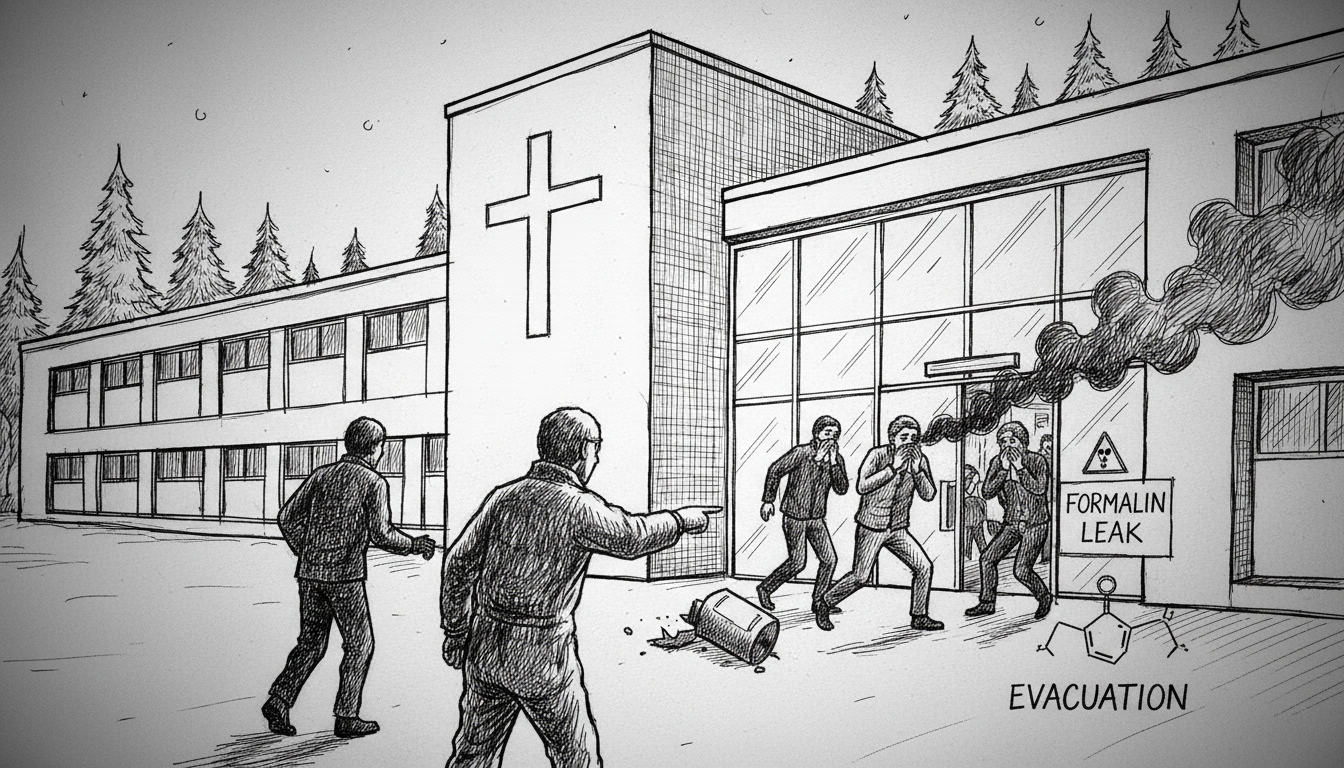
Finland's Kymenlaakso Central Hospital laboratory staff evacuated rapidly on Tuesday morning after the sharp, pungent odor of formalin filled the air. The incident, triggered by a broken ventilation system that failed to extract the hazardous gas, forced workers to flee their posts and call emergency services. No injuries were reported, but the event exposes critical fault lines in maintenance protocols for dangerous chemicals within vital public health infrastructure.
Jarno Rämä, Safety Manager for the Kymenlaakso wellbeing services county, confirmed the staff response was correct. “No personal injuries occurred. The employees acted according to instructions in the situation,” Rämä stated. His praise for the staff's adherence to procedure underscores a successful emergency response, yet it also redirects scrutiny toward the systemic failure that necessitated it. A functioning ventilation system is the primary defense in such settings, and its breakdown represents a significant safety lapse.
A Breakdown in First-Line Defense
The failed ventilation unit at the Kotka hospital served as the laboratory's first and most important containment measure. Formalin, a solution of formaldehyde gas in water, is a staple in medical labs for preserving tissue samples and disinfecting equipment. It is also a potent irritant and a classified carcinogen. Short-term exposure causes burning sensations in the eyes, nose, and throat, coughing, wheezing, and skin irritation. Prolonged or repeated exposure is linked to respiratory issues like asthma, allergic sensitization, and an increased risk of certain cancers, notably nasopharyngeal cancer and leukemia.
“This incident highlights a non-negotiable principle in industrial hygiene: engineering controls like ventilation must be fail-safe,” explains a Finnish occupational health specialist familiar with laboratory environments. “Personal protective equipment is your last line of defense. When the primary engineering control fails, you are relying on human response and emergency protocols, which introduces risk.” The specialist, who requested anonymity as they were not directly involved in the incident, emphasized that regular, documented inspection and maintenance of such systems is not just best practice but a mandatory requirement under Finnish and EU workplace safety directives.
Systemic Pressures and Safety Compliance
The Kymenlaakso incident did not happen in a vacuum. Finland’s public healthcare system, reorganized into wellbeing services counties (hyvinvointialueet) in 2023, operates under significant financial and operational strain. The reform aimed to curb rising costs and improve service integration but has been met with challenges, including concerns over resource allocation. Preventive maintenance of infrastructure, while crucial, can sometimes be deferred under budget pressures, creating potential vulnerabilities.
This event will likely trigger an internal investigation by the hospital’s safety committee and possibly a follow-up by the Regional State Administrative Agency (AVI), which oversees occupational safety. Their findings will determine whether the ventilation failure was due to a sudden mechanical fault, a missed maintenance schedule, or an underlying design flaw. The probe will also review the completeness of staff training on handling chemical emergencies beyond immediate evacuation.
“Training must be dynamic and scenario-based,” the occupational health expert adds. “It’s not enough to know you should leave. Staff need to recognize early warning signs—like unusual odors or air flow changes—before a full-scale leak develops, and they must know how to initiate immediate containment actions if safe to do so.”
The EU Regulatory Backdrop
Finland’s strict occupational safety laws are reinforced by European Union frameworks. The Carcinogens and Mutagens Directive (2004/37/EC) sets binding occupational exposure limits for formaldehyde, mandating that employer risk assessments lead to measures that eliminate or reduce exposure to as low a level as technically possible. The Seveso III Directive, governing major accident hazards involving dangerous substances, also influences how large stocks of hazardous chemicals are managed, though it typically applies to larger quantities than those found in a hospital lab.
Compliance is enforced through a combination of employer responsibility, employee safety representative oversight (a strong feature in Nordic labor models), and government inspection. The incident in Kotka will test this compliance chain. It raises questions about the efficacy of internal audit systems within the new wellbeing services counties and whether safety budgets have kept pace with operational demands.
A Close Call with Lasting Implications
The absence of injuries makes this a near-miss, but in safety management, a near-miss is a critical warning. It represents a free lesson in system failure. For the staff at Kymenlaakso Central Hospital, returning to the laboratory will require confidence that the ventilation system is not only repaired but its reliability assured. The psychological impact of such a scare, while not a physical injury, can affect workplace morale and performance.
For hospital management and the Kymenlaakso wellbeing services county leadership, the path forward involves transparent communication about the investigation's root cause and the corrective actions taken. This will be essential for restoring trust. It also involves a likely review of all similar engineering controls across their facilities—a resource-intensive but necessary undertaking.
The broader implication for Finland’s network of hospitals is a reminder that patient safety is inextricably linked to employee safety. A laboratory handling hazardous materials is a high-risk environment where a single point of failure can have swift consequences. The country prides itself on a strong social contract and a safe working environment; this incident is a test of those foundations under the new healthcare structure.
Will this near-miss in Kotka catalyze a nationwide check of laboratory ventilation systems, or will it remain an isolated report? The answer will reveal much about the resilience of Finland's cherished safety standards in an era of public sector reform.