
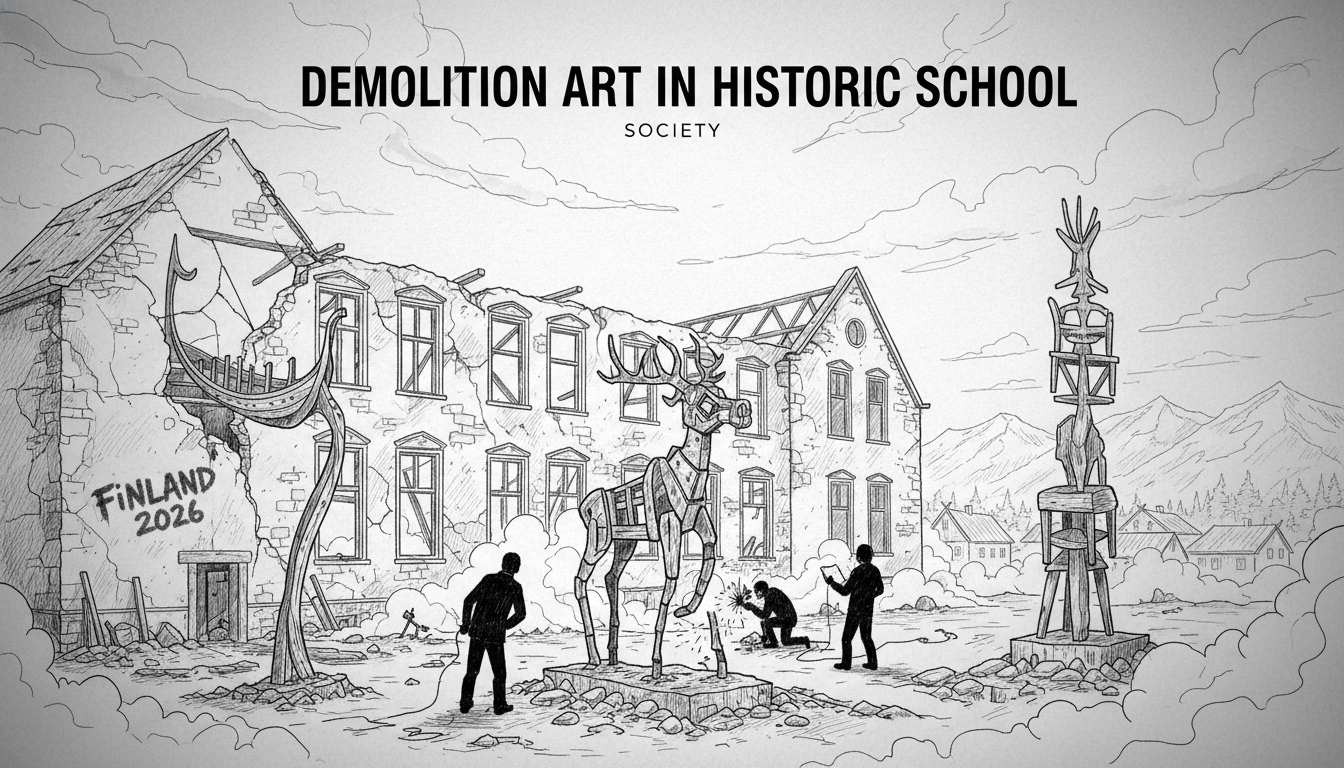
Finland's city of Jyväskylä will transform a school building marked for destruction into a temporary art gallery during the summer of 2026. The Jyväskylä Lyseo school's additional building, scheduled for demolition that autumn, will house a final exhibition curated by the local association Art Habitat Jyväskylä. This project represents a growing trend of using interim spaces for cultural expression, giving a condemned structure a poignant final chapter.
A Creative Final Act for a Historic Site
The decision bridges practical urban planning with community-focused cultural policy. Art Habitat Jyväskylä, led by artists Johanna Juvonen and Biagio Rosa alongside cultural manager Laura-Kristiina Moilanen, signed a usage agreement with the City of Jyväskylä. The exhibition will activate the space for one last summer, inviting the public to engage with art within the unique, transient atmosphere of a building living on borrowed time. This approach provides artists with an unconventional platform and allows the community to say farewell to a familiar locale through a cultural lens.
Jyväskylä Lyseo itself is a cornerstone of local history, founded in 1858. The specific 'lisärakennus' or additional building slated for demolition is a later addition, likely from the post-war expansion period to meet growing student numbers. Its pending removal is part of the city's ongoing urban development, but officials have opted for a creative transitional use. "This is about valuing the space's potential right up to its final moment," said a city cultural affairs representative in a statement. "It creates a unique dialogue between art, memory, and urban change."
The Growing Practice of Interim Use
This project in Central Finland reflects a broader, deliberate strategy in Nordic urban management. Rather than leaving buildings empty and secured before demolition, cities increasingly seek temporary functions. These can range from pop-up galleries and studios to community workshops or event spaces. This practice, often called 'meanwhile use' or 'interim use,' mitigates urban blight, fosters community engagement, and supports artists and entrepreneurs who need affordable space.
Experts in Nordic urban planning see clear benefits. "Finland has been a thoughtful adopter of interim use strategies," notes Dr. Elina Silvennoinen, a researcher in urban studies at the University of Helsinki. "It turns a period of transition—which is often seen as a negative, empty phase—into an opportunity for cultural production and social activity. It tests new ideas for space usage without long-term commitment and can genuinely enrich the community's experience of their evolving city." The Jyväskylä project fits this model perfectly, using art to process the physical change happening in the city fabric.
Art Habitat's Vision for Ephemeral Spaces
For the organizing association Art Habitat, the project aligns with its core mission of exploring intersections between art, community, and environment. The group often focuses on site-specific works and ecological themes. An exhibition in a doomed building presents a powerful conceptual framework for artists to tackle themes of impermanence, memory, materiality, and transformation. The raw state of a building in its final year can inspire work that a white-walled gallery cannot.
"We are interested in the life cycle of spaces," said artist Johanna Juvonen, a board member of Art Habitat, in a brief comment. "A demolition site is not an end, but a phase full of narrative potential. It allows artists to respond directly to the architecture, history, and impending fate of the structure." The call for artists and the specific theme for the 2026 exhibition are expected to be announced in the coming year, but it will undoubtedly encourage responses to the site's unique context.
Cultural Policy in Action
The collaboration between a volunteer-led art association and the municipal government highlights a functional aspect of Finnish cultural policy. Local governments frequently partner with third-sector organizations to deliver cultural programming, leveraging specialized expertise and community networks. The city provides the asset—the soon-to-be-demolished building—and the association provides the artistic vision and operational manpower. This public-civil society partnership is a common and effective model across Finland for activating public spaces.
From a practical standpoint, the agreement must navigate insurance, safety, and access logistics for a building that is no longer fit for its original educational purpose. The solutions found here could serve as a case study for similar future projects in other Finnish cities like Tampere, Oulu, or Turku, where building replacements and urban densification are ongoing. The project demonstrates that with will and coordination, bureaucratic hurdles can be overcome to create meaningful public experiences.
A National Trend with Nordic Roots
While notable in Jyväskylä, this phenomenon is not isolated. Similar 'demolition art' or 'goodbye exhibitions' have occurred in Helsinki, where old hospitals or industrial buildings hosted shows before redevelopment. The concept also has strong roots in other Nordic countries, particularly in Sweden and Denmark, where the terms 'omställningskonst' (transition art) or 'slutspurt' (final sprint) are used. These projects acknowledge the emotional resonance of places and use art to create a collective, reflective moment before physical erasure.
The trend speaks to a societal preference for finding value and meaning throughout all stages of a building's life. It is seen as more desirable than a simple, abrupt demolition. The exhibition creates a documented memory and a cultural product from the process of change itself. For residents, it offers a chance to participate in a ceremonial farewell, softening the loss of a familiar landmark by replacing it with a unique shared experience.
Looking Toward 2026 and Beyond
The Jyväskylä Lyseo additional building will host its artistic swan song in the summer of 2026 before demolition machinery arrives that autumn. The site's future use has not been detailed in the announcement, but it is likely part of a broader plan for the school's campus or central Jyväskylä development. The temporary exhibition ensures the building's conclusion is marked by creativity rather than silence.
This project raises pertinent questions about how all Finnish cities manage their built heritage and transitional spaces. As the nation continues to update its building stock for climate, efficiency, and functional needs, the number of structures facing demolition or major renovation will remain significant. The Jyväskylä model presents a compelling template: one that honors the past, energizes the present, and thoughtfully paces the journey toward the future. The final exhibition in 2026 will not just be about art in a space; it will be a conscious, community-minded ritual of urban transformation.