
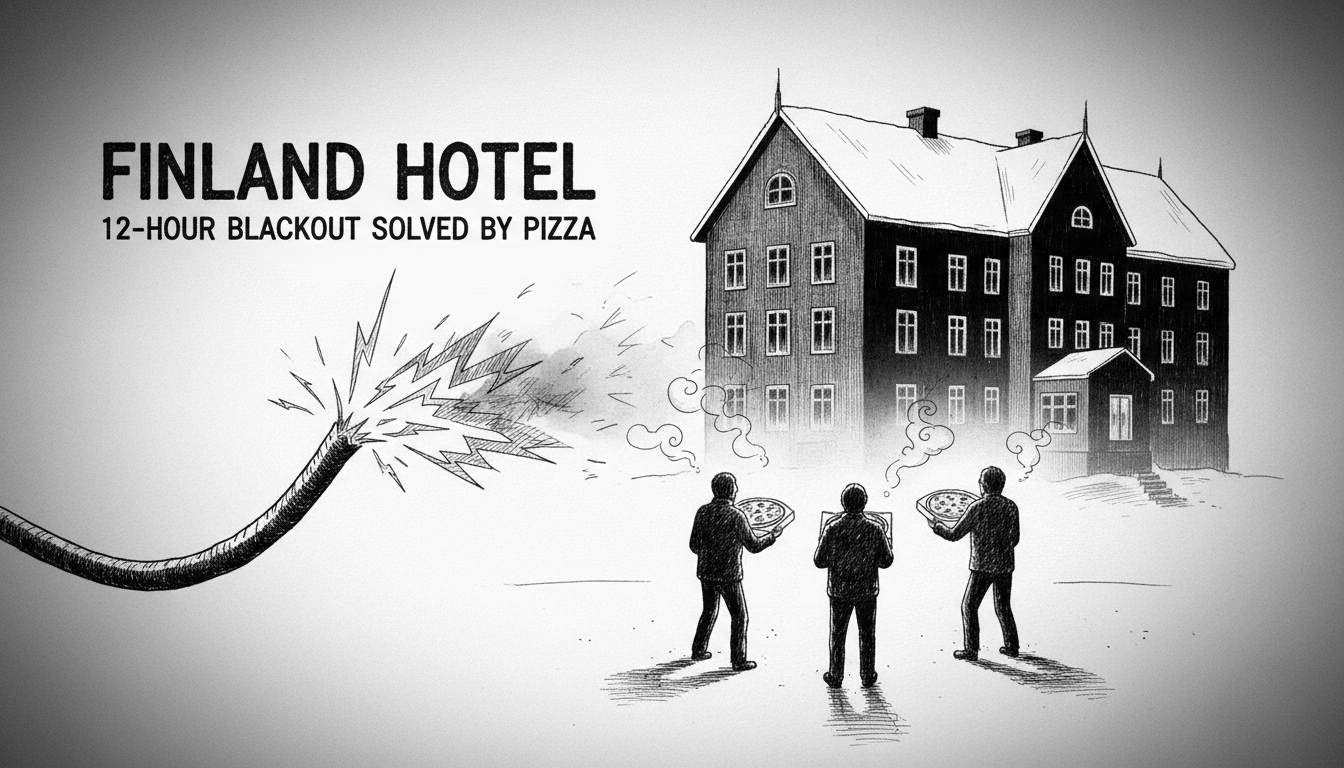
Finland power outages returned with force as autumn storm Hannes severed electricity for thousands, testing the resilience of communities and businesses far from the capital. At the Peurunka Spa Hotel in Laukaa, a sudden blackout lasting nearly 12 hours forced a creative and delicious solution, turning a local pizzeria into an impromptu emergency canteen and highlighting the practical Finnish approach to unexpected crises.
A Dark and Quiet Morning at the Spa
Guest Katri Soininvaara discovered the problem in the early hours. “I wondered why I couldn't get the lights on in the bathroom,” she recalled. A quick check of the news confirmed the culprit: Storm Hannes was sweeping across central Finland, toppling trees and power lines. By morning, with her family awake and the hotel still silent and dark, the practicalities of modern life without electricity set in. Soininvaara and her partner moved perishable food from their refrigerator out to the balcony, leveraging the near-freezing outdoor temperatures—a classic Finnish workaround. Their morning plans for a walk in the woods remained unchanged. “We had planned to go outdoors together anyway, so we visited a campfire shelter in the morning. The power cut didn't really change our plans,” she said, embodying the characteristic ‘sisu’—a Finnish concept of stoic determination.
For the hotel management, however, the situation presented an immediate operational challenge. With no power to run kitchen appliances or dining services, the provision of meals for hundreds of guests was in jeopardy. The solution was not found in a complex emergency manual but in simple, local cooperation.
Pepperoni and Practicality: The Local Lifeline
The hotel staff quickly contacted a nearby pizzeria. What followed was a large-scale order, transforming the local eatery into a temporary mass catering service. Boxes of pizzas were delivered to the darkened hotel, ensuring guests were fed. This ad-hoc partnership between businesses underscores a community-level resilience often seen in Finland, where sparse populations in regions outside Helsinki necessitate reliance on local networks during disruptions. The incident at Peurunka is a microcosm of a wider national experience. Finland's vast forest cover and dispersed settlement patterns make its electricity grid particularly vulnerable to autumn and winter storms. While major urban centers like Helsinki have highly reliable systems, regional areas can face longer restoration times. The government in Helsinki, through the Ministry of Economic Affairs and Employment, has long emphasized improving grid durability. Investments are channeled through companies like Fingrid, the national grid operator, and local distribution network operators to underground cables, automate fault management, and reinforce structures against extreme weather, which is becoming more frequent due to climate change.
A National Infrastructure Challenge
“Events like Storm Hannes test the system and show where further investments are needed,” said a senior advisor from the Finnish Energy Authority, speaking on background about general preparedness. “The focus is on minimizing disruption time and ensuring critical services have backup plans.” For a spa hotel, critical services include guest welfare and food. The pizza solution, while effective, also points to the potential value of on-site backup power for hospitality businesses in outage-prone areas. The Finnish government’s climate and energy strategy pushes for a carbon-neutral society by 2035, which involves a major shift to renewables like wind power. This transition must also account for grid stability. A more distributed energy system, with better local storage and generation capabilities, could mitigate the impact of single points of failure on the main grid.
Beyond the Outage: Policy and Preparedness
From the parliament building in Helsinki, Eduskunta members periodically review legislation concerning energy security and crisis preparedness. The Resilience Act and other measures require critical service providers to have contingency plans, though the scale and nature of those plans vary. For a private business like a hotel, the decision to install backup generators is an economic one, weighed against the frequency and cost of outages. The storm that hit Peurunka is not an isolated event. As recently as last winter, similar storms caused widespread blackouts across Nordic countries, leaving homes without power for days in some rural areas. This pattern reinforces the need for continuous investment and community-level preparedness. The Peurunka incident ended as power was restored after the long 12 hours. Guests like Soininvaara took the disruption in stride, a testament to a societal expectation that nature can sometimes interrupt the rhythm of daily life. The hotel management gained a real-world test of its emergency response, with a surprisingly cheesy and positive outcome. The story of the pizza-fueled hotel during a blackout is more than a quirky anecdote. It is a snapshot of Finland’s ongoing negotiation with its environment, the practicality of its people, and the quiet, uncentralized cooperation that keeps society functioning when the lights, quite literally, go out. As autumn storms become more potent, will Finland’s blend of national investment and local ingenuity be enough to keep the power on, or will pizza deliveries remain a key part of the national emergency response plan?