
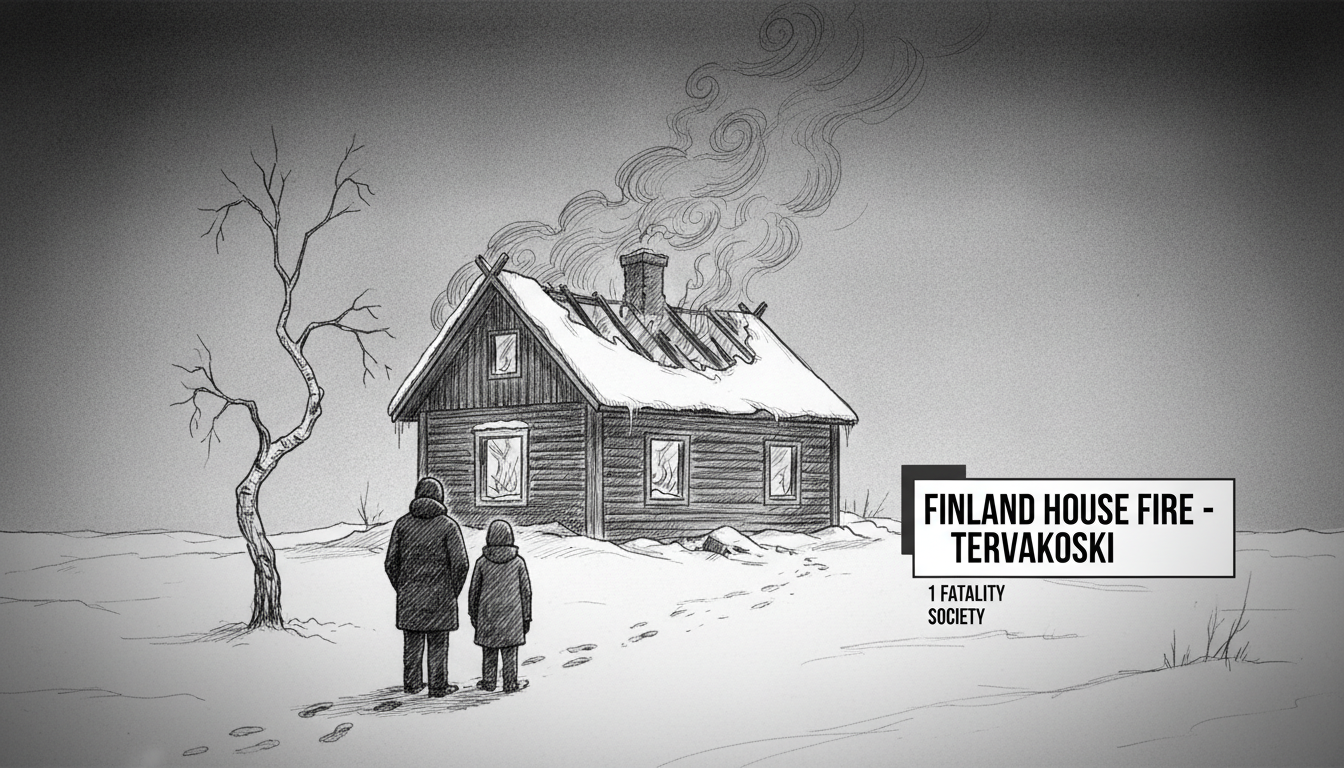
Finland house fires claim dozens of lives annually, a tragic statistic made real by the discovery of a body in the charred ruins of a Tervakoski home this weekend. Police confirmed one fatality after firefighters extinguished the blaze that consumed a detached house near the village center. Authorities stated they do not suspect criminal activity, turning the investigation toward potential accidental causes in a country where residential fires remain a persistent danger.
Smoke Over a Quiet Village
Emergency services responded to the fire in Tervakoski, a village within the municipality of Janakkala in Southern Finland, in the early hours of Sunday. The scene they encountered was one of complete destruction. The omakotitalo, or detached house, was fully engulfed, leaving behind only smoldering ruins by the time the flames were subdued. A painstaking search of the debris later revealed the remains of a single individual. The identity of the deceased has not been publicly released, pending notification of next of kin. The quiet community, home to roughly 1,700 people, was left grappling with the sudden loss.
Police have been clear in their initial assessment. "We do not suspect a crime in connection with this fire," a police representative said in a statement. This direction points investigators toward examining common domestic fire triggers. Their focus will likely include the home's electrical wiring, heating appliances, and other potential sources of ignition. Determining the precise cause can be a lengthy process, requiring expert analysis of the scene and any surviving evidence.
A Recurring National Concern
This tragedy highlights a somber reality in Finnish safety data. While Finland boasts excellent emergency services, it experiences a higher rate of residential fires per capita than its Nordic neighbors Sweden and Norway. According to the Finnish Rescue Federation (SPEK), structural fires numbered 3,500 in 2022. Of these, approximately 40%—or about 1,400 fires—originated in residential buildings like apartments and detached houses. These blazes result in property damage, injuries, and an average of several dozen fatalities each year.
Older detached houses, which form a significant part of Finland's housing stock outside urban centers, often present particular risks. "The risk profile changes with the age of the building," explains a fire safety engineer familiar with Finnish housing. "Many older omakotitalot were built before modern electrical codes. Their heating systems, whether based on fireplaces, boilers, or electric radiators, require diligent maintenance and operation."
Winter months can intensify these risks. The use of supplemental heating, candles during the dark season, and sometimes-dry indoor air create a more hazardous environment. Fire officials consistently campaign for the installation and regular testing of smoke detectors, which are mandatory in all Finnish homes. They are considered the single most effective early warning system, capable of providing the crucial minutes needed to escape.
The Investigation's Path Forward
With foul play currently ruled out, the investigative work shifts to forensic fire analysis. Specialists will methodically sift through the Tervakoski site, looking for clues to the fire's origin and cause. They will examine electrical junction boxes, appliance remnants, and the patterns of burning on surviving structural elements. This process is meticulous and often takes weeks to yield definitive conclusions.
The goal is not just to understand what happened in this specific case but to gather data that can prevent future incidents. Information on common failure points—such as a specific type of aging wiring or a frequently misused heating device—feeds back into public safety campaigns and can inform building code updates. Every fatal fire is a devastating loss, but the resulting knowledge contributes to a broader effort to enhance national fire safety.
Local authorities in Janakkala will also be involved in reviewing the circumstances. While the home was a private residence, the event triggers a review of local response protocols and community safety outreach. For the neighbors and residents of Tervakoski, the fire serves as a jarring reminder to check their own smoke alarms and review fire escape plans with their families.
A Community in Mourning
Beyond the statistics and safety protocols lies the human impact. A life has been lost in a profoundly traumatic way. The close-knit nature of Finnish villages means the victim was undoubtedly known to many in Tervakoski. The tragedy leaves a void in the community's social fabric, prompting grief and reflection. Support services for those affected, including firefighters who attended the grim scene, are a critical part of the aftermath.
Such events often spark local conversations about checking on elderly or vulnerable neighbors, especially those living alone in older properties. Community watch programs and neighborhood associations sometimes see renewed engagement following a tragedy, as residents seek ways to foster mutual care and prevent future harm. The collective response underscores a fundamental Finnish value: shared responsibility for community well-being.
The Persistent Challenge of Prevention
Finland's rescue services are highly trained and efficient, yet preventing fires before they start remains the ultimate objective. Public education campaigns run by SPEK and insurance companies stress simple, life-saving habits: never leaving open flames unattended, keeping flammable materials away from heat sources, and having chimneys and flues cleaned regularly. For homeowners, investing in modernizing old electrical systems is a significant but potentially life-preserving expense.
The government also plays a role through building regulations. Current codes for new construction are stringent, but the legacy of older housing stock is a nationwide challenge. Subsidy programs for safety renovations, though available, require homeowner initiative. The tragedy in Tervakoski poses a difficult question: how can a society with a deep respect for private property and individual homes effectively ensure their safety when they were built to different, less rigorous standards?
As the investigation in Tervakoski continues quietly, the broader issue continues to smolder. Each fatal fire is a statistical data point and an immense personal catastrophe. It reinforces the message that fire safety is not a passive state but requires active, continuous attention from homeowners, communities, and authorities alike. The hope is that from this latest loss, heightened awareness will spread, prompting actions that save lives in other homes across Tavastia Proper and beyond. Will this tragic event lead to more widespread safety checks in communities like Janakkala?