
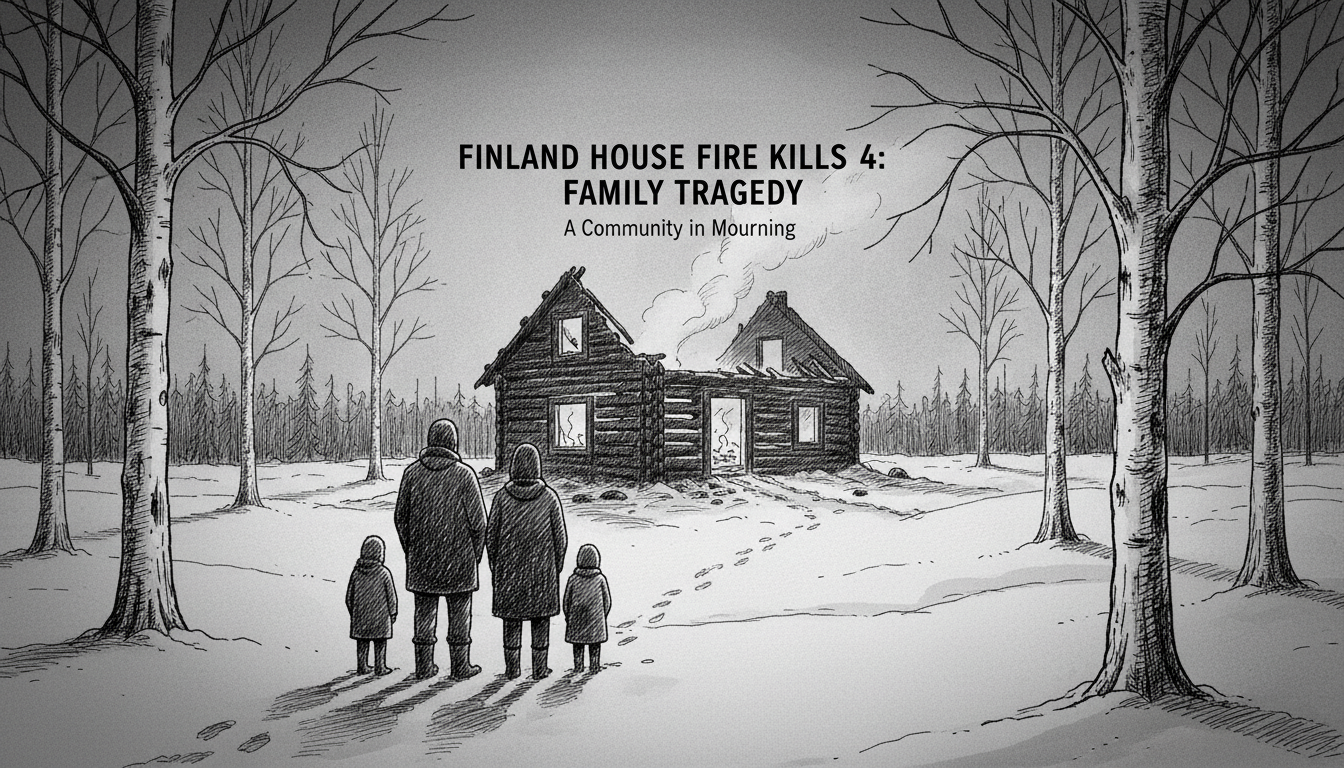
Finland's latest house fire has claimed four lives in Savonlinna, with local officials confirming the victims were likely a family. The tragedy occurred in a detached home that burned to the ground early Saturday morning, marking one of the deadliest residential fires in the country this year. Rescue services found the bodies after responding to a large blaze in the Louhi village area on Hattukalliontie street, where the single-story house was fully engulfed in flames.
Police have not yet identified the victims or determined the cause of the fire. Technical investigation at the site continues through the weekend, according to Detective Chief Inspector Markku Kärpänen. Savonlinna's acting mayor Markus Hämäläinen described the news as profoundly shocking and extended condolences to the families affected. Crisis support is being planned with the welfare district in case children were among the deceased.
Background on Finnish Fire Safety
Finland experiences periodic fatal house fires despite strict Nordic building codes and a strong public safety culture. The country has about 2,000 residential fires annually, with an average of 50 fatalities per year, according to national rescue service statistics. Most deadly fires occur in older detached homes, often during winter months when heating systems are in high use. The Finnish government has prioritized fire safety in its national security strategy, with regular Eduskunta reviews of building regulations.
EU directives on construction products and fire safety, such as the CPR (Construction Products Regulation), influence Finnish standards. However, implementation varies across municipalities, and retrofitting older homes remains a challenge. The Ministry of the Interior coordinates with local rescue departments to conduct inspections and public awareness campaigns. Recent policy debates in Helsinki have focused on subsidizing smoke detector upgrades and electrical system renovations in rural areas.
Details of the Savonlinna Tragedy
The fire broke out around 8 a.m. on Saturday in a roughly 100-square-meter wooden house in Savonlinna, a lakeside town in Eastern Finland. Over a dozen rescue units from the South Savo region responded, but the structure was already ablaze upon arrival. Pelastuslaitos, the rescue service, reported that the house was completely destroyed and deemed uninhabitable. Mopping-up operations continued into the afternoon as investigators secured the scene.
Acting Mayor Markus Hämäläinen stated that preliminary information suggests the tragedy struck a family unit. He emphasized that the city, in collaboration with the Etelä-Savo welfare district, is preparing psychological crisis intervention for the community. The police have not released ages or genders of the victims, pending formal identification and family notifications. No additional bodies are expected to be found, but the investigation remains open.
| Incident | Location | Date | Fatalities | Cause |
|---|---|---|---|---|
| Savonlinna House Fire | Savonlinna, Louhi | Recent Saturday | 4 | Under Investigation |
| Vantaa Apartment Fire | Vantaa, Hakunila | October 2023 | 5 (4 children, 1 adult) | Sauna Heater |
This table highlights recent fatal fires in Finland, showing the Savonlinna incident as the most significant since the Vantaa tragedy nearly two years ago. The Vantaa fire, which killed five including four young children, prompted nationwide scrutiny of sauna safety standards and led to parliamentary questions about enforcement.
Response and Investigation
Local authorities have mobilized quickly following the Savonlinna fire. The police technical team is examining debris for ignition sources, focusing on electrical faults, heating appliances, or possible human error. Detective Chief Inspector Kärpänen noted that the intensity of the fire complicates the investigation, requiring careful forensic analysis. The rescue service will produce a report on response times and operational effectiveness, which will be reviewed by the Ministry of the Interior.
Mayor Hämäläinen has activated municipal crisis protocols, ensuring that social services and schools are ready to offer support. The Etelä-Savo welfare district has publicized a crisis helpline (044 794 2394) for those needing immediate assistance. This coordinated response reflects Finland's integrated approach to emergencies, where local governments work closely with national agencies and healthcare providers. The Finnish Red Cross and church organizations are also involved in community outreach.
Analysis: Fire Safety Policies in Finland
As a political correspondent, I observe that this tragedy will likely reignite debates in the Eduskunta about fire prevention funding and regulation. Finland's building code, updated in 2018, mandates smoke detectors in all homes and fire-resistant materials in new constructions. However, older properties like the one in Savonlinna may not meet current standards, exposing gaps in retrofit programs. The government's recent budget allocation for rural safety upgrades, debated just last month, may see increased urgency.
EU-wide initiatives, such as the Green Deal, indirectly affect fire safety by promoting energy-efficient renovations that can alter building ventilation and fire risks. Finnish MEPs have pushed for harmonized safety standards across Europe, but national sovereignty over building rules often slows progress. Experts from the Finnish National Rescue Association emphasize that human behavior—like improper use of heaters or delayed maintenance—remains a critical factor. Public education campaigns, funded by the state, need continuous reinforcement to reduce fatalities.
What This Means for Future Prevention
The Savonlinna fire underscores persistent vulnerabilities in Finland's housing stock, particularly in remote areas where emergency response times can be longer. Policy implications include potential legislative proposals for mandatory fire safety inspections during property sales, a measure discussed but not yet passed in Parliament. The Ministry of Economic Affairs and Employment could also review insurance incentives for homeowners who install sprinkler systems or advanced alarms.
Community resilience is tested in such events, and local governments may demand more resources from Helsinki. The tragedy could prompt a review of the Rescue Act, which governs fire services, to ensure adequate staffing and equipment in rural regions. For families across Finland, this serves as a stark reminder to check smoke detectors and escape plans. As investigations conclude, the findings will inform national safety strategies and possibly influence EU discussions on disaster prevention.
The loss of four lives in Savonlinna is a somber moment for Finland, highlighting the need for vigilant safety practices and robust government support. While the country excels in many aspects of public welfare, tragic fires reveal areas for improvement. Ongoing policy adjustments and community solidarity will be essential in preventing future such incidents.