
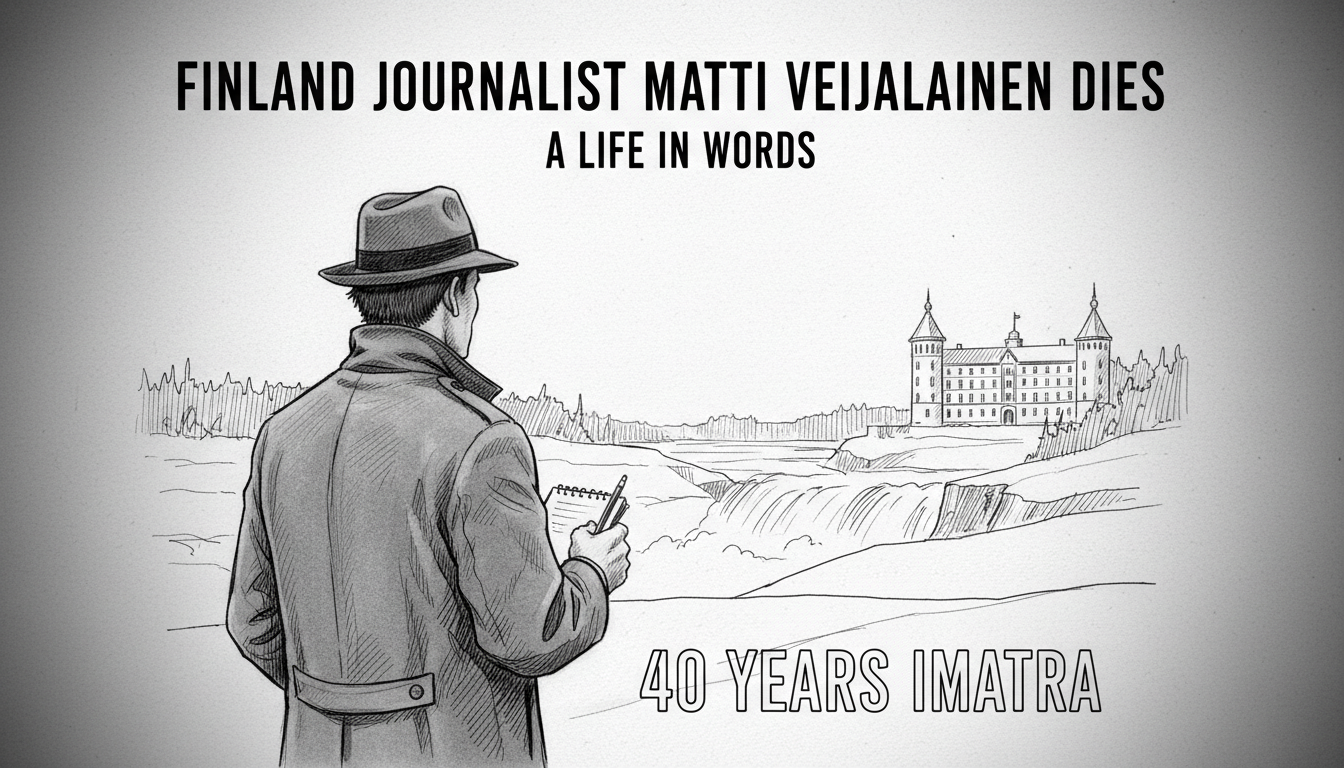
Finland journalist Matti Veijalainen, whose career chronicled life in the southeastern border city of Imatra for over four decades, died on December 16th. He was 71. Veijalainen passed away at Meilahti Hospital in Helsinki from complications following a stroke, according to his son, Mikko Veijalainen. The veteran reporter had worked at three different local newspapers—Ylä-Vuoksi, Etelä-Saimaa's Imatra office, and Uutisvuoksi—before retiring in 2017. His death marks the end of a journalistic era for a community where local papers remain a vital connective tissue.
A Life Dedicated to Local Stories
Matti Veijalainen was born in the nearby municipality of Rautjärvi on August 16, 1954. His professional life was spent almost entirely within the Imatra region, a city defined by the powerful Vuoksi River and its iconic Imatrankoski rapids. For more than 40 years, he reported on the events that shaped daily life in this corner of South Karelia, close to the Russian border. Colleagues describe a journalist committed to the foundational principles of local news: covering municipal council meetings, school events, factory anniversaries, and the countless personal stories that collectively define a place. His career spanned significant technological shifts, from typewriters to digital publishing, yet his focus remained steadfastly on the community he served.
The Unseen Pillars of Finnish Society
Veijalainen's long tenure exemplifies the critical role of local journalism in Finland's media ecosystem. While national headlines often focus on Helsinki politics or global affairs, newspapers like Uutisvuoksi provide the essential service of holding local power to account and fostering community identity. "Journalists like Matti are the archivists of everyday life," said Dr. Liisa Tervonen, a media researcher at the University of Eastern Finland. "They document the decisions of the town council, the success of the local hockey team, and the obituaries of beloved residents. This creates a continuous record that binds generations together. When a reporter of his experience passes, a vast repository of institutional memory and community trust is lost." This local focus is particularly vital in regions like Imatra, where economic transitions and geopolitical proximity to Russia create unique local narratives that require deep, contextual understanding.
The Changing Landscape of Local News
Veijalainen's career, which concluded with his retirement from Uutisvuoksi six years ago, witnessed profound challenges to the business model of local newspapers. The rise of digital platforms, declining print advertising, and consolidated media ownership have pressured newsrooms across Finland. Despite these pressures, local media outlets maintain high public trust and are often the primary source of information for residents outside major urban centers. The work involves a specific kind of resilience and commitment, as the audience is also one's neighbors and friends. Reporting on difficult local issues—factory layoffs, political disputes, or community tragedies—requires a balance of professional detachment and personal investment that few outside the field fully appreciate.
A Personal and Professional Legacy
The circumstances of Veijalainen's passing, beginning with treatment for a foot injury that led to the discovery of a severe stroke, were shared by his family. This personal detail underscores the connection between a local journalist and the community; in smaller cities, the reporter's own life often becomes part of the shared public narrative. His decades of work mean that generations of Imatra residents saw their milestones, concerns, and achievements reflected in his reporting. He was a constant presence at events that shaped the city's post-industrial identity, from cultural festivals to coverage of the complex economic and social ties across the border with Russia. This type of journalism builds a scaffold for civic engagement and informed local democracy.
An Era Ending, A Model Remembered
The death of Matti Veijalainen prompts reflection on the future of the profession he embodied. While digital tools offer new ways to tell stories, the core mission of local journalism—attending meetings, verifying facts, and explaining their impact on citizens—remains unchanged. The depth of knowledge required to cover a specific place well cannot be quickly replicated. New journalists in Imatra and similar towns now must build their own sources and understanding, often without the direct mentorship of veterans who spent entire careers in one newsroom. The value of that sustained, grounded perspective is immense, especially in an age of fragmented information and nationalized political discourse. Veijalainen's career stands as a testament to the idea that profoundly important journalism is not always about breaking international scandals, but about consistently and faithfully documenting the life of a single community.
What happens to a community's sense of itself when the chroniclers of its daily life are gone? The passing of journalists like Matti Veijalainen leaves a quiet but significant void. It challenges the next generation to pick up the notebook, attend the planning meeting, and continue the essential work of asking questions close to home. In Finland's media landscape, where local news is still a respected pillar, his life's work reinforces a crucial truth: all news is ultimately local to someone. The story of Imatra, with its rushing waters and borderland dynamics, was his story to tell for over forty years, and that record now becomes part of the city's permanent history.