
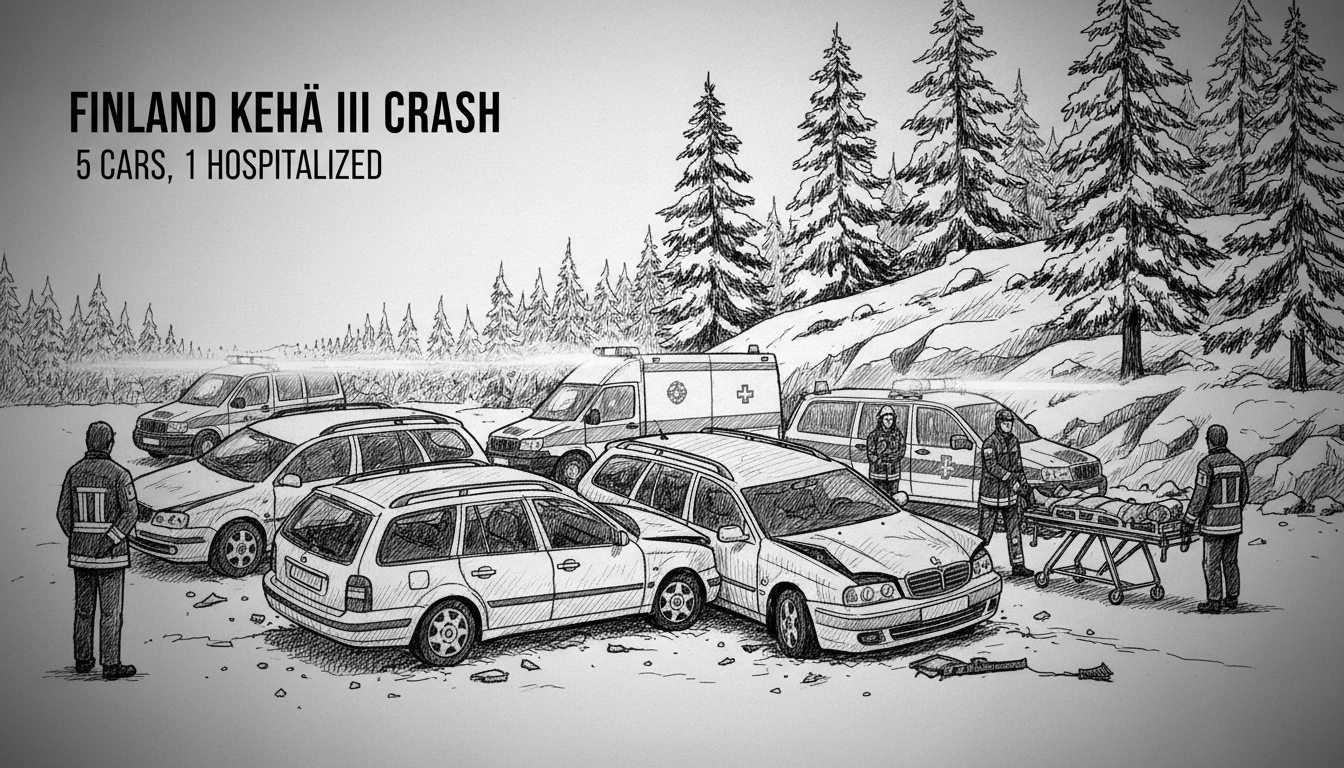
Finland's Ring Road III witnessed another severe chain collision Friday evening as five vehicles crashed on the busy Vantaa beltway. The incident near the Lahdentie ramp sent one person to the hospital and caused significant eastbound traffic disruptions for over an hour, highlighting persistent safety concerns on one of the nation's most critical traffic arteries.
Emergency services from the Central Uusimaa Rescue Department responded to the scene after 7:00 PM. Crews worked to secure the site, assist those involved, and coordinate the complex recovery of multiple damaged vehicles. The necessity of towing all five cars from the high-speed roadway prolonged the traffic headache for evening commuters well past 8:20 PM. While authorities have not released the condition of the hospitalized individual, such multi-vehicle impacts on highways often result in whiplash, fractures, and other impact-related trauma.
Emergency Response on Busy Beltway
The immediate aftermath of a multi-car pile-up requires a highly coordinated response. Police, rescue services, and tow operators must work in tandem to clear the scene safely while investigators document evidence. On Kehä III, which carries over 100,000 vehicles daily, any closure creates immediate and severe congestion. The choice of the Lahdentie ramp location, a key interchange, amplified the disruption. Traffic management centers likely activated electronic message signs and updated routing apps to divert vehicles, but the ripple effects on Friday evening travel were inevitable. The efficiency of this response is critical, not just for those involved, but for minimizing secondary economic and logistical impacts across the Helsinki metropolitan area.
Chain Collisions: A Recurring Challenge
This incident fits a familiar and dangerous pattern on Finnish high-speed roads. Chain collisions, or pile-ups, are a disproportionate cause of serious traffic incidents in Finland, especially during the autumn and winter months. Slippery conditions from rain, ice, or snow drastically reduce tire grip and increase stopping distances. When one vehicle loses control or brakes suddenly on a crowded, fast-moving road like Kehä III, the result can be a rapid sequence of impacts. Experts repeatedly point to two primary factors: inadequate following distance and speed inappropriate for conditions.
“The fundamental rule is simple: greater distance equals greater safety, especially at highway speeds,” notes traffic safety researcher Dr. Eero Pärssinen, whose work is often cited by the Finnish Transport Agency. “On wet or icy asphalt, the required stopping distance can be triple that of dry conditions. Many drivers underestimate this dramatically.” Finnish law mandates a general duty of care, and while no specific minimum following distance in meters is codified, courts have ruled that drivers must maintain a gap sufficient to stop safely should the vehicle ahead brake suddenly.
Infrastructure and Behavior Under Scrutiny
Kehä III’s role as a vital commercial and commuter conduit places its safety record under constant scrutiny. The road forms a key link between Helsinki-Vantaa Airport, major logistics hubs, and residential areas. Its design, with numerous entry and exit ramps and consistently heavy traffic volumes, creates a complex environment where merging and lane-changing maneuvers are frequent. These interactions increase the risk of sudden braking and conflict points. The Finnish Transport Infrastructure Agency (FTIA) continuously monitors accident blackspots, implementing engineering countermeasures like improved signage, lighting, and road surface treatments where data shows repeated incidents.
However, engineering alone cannot solve the problem. Analyst Laura Mäkinen, who has advised the Ministry of Transport and Communications, argues for a dual approach. “Infrastructure improvements are essential, but they must be coupled with sustained driver education and enforcement,” Mäkinen states. “Campaigns reminding drivers of ‘two seconds’ following rules in good weather and ‘four seconds or more’ in poor conditions need to be as perennial as the winter itself. Targeted police patrols on known high-risk stretches during peak congestion or bad weather also have a proven deterrent effect.”
This latest crash will inevitably feed into ongoing policy discussions in Helsinki. The Finnish government’s current strategic road safety plan, aligned with the EU’s Vision Zero ambition, aims to halve serious injuries and fatalities by 2030. Members of Parliament’s Transport and Communications Committee regularly review progress, and data from incidents on major roads like Kehä III directly influences budget allocations for safety upgrades and public awareness campaigns. The Ministry of the Interior and the Finnish Police also assess enforcement strategies based on collision trends.
Preventing the Next Pile-Up
The path forward relies on integrating technology, infrastructure, and human factors. Modern vehicles with autonomous emergency braking (AEB) and electronic stability control can prevent some incidents, but the fleet turnover takes time. Road authorities are exploring intelligent transportation systems (ITS) for Kehä III, such as variable speed limits that automatically adjust based on real-time traffic density and weather feeds. These systems, common in other European countries, could smooth traffic flow and reduce stop-start waves that lead to multi-car accidents.
Ultimately, the responsibility returns to the driver. As days shorten and weather turns, the risk on all Finnish roads rises. The Friday evening crash on Kehä III serves as a stark, metallic reminder. It underscores the brittle margin for error on congested high-speed roads when just one moment of inattention, one following distance judged too optimistically, can set off a chain of events with profound consequences. The question for authorities is whether current measures are sufficient, or if a more aggressive combination of education, engineering, and enforcement is needed to break the chain-reaction cycle on Finland’s busiest corridors.
The investigation into the precise cause of this collision continues. Police will examine witness statements, potential vehicle malfunctions, and road conditions at the time. The findings will add another data point to Finland’s relentless pursuit of safer roads, a pursuit measured not in kilometers of asphalt, but in the prevention of shattered glass, crumpled steel, and disrupted lives on routes like Kehä III.