
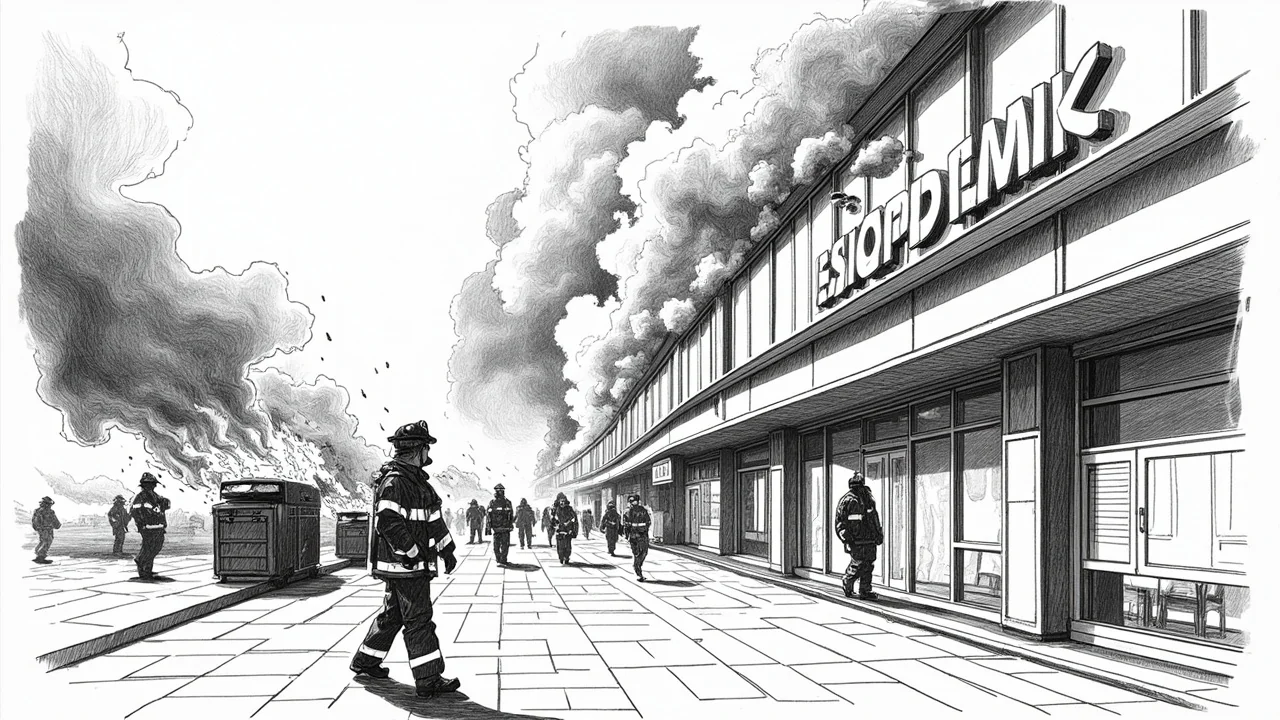
Finland's Koria district narrowly avoided a major commercial disaster Sunday afternoon when a fire in a waste collection bin spread to the wall of a large shopping complex. The incident on Kaupinkatu street required a significant emergency response to prevent the 1,600-square-meter building from igniting fully. 'It was a close call. When the rescue service arrived, the bin had already melted. Fortunately, the fire was noticed in time,' said on-duty chief Asko Rouhiainen of the Kymenlaakso Rescue Department.
The fire started shortly before 3:00 PM. A passerby first noticed the flames and alerted authorities. The business owner also arrived quickly on the scene. According to Rouhiainen, these individuals began initial firefighting efforts using snow before professional crews arrived. The rescue department handled subsequent extinguishing operations. Firefighters had to dismantle parts of the building's exterior wall to ensure the fire was completely out. No one was inside the store or on its premises when the blaze began.
A Critical Timeline and Community Response
The sequence of events highlights both vulnerability and rapid response. The fire originated in a waste bin located in the building's courtyard. Flames then climbed the building's exterior wall. The quick actions of the civilian who spotted the danger and the owner who helped combat it with snow likely prevented a much larger incident. The Kymenlaakso Rescue Department's prompt deployment from nearby Kouvola was the next critical factor. Their work included thorough overhaul—searching for hidden fire within the structure—and the controlled removal of wall sections to eliminate hot spots.
This incident underscores a recurring winter fire hazard in Finland. While snow can be a makeshift suppression tool, as demonstrated here, frozen hydrants and icy access roads can complicate official responses. The fact that civilians used available snow reflects a common-sense, proactive attitude toward immediate danger. However, fire chiefs consistently warn against untrained individuals taking significant risks.
Investigating the Source of the Flames
The exact cause of the fire remains officially undetermined. Chief Rouhiainen noted a significant clue at the scene. 'There was a battery collection bin next to the waste bin, which may have played a part in this,' he stated. This single remark points to a growing and serious national safety concern. Improperly discarded batteries, particularly lithium-ion batteries found in consumer electronics, are a known fire starter in waste streams. When damaged or short-circuited, they can generate intense heat and ignite surrounding materials.
Finland has a established system for battery recycling, with collection bins common in store parking lots and civic areas. The potential involvement of such a bin in this fire raises immediate questions. Was a damaged battery tossed into the general waste instead of the dedicated bin? Did a battery within the correct collection bin malfunction? The investigation will need to trace the origin point within the waste container. This aspect transforms the story from a local fire report to a narrative with national relevance regarding waste management and public safety education.
The Broader Context of Commercial Fire Safety
This near-miss in Koria occurs amidst ongoing national discussions about building safety and fire prevention regulations. Commercial buildings in Finland must adhere to strict fire codes, including the use of non-combustible or fire-retardant materials for external cladding in larger structures. The speed at which fire traveled up the wall will be a point of examination for fire safety engineers. Was the material compliant? Had it been maintained properly? The rescue department's necessary action of tearing down part of the wall suggests significant heat damage, indicating the fire had a firm hold on the structure.
Finland's rescue services frequently conduct prevention inspections of commercial properties. These inspections assess escape routes, alarm systems, fire extinguisher availability, and the safe storage of flammable materials. The placement and management of external waste collection points, especially near building walls, is a standard part of this scrutiny. This incident will likely prompt a local surge in such preventative checks, with inspectors paying particular attention to bin placement and the risks associated with collected materials.
Battery Disposal: A National Hazard in Focus
The suspected link to batteries ties this event directly to legislative efforts in Helsinki and Brussels. Finland follows the EU's Battery Directive, which aims to improve collection and recycling rates while reducing hazardous content. However, public compliance is a constant challenge. Even batteries placed in the correct bin can pose a risk if they are damaged. Fire safety campaigns have increasingly focused on telling citizens to tape the terminals of used lithium batteries with insulating tape before disposal to prevent short-circuiting.
The Finnish Safety and Chemicals Agency (Tukes) has issued warnings on this topic. They note that fires in waste trucks and recycling centers caused by batteries are a increasing problem. A fire in a stationary bin adjacent to a building, as seen in Koria, presents a different but equally dangerous scenario. It exposes a gap in the safety chain—managing risk between disposal and collection. This incident provides a concrete case study for policymakers and safety authorities advocating for better public information campaigns and potentially revised regulations for the storage of collected batteries.
Lessons from a Close Call
While the Koria fire resulted in no injuries, it serves as a potent warning. The financial damage to the building, though limited compared to a total loss, is still significant. Business interruption for the affected store and potential others in the complex is another consequence. The real cost of this 'close call' will be tallied in repair bills and lost revenue.
The more valuable outcome must be heightened awareness. For commercial property owners, it's a reminder to audit their external premises for fire hazards, especially waste storage. For the public, it reinforces the critical importance of responsible battery disposal. For municipalities and rescue authorities, it highlights the need for clear guidelines on bin placement and management.
Asko Rouhiainen's simple summary—'Läheltä piti' (It was close)—captures the essence of the event. It was not a tragedy, but it was a near miss that required hard work from civilians and professionals to avert. In the end, the system worked, but the margin for error was slim. The investigation's findings, particularly regarding the battery bin, will be awaited not just in Koria, but by fire safety experts across Finland looking to prevent the next call from being even closer.
The Koria incident ultimately asks a pressing question of consumers and regulators alike: as our society generates more electronic waste, are our disposal habits and safety protocols evolving fast enough to prevent buildings from melting around us?