
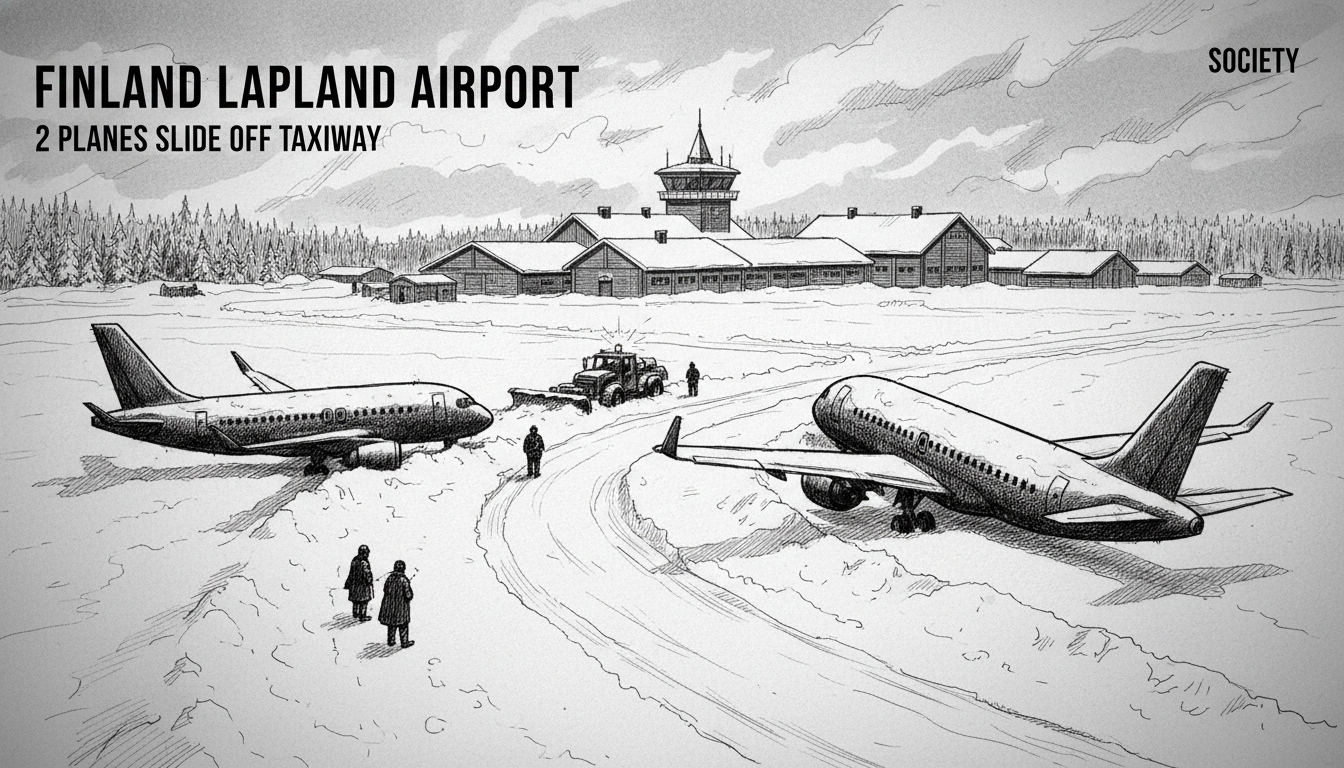
Finland's Lapland rescue services reported a significant aviation incident at Kittilä Airport on Tuesday. A passenger jet carrying approximately 150 people and a smaller aircraft with fewer than 10 passengers slid off a taxiway into a snowbank due to powerful winds. No injuries were reported among passengers or crew, according to official statements.
Emergency services responded with ten rescue vehicles after an alert for a major air traffic accident was issued. The incident highlights the operational challenges faced by Finland's northern airports during severe winter weather, even with the country's strong aviation safety record.
A Chaotic Scene in Arctic Conditions
Initial reports from the Lapland Rescue Department described a scene of controlled chaos. The two aircraft, one a standard commercial passenger jet and the other a smaller regional or private plane, were maneuvering on the ground when strong gusts caught them. The planes subsequently slid from the paved taxiway surface into adjacent deep snow.
Meteorologist Elias Paakkanen confirmed that weather conditions across Lapland were poor at the time of the incident. The region is experiencing a period of intense winter weather, with high winds, blowing snow, and low visibility common. These conditions, while challenging, are not unusual for Arctic operations in December.
"The priority was immediately ensuring the safety and well-being of all passengers," a rescue services spokesperson said. "Despite the alarming nature of the event, the situation was managed without physical harm." Passengers were disembarked safely onto the airfield and transported to the terminal building.
Kittilä: A Critical Arctic Hub
The incident occurred at a critical time for Kittilä Airport (IATA: KTT), a vital economic gateway for Finnish Lapland. The airport serves the popular ski resort of Levi and is a key entry point for tourists seeking the Northern Lights. December is the start of the high season, with thousands of international travelers arriving weekly.
In 2022, Kittilä Airport handled over 420,000 passengers, with a significant portion during the winter months. Any disruption to its operations has immediate economic consequences for the tourism-dependent region. The airport is equipped to handle harsh conditions, with regular snow clearing and de-icing procedures. This incident underscores how extreme wind can present a unique hazard beyond typical snow and ice.
Aviation operations in Lapland require specific protocols. Pilots operating in the region undergo specialized training for cold weather operations, which includes procedures for taxiing in high winds and on icy surfaces. Ground crews are also trained to assist aircraft in low-visibility and high-wind conditions.
The Safety Investigation Begins
Finland's Safety Investigation Authority (SIA) will lead a formal probe into the incident. The agency, known for its thorough and independent investigations, will examine multiple factors. Their mandate is not to assign blame but to determine causal factors and recommend safety improvements for the entire aviation system.
Experts anticipate the investigation will focus on several key areas. The exact wind speed and direction at the time of the incident will be scrutinized, using data from the airport's weather station and aircraft instruments. Investigators will review whether operational wind limits for ground movements were being followed.
The condition of the taxiway, including snow and ice accumulation, and the effectiveness of recent clearing operations will be assessed. The actions of the pilots, air traffic control, and ground marshals will be reconstructed through cockpit voice recordings, ATC transcripts, and witness interviews.
"An incident like this is a systems test," said Captain Laura Niemi, a retired Finnish airline pilot with Arctic experience. "It examines procedures, training, and infrastructure. Finland's safety culture is strong because we investigate thoroughly and implement findings. The fact that no one was hurt is the first success. The next is learning everything possible from the event."
Finland's Aviation Safety Record in Focus
Finland maintains an exemplary aviation safety record. The country's last fatal commercial airline accident occurred in 1963. This record is built on a foundation of rigorous regulation, high training standards, and a proactive safety culture that encourages reporting of incidents and near-misses.
The Finnish Transport and Communications Agency (Traficom) sets and enforces strict operational guidelines for winter operations. These include mandatory de-icing/anti-icing procedures, specific tire requirements for winter, and detailed protocols for low-visibility taxiing. Airports like Kittilä invest heavily in winter maintenance equipment, including heavy snowplows, sweepers, and de-icing fluid trucks.
However, climate change is introducing new variables. Arctic regions are experiencing more volatile weather patterns, including sudden storms and variable precipitation. This requires continuous adaptation of procedures and investment in forecasting technology.
Economic and Operational Ripple Effects
While the immediate danger was averted, the incident caused significant disruption. The taxiway blockage likely halted all ground movements at the airport until the aircraft could be recovered. Incoming flights may have been delayed or diverted to other airports like Rovaniemi or even as far as Oulu or Helsinki.
For passengers, the ordeal meant unexpected delays, potential missed connections, and the psychological stress of an emergency disembarkation in freezing conditions. Airlines face costs associated with delays, potential aircraft damage, and passenger care.
The local tourism industry watches such events closely. Lapland's brand is built on a promise of a seamless Arctic adventure. While winter weather is part of the allure, safety concerns around travel can impact booking decisions. Quick, professional resolution of incidents is crucial to maintaining traveler confidence.
The Path to Recovery and Prevention
Recovery operations at the airport are complex. Moving large aircraft from a snowbank requires specialized heavy equipment, such as large tow tractors and possibly cranes, to avoid further damage. Aircraft mechanics must conduct thorough inspections for any damage to landing gear, fuselage, or engines from the impact with the snowbank and the recovery process.
Once the SIA completes its initial fieldwork, the focus will shift to implementing any immediate safety recommendations. These could be operational, such as adjusting local wind limits for taxiing, or physical, like reviewing the design or maintenance of taxiway edges and snow banks.
Long-term, data from this incident will feed into simulator training programs for pilots and ground handlers. It may also influence airport design standards in Finland and other Nordic countries with similar climates.
A Reminder of Nature's Power
This incident at Kittilä Airport serves as a stark reminder. Even with advanced technology, rigorous training, and robust infrastructure, nature remains a powerful force in Arctic aviation. The successful outcome—no injuries—demonstrates the effectiveness of Finland's safety protocols and emergency response.
It also highlights the skill and composure of the flight crews, cabin crews, and ground responders who managed a sudden, dangerous situation. As the investigation unfolds, the global aviation community will watch. The lessons learned in the snow of Finnish Lapland will contribute to safer winter operations for airlines and airports worldwide facing similar extreme conditions.
The final question is not if another extreme weather event will challenge Arctic aviation, but when. The response at Kittilä suggests that when it does, the systems in place are designed to protect human life above all else, proving that even in a snowbank, safety remains the paramount destination.