
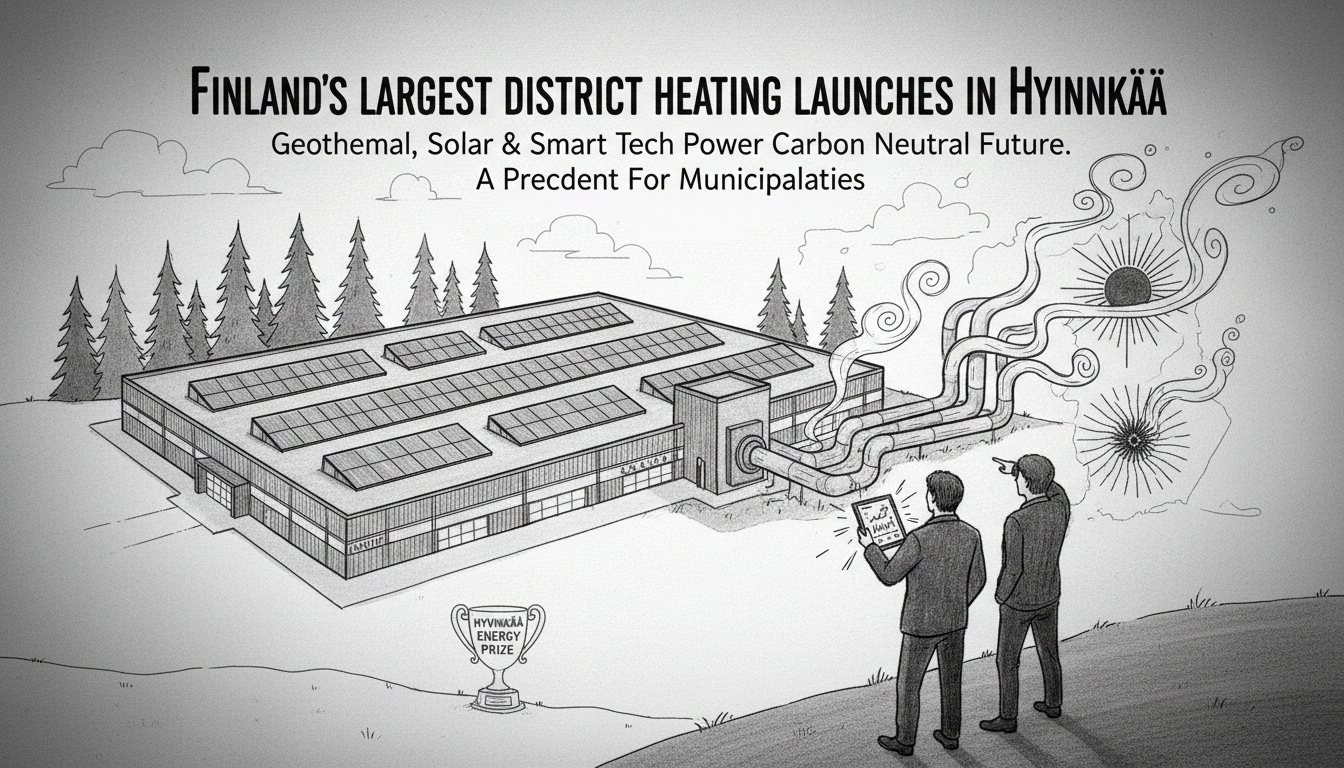
A new logistics center in the city of Hyvinkää has won a local energy efficiency prize and deployed Finland's largest implementation of a specific district heating optimization technology. The Onnela logistics center, operated by Kesko and K-Auto, received the award from the city, local entrepreneurs, and the chamber of commerce. The annual competition encourages businesses to improve energy efficiency and adopt renewable energy sources.
Hyvinkää is a municipality committed to carbon neutrality goals under the national HINKU and FISU frameworks. This makes corporate participation in climate action critical, as companies are responsible for roughly 40 percent of the city's climate emissions, according to a statement from Kesko.
The Onnela facility spans 85,000 square meters, equivalent to twelve football pitches, and will provide jobs for 400 to 500 people. Its energy solutions are ambitious. The building features high-grade insulation in walls and roofs. The primary heating source is geothermal, supported by 95 boreholes drilled on the property.
The heat pumps use environmentally friendly carbon dioxide instead of traditional refrigerants. A key innovation is the district heating return solution, which reuses already-cooled district heating water. This is the largest such installation in Finland and improves the efficiency of the entire district heating network in Hyvinkää.
A solar power plant on-site has an average annual production of 630 MWh. This covers about 10 percent of the center's yearly electricity demand, matching the consumption of 35 single-family homes. All electricity and heat for the center are generated from renewable sources.
Smart automation systems further support efficiency by optimizing heating, cooling, and lighting based on real-time need. A stormwater management system protects the nearby Vantaanjoki river.
During construction, Kesko also carried out a voluntary ecological compensation pilot project in cooperation with Hyvinkää City. This agreement could serve as a future model for other municipalities and companies seeking to compensate for nature loss.
This project reflects a broader trend in Finnish regional policy and EU-aligned climate strategy. Municipalities are actively leveraging local competitions and partnerships to meet national carbon neutrality targets. The technical scale of the district heating solution is notable, as optimizing existing network infrastructure often provides greater systemic benefits than standalone projects. The pilot compensation scheme also points to evolving corporate responsibility standards beyond direct emissions. For international observers, this demonstrates how mid-sized Finnish cities are implementing concrete, large-scale green infrastructure, blending geothermal, solar, and smart grid technologies within a strict regulatory framework. The real test will be the long-term operational data and whether this model is replicated elsewhere in the Nordic region.