
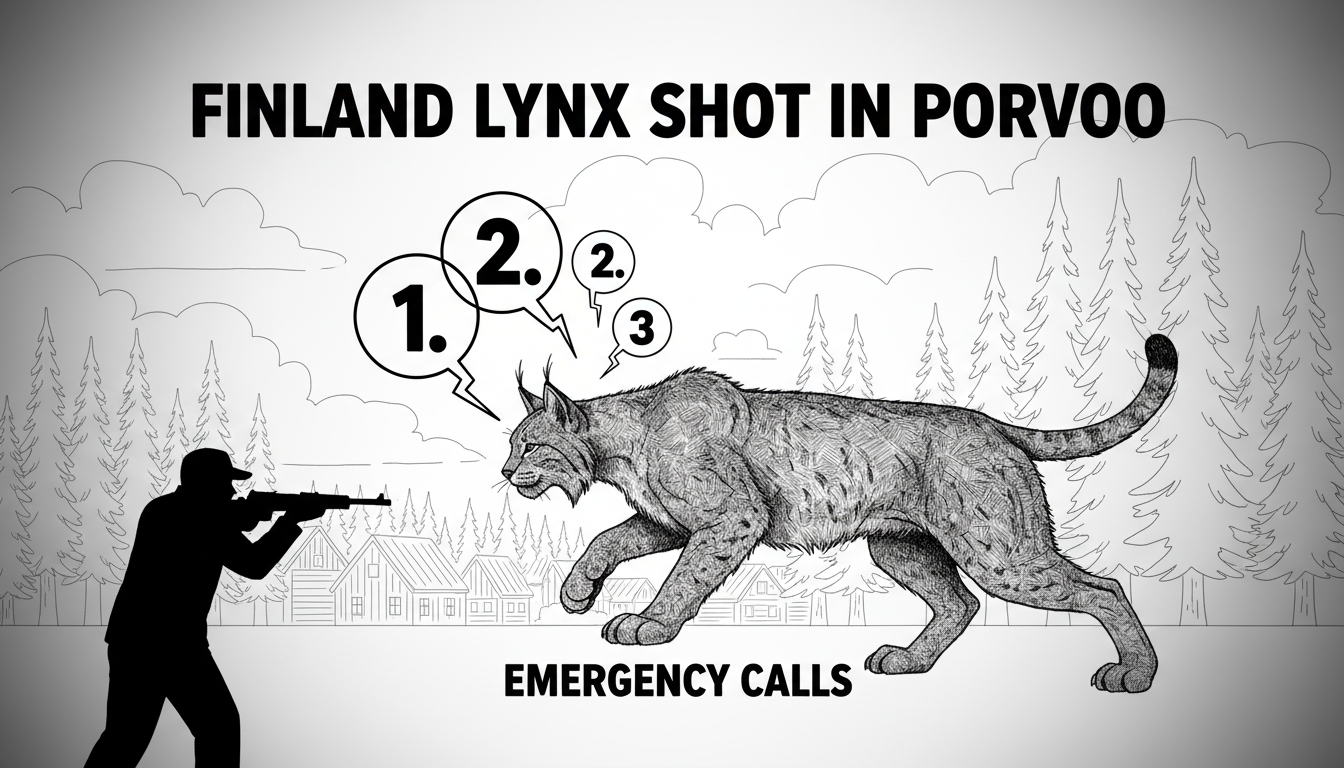
Finland police shot and killed a badly injured lynx in central Porvoo this weekend, ending a rare urban wildlife encounter that drew public attention and emergency calls. The Eastern Uusimaa Police Department confirmed officers ended the animal's life with a firearm in the early hours of Sunday morning. Police Commissioner Olavi Merihaara stated the force received three separate reports about the injured lynx through the emergency center, with the animal's movements also tracked by residents on social media platforms. The incident highlights the complex and sometimes tragic intersection of Finland's robust wild predator populations and its human settlements, raising questions about protocols for urban wildlife emergencies.
A Rare Urban Visitor Meets a Tragic End
The Eurasian lynx, Finland's only wild feline, is a creature of deep forests and remote terrain. An adult lynx appearing in the historic center of Porvoo, a coastal city just 50 kilometers east of Helsinki, is an exceptional event. These solitary predators typically avoid human contact, making their presence in a populated urban area a clear sign of distress or disorientation. According to Commissioner Merihaara, the animal was 'badly injured,' though the specific nature or cause of its wounds was not disclosed in the initial police statement. The decision to dispatch the lynx was made on welfare and public safety grounds, a judgment call police are occasionally forced to make when wild animals enter the human domain.
Social media played an unexpected role in tracking the lynx's final movements. Residents posted sightings and updates, creating a real-time, crowdsourced map of the animal's path through the city. This digital monitoring likely aided police in locating the lynx but also amplified public concern and scrutiny over the animal's fate. The incident unfolded not in secrecy but under the watchful eyes of a connected community, adding a layer of modern complexity to a primal encounter between human authority and wild nature.
Finland's Lynx: A Protected Predator in a Managed Landscape
Finland hosts a significant and stable population of Eurasian lynx, with recent estimates placing their numbers at approximately 2,200 individuals. The species is protected under national nature conservation laws and the European Union's Habitats Directive, to which Finland is bound. However, this protection is not absolute. The Finnish Wildlife Agency issues annual culling quotas to manage the population, primarily to prevent predation on semi-domesticated reindeer in the north and to address concerns from game hunters about lynx preying on roe deer. This system represents a characteristically Nordic approach to wildlife management: a balance between strict protection and pragmatic population control based on scientific assessment.
The Porvoo incident sits outside this normal framework of managed hunting. This was not a cull but an emergency intervention. The legal foundation for such police action rests on public safety provisions and animal welfare legislation. If an animal is deemed to pose an immediate threat to people or is suffering from severe, untreatable injuries, authorities have the mandate to act. The critical question, often debated by wildlife experts, is the threshold for that determination. Was the injured lynx in Porvoo truly a public danger, or was it a frightened, vulnerable animal seeking refuge? The police, as first responders, must make rapid decisions without the luxury of lengthy consultation.
Expert Perspectives on Urban Wildlife Protocols
Wildlife biologists and veterinarians often argue for more nuanced protocols when large predators appear in urban settings. 'The immediate default in many municipalities is to see a large wild animal in a city as a threat that must be eliminated,' notes Dr. Eeva Kettunen, a large carnivore researcher at the University of Helsinki. 'While public safety is paramount, we should develop clearer response chains that can bring in wildlife veterinarians or trained animal handlers for assessment. A sedative dart and an examination could determine if relocation or treatment is a viable option.'
In Finland, the responsibility for large carnivore issues is shared between the Finnish Wildlife Agency, the Ministry of Agriculture and Forestry, and regional police forces. For an acute, urban situation like Porvoo, the police are the primary operational authority. They have the equipment and mandate to secure a scene but rarely have specialized training in wildlife biology or veterinary medicine. This gap can lead to outcomes where lethal force is the only tool available. Some Finnish cities have begun discussing cooperative agreements with local zoos or wildlife parks whose staff possess the skills and equipment for safe animal capture, but such frameworks are not yet widespread.
Dr. Kettunen also points to the importance of public education. 'People need to know how to act. If you see a lynx, a wolf, or a bear in an unusual place, the advice is always the same: keep a safe distance, bring children and pets indoors, and contact the authorities. Do not approach, do not try to feed it, and certainly do not chase it for a social media video.' The Porvoo lynx's movements were tracked online, but there is no indication that any residents attempted to interact with it directly, suggesting a generally responsible public response.
The Broader Context of Human-Wildlife Coexistence
This incident is a microcosm of a larger, ongoing discussion in Finland about coexistence with its four large carnivores: lynx, wolf, bear, and wolverine. As protected species, their populations have recovered from historical lows, bringing them into more frequent contact with human activities. The debates are often heated, pitting rural livelihoods and safety concerns against conservation goals and EU directives. The Porvoo case is unusual because it occurred not in a remote forest community but in a picturesque tourist town, bringing the reality of living alongside predators closer to the urban majority.
Finland's approach is often held up as a model of science-based management, but it is not without controversy. Conservation groups sometimes challenge hunting quotas in courts, arguing they are politically motivated rather than ecologically justified. Rural residents sometimes feel their security concerns are dismissed by urban policymakers. The silent lynx in Porvoo's streets became an unwitting symbol of these tensions—a protected animal that ultimately could not be saved, whose fate was decided by a police bullet in the night.
Looking Ahead: Policy and Preparedness
The shooting in Porvoo will likely prompt internal reviews within the Eastern Uusimaa Police Department and discussions at the municipal level. Key questions remain unanswered publicly: What was the exact nature of the lynx's injuries? Were any non-lethal measures considered or attempted? Is there a regional resource, like a wildlife veterinarian on call, that could be mobilized for future incidents?
Finland's Ministry of Agriculture and Forestry, which oversees large carnivore policy, has guidelines, but local implementation varies. This event may catalyze efforts in the Helsinki capital region and other urban areas to formalize response plans that include expert consultation before lethal action is taken. It also underscores the need for clear public communication during such events to explain the difficult decisions authorities face.
The death of the Porvoo lynx is a singular tragedy, not a sign of systemic failure. Finland remains a country where wild lynx thrive across vast boreal forests. Yet, its conclusion on a city street forces a sober reflection. As humans continue to shape the landscape, the lines between our world and the wild become blurred. Creating systems that respect the intrinsic value of wild life, ensure public safety, and allow for compassionate intervention in moments of crisis is a challenge that extends far beyond this one Finnish town. The ultimate goal, experts agree, is to have the tools and the time to choose an option other than the bullet.