
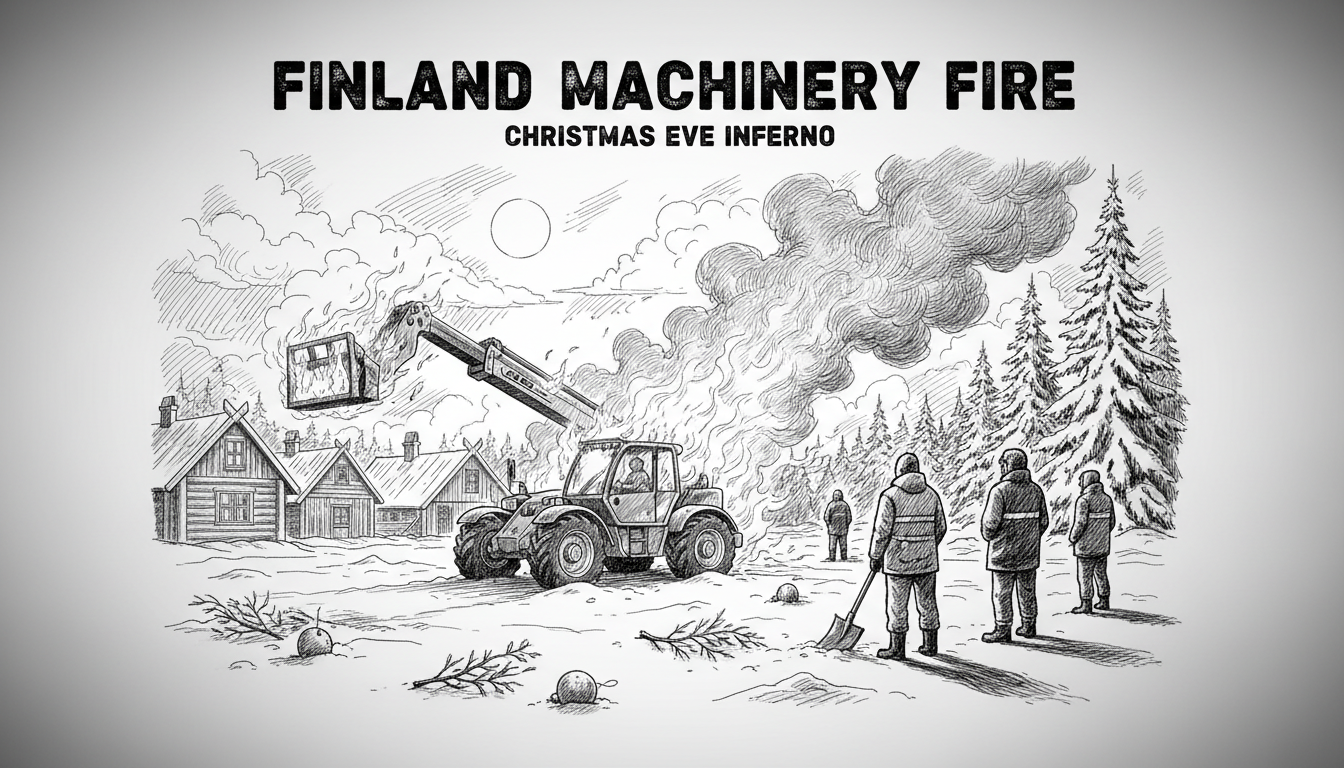
Finland machinery fire erupted on a quiet country road in Perho as a telehandler, known locally as a kurottaja, burst into flames on Christmas Eve. The incident on Suurensuontie road was reported to emergency services at 17:50, casting an unexpected and dramatic light on the otherwise peaceful holiday evening. On-site personnel managed to contain the blaze using initial firefighting efforts before the arrival of the Keski-Pohjanmaa Rescue Department, preventing the complete destruction of the valuable piece of equipment. No personal injuries resulted from the fire, though the machine sustained what officials described as "some fire damage."
This event highlights the ever-present risks in Finland's rural and industrial sectors, where heavy machinery operates year-round despite harsh conditions. The successful initial suppression by those present underscores a critical layer of Finland's safety culture: immediate local response. While the fire department's official report confirms the incident as a "traffic vehicle fire," the reality involves a complex piece of engineering essential to local logistics and construction, now sidelined by unexpected damage.
A Holiday Interruption in Rural Perho
The fire disrupted the calm of Jouluaatto, or Christmas Eve, in the municipality of Perho, located in the Central Ostrobothnia region. Suurensuontie road, where the telehandler caught fire, runs through a landscape typical of inland Finland—a mix of forest and scattered settlements. Telehandlers are ubiquitous in such environments, used in agriculture, forestry, and construction for lifting pallets, bricks, and timber. Their versatility makes them indispensable, but their complex hydraulics and electrical systems also present fire risks, particularly in cold weather or after intensive use.
"The fact that people on the spot could begin extinguishing the fire immediately was decisive," said a representative from the Keski-Pohjanmaa Rescue Department, emphasizing the value of quick action. The department, which serves the region, was alerted through standard emergency channels. Their response, though ultimately not needed for full extinguishment, followed standard protocols for machinery fires, which can involve flammable fluids and potential re-ignition. The scene was secured, and the damaged machine was later recovered.
The Anatomy of a Machinery Fire
Industrial safety experts point to several potential causes for such incidents, especially during winter. "Machinery fires in Finland during the colder months often stem from a combination of factors," explains Jari Laine, a Finnish safety consultant specializing in heavy equipment. "Electrical faults can occur due to condensation and temperature swings. Hydraulic lines under high pressure can leak, and if fluid contacts a hot surface like an exhaust manifold, it can ignite instantly. Even accumulated dry debris like leaves or sawdust around the engine compartment can become a hazard."
The telehandler involved was a materials handling machine, essentially a hybrid between a forklift and a small crane. These machines contain diesel engines, batteries, hydraulic reservoirs, and often complex electronic control systems. Regular, thorough maintenance is the primary defense against such failures. This includes checking electrical wiring for wear, ensuring hydraulic hoses are in good condition, and keeping engine bays clean of flammable materials. The Christmas Eve timing suggests the machine was likely in use right up to the holiday break, a common practice in many industries.
Finland's Emergency Response Framework
The incident offers a microcosm of Finland's decentralized yet highly effective rescue service model. Fire and rescue services are primarily a municipal responsibility, but they operate within a strong national framework for training and standards. In regions like Central Ostrobothnia, resources are pooled to ensure coverage across often sparsely populated areas. The system is designed for reliability, with the goal of reaching any emergency within a target time, even in rural locations.
The successful initial firefighting by the personnel on site aligns perfectly with this model's philosophy. Finnish safety protocols strongly encourage immediate action if it can be done without personal risk. Many workplaces, especially those using heavy machinery, have basic firefighting equipment like extinguishers readily available, and staff often receive basic fire safety training. This layered defense—immediate local response followed by professional intervention—likely saved the telehandler from being a total loss.
Economic and Operational Ripple Effects
While no one was hurt, a machinery fire like this carries significant economic consequences for a small business or a farm. A telehandler represents a substantial capital investment, often costing tens of thousands of euros. Even partial damage can lead to costly repairs, lengthy downtime, and insurance claims. For a contractor in Perho, losing a key piece of equipment during the holiday period could delay projects scheduled for the new year, affecting income and client relationships.
Insurance companies in Finland closely analyze such incidents. Claims for machinery fires require investigation to determine if proper maintenance protocols were followed. A finding of negligence could affect coverage. Furthermore, the incident serves as an unwelcome reminder for business owners to review their risk management during seasonal shutdowns. Ensuring machinery is properly stored, inspected, and prepared for periods of non-use is a critical part of operational security.
A Broader Look at Nordic Industrial Safety
Finland generally maintains an excellent record in workplace and industrial safety, consistently ranking high in European comparisons. However, machinery-related incidents remain a persistent challenge, particularly in the forestry and agricultural sectors which are pillars of the rural economy. The Finnish Safety and Chemicals Agency (Tukes) oversees technical safety and investigates serious accidents, promoting regulations and guidelines for equipment use.
Compared to its Nordic neighbors, Finland's vast forested interior and colder climate present unique challenges. Machinery is pushed hard during operational seasons and must withstand extreme temperature variations. This incident, though minor in outcome, fits a pattern of cold-weather operational hazards. It reinforces the need for pre-winter maintenance checks, a practice heavily advocated by industry groups like the Technology Industries of Finland and agricultural associations.
Lessons from the Christmas Eve Blaze
The Perho telehandler fire concludes with more of a sigh of relief than a catastrophe. The absence of injuries is the paramount success. The partial saving of the machine is a secondary victory credited to the preparedness of those on site. For safety professionals, the event is a case study in the effectiveness of basic training and the importance of never becoming complacent, even on a holiday.
As the machine is assessed for repair, the key question for its owners and operators will be "why?" Determining the ignition source is crucial for preventing a recurrence. Was it a preventable maintenance issue, or a sudden mechanical failure? The answer will inform not just the repair bill, but the safety protocols for all equipment in their fleet. In the quiet aftermath of the holiday, this single incident on a country road serves as a potent reminder that vigilance is a year-round responsibility, one that ensures the safety of people and the productivity that drives Finland's regions forward. Does your business treat equipment safety as a seasonal checklist or a continuous culture?