
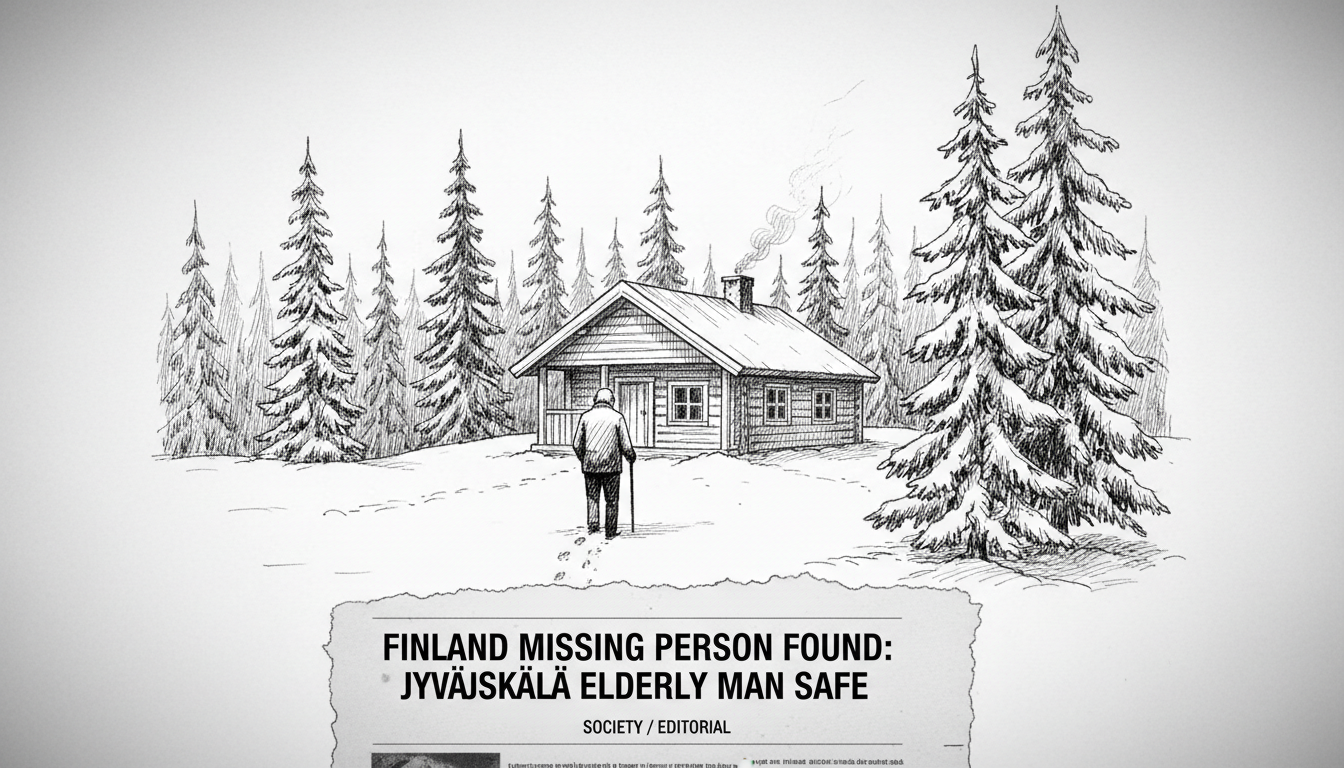
Finland missing person cases often end with community-led rescues, as demonstrated by the safe recovery of a 77-year-old man in Jyväskylä this week. The man, who disappeared from the Keljonkangas district on Monday afternoon, was located in good condition by Central Finland Police after a coordinated search effort. Police officials have publicly thanked local residents for their observations and assistance, highlighting a system that relies on rapid public engagement. This successful outcome provides a window into Finland's approach to vulnerable missing persons, a procedure tested regularly across its municipalities.
A Community Response in Central Finland
The search operation activated standard protocols for a high-risk missing person. Central Finland Police, responsible for the Jyväskylä region, mobilized resources following the report of the man's disappearance. While police have not disclosed the specific reasons for his disappearance, cases involving elderly individuals often involve disorientation or underlying health conditions. Keljonkangas, a residential district in Jyväskylä, became the focal point of the search. Jyväskylä, with a population of over 140,000, is Finland's largest inland city and a major educational center, home to the University of Jyväskylä. Its urban forests and lake shores, while scenic, can present challenges during search operations.
“We thank the public for their observations,” the Central Finland Police stated in their announcement of the man's recovery. This standard acknowledgment underscores a critical component of Finnish search and rescue: civilian cooperation. In a country with vast forested areas, even within city limits, public vigilance is a force multiplier for police. The man was found unharmed, a detail that brings immense relief but also concludes the public narrative; Finnish authorities strictly protect the privacy and medical details of individuals in such cases.
The Framework for Finding the Vulnerable
This incident, while swiftly resolved, operates within a structured national framework. Finland's police system, divided into regional departments like the Central Finland Police, follows established guidelines for missing persons. When an elderly person or a child is reported missing, the case is typically classified as urgent, triggering immediate action. Factors such as age, weather conditions, and known medical issues like dementia elevate the priority. The Finnish model emphasizes speed and the efficient use of both professional resources and community networks.
“The safe recovery of a vulnerable missing person is always the best possible outcome, and it frequently depends on the first few hours and the information provided by the public,” explains Dr. Eeva-Liisa Kivelä, a Finnish sociologist who has studied elderly care and community safety networks. “In Finland, there is a strong sense of communal responsibility. People pay attention, and they are not hesitant to contact authorities if something seems amiss. This social cohesion is a key asset in these situations.”
This system is supported by Finland's well-regarded social and healthcare services, which maintain registries and support networks for elderly citizens, though strict data protection laws limit how this information is shared with police during active searches. The search in Jyväskylä likely involved a combination of patrols, possibly canine units, and the dissemination of information to key community points and, if necessary, through national alert systems.
A Contrast with Urban Challenges Elsewhere
Finland's low population density and high levels of social trust create a distinct environment for handling missing persons cases, especially outside major urban centers like Helsinki. The response in Jyväskylä, a city integrated with nature, differs from protocols in more densely populated European capitals. Here, the challenge is often one of terrain rather than anonymity. The successful conclusion of this case reflects high operational coordination within the police district and an engaged citizenry.
Comparatively, Finland's overall rate of missing persons who remain missing long-term is low. Most cases are resolved within 48 hours. The country's comprehensive digital infrastructure and national police database facilitate information sharing across regions, crucial if a missing person travels. Furthermore, voluntary organizations like the Finnish Red Cross and Suomen Rescue provide specialized volunteer search groups that can be activated to support police, adding another layer of capacity.
The Unseen Work After the Headline
While the news cycle moves on after a “found safe” announcement, a quieter process often continues. For the individual and their family, the incident may trigger a review of support needs. Municipal social services may conduct a follow-up to assess if additional home care, safety technology like GPS locators, or health checks are warranted. This preventative approach aims to reduce recurrence, addressing potential causes such as undiagnosed cognitive decline or the need for better home safety measures.
For police, every operation is a chance to evaluate procedures. The efficiency of communication channels with the public, the deployment of assets, and the coordination with other services are all reviewed. The public thanks expressed by police are not merely polite; they are an essential investment in maintaining the community's willingness to participate in future incidents. This reciprocal relationship between authorities and citizens is a cornerstone of public safety in the Nordic model.
A Reassuring Norm in a Harsh Climate
As Finland endures the dark and cold of December, the safe recovery of the Jyväskylä man carries particular weight. Winter conditions dramatically increase the risks for anyone, especially an elderly person, who becomes lost or disoriented outdoors. Hypothermia can set in quickly. The successful resolution of this case before serious harm occurred demonstrates the system functioning under pressure. It is a reminder of the very real, human stakes involved in what might otherwise be a routine police bulletin.
The story, from disappearance to recovery, encapsulates a Finnish expectation: that society's structures—from official police work to informal neighborly watchfulness—will function to protect the vulnerable. It is a story that repeats in various forms across the country throughout the year, rarely making national headlines precisely because the outcome is so often positive. This normalcy of a safe return is perhaps the most telling indicator of the system's strength. Yet, it begs a question for an aging population: as demographic pressures grow, can this model of communal vigilance and rapid police response continue to deliver such consistently safe outcomes without greater investment and innovation in preventative care?