
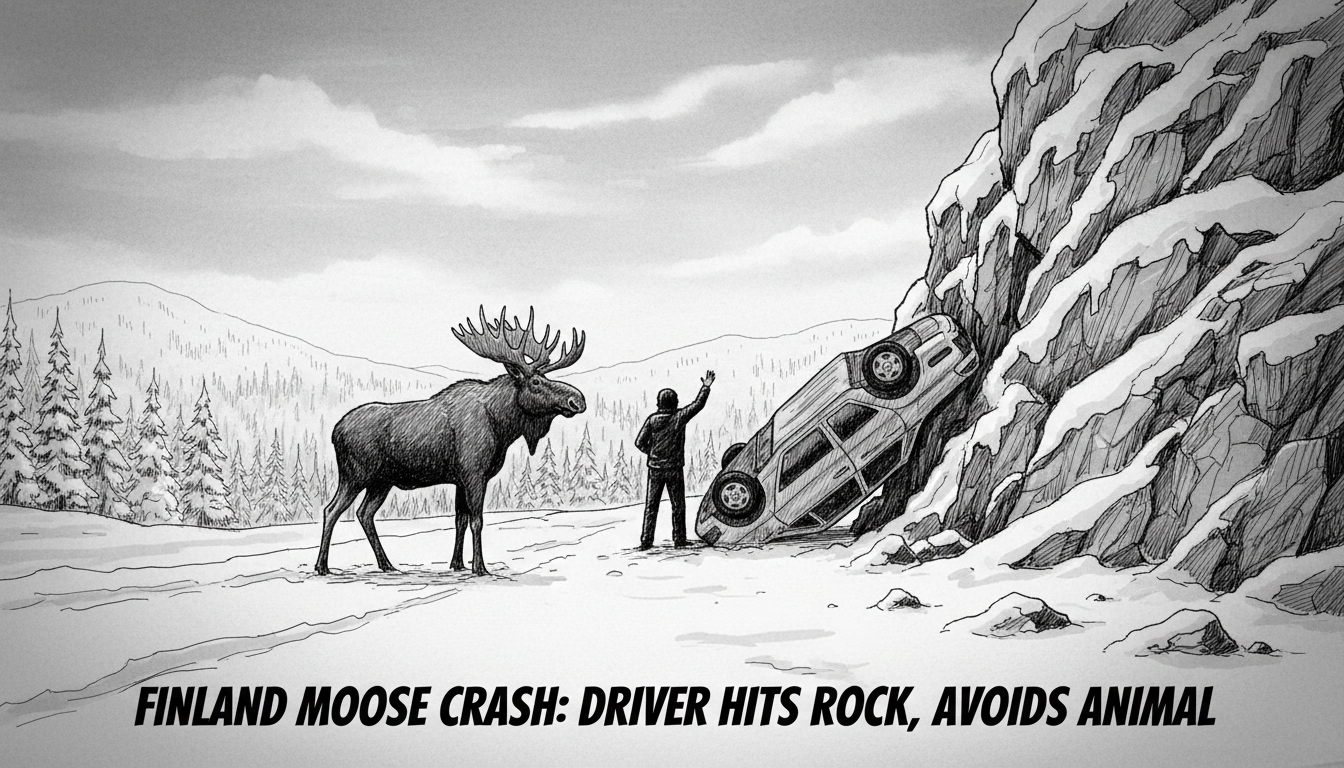
Finland road accidents involving wildlife are a common and dangerous reality, as demonstrated by a recent crash near Keuruu where a driver swerved to avoid a moose and collided with a rock outcrop. The incident occurred on Sunday evening on Road 23, approximately five kilometers west of the town center. According to rescue services, the alert came in after 10 PM. The driver escaped injury, but the vehicle sustained significant damage to its front right corner, with the impact detaching a front wheel and causing bodywork damage. This single-vehicle accident underscores a persistent national safety challenge that blends environmental factors, infrastructure, and driver behavior.
A Narrow Escape on a Dark Road
The driver's split-second decision to avoid a collision with a large animal—commonly referred to as a 'hirvieläin' in Finnish, which typically means a moose or deer—resulted in the car leaving the roadway. It ended up in a ditch before striking a rocky protrusion. The location, Road 23, is a significant transport route running through central Finland's forested regions, prime habitat for Finland's large moose population. The time of the accident, after dark on a Sunday, aligns with high-risk periods for such encounters. Wildlife is most active during dawn and dusk, and reduced weekend traffic can sometimes lead to higher animal presence near roads. The fact that no one was injured is fortunate, given the potential severity of collisions with stationary objects like rock faces.
The Scale of Finland's Wildlife Collision Problem
This incident near Keuruu is not an isolated event but a routine entry in national traffic statistics. The Finnish Transport Infrastructure Agency (Väylävirasto) records thousands of reported animal-vehicle collisions annually. Moose, one of the largest land mammals in Europe, pose a particular threat. An adult male moose can weigh between 400 and 600 kilograms; a collision at highway speeds generates immense force, often causing catastrophic damage to vehicles and serious or fatal injuries to occupants. The economic costs are substantial, encompassing vehicle repairs, medical expenses, and road maintenance. Beyond the numbers, these incidents create a lingering anxiety for drivers, especially those regularly traveling on rural highways flanked by dense forests.
Expert Advice for Drivers in High-Risk Zones
Road safety organizations and experts consistently emphasize specific strategies for driving in areas prone to wildlife. 'The primary advice is to maintain a speed appropriate for the conditions, especially in marked wildlife areas,' explains a senior traffic safety advisor. 'Using your high-beam headlights when possible increases your reaction time, but you must be prepared to dim them for oncoming traffic.' The instinct to swerve violently, as seen in the Keuruu case, is a natural reaction but carries its own risks. Safety campaigns often stress that if a collision is unavoidable, it is generally safer to brake firmly and hit the animal straight on rather than lose control and veer into oncoming traffic or off the road into a tree or rock. This is a difficult calculation for any driver to make in a moment of panic.
Infrastructure and Prevention Strategies
Mitigating these collisions is a long-term challenge for Finnish authorities. Passive measures include the widespread use of reflective wildlife warning signs along known crossing corridors. More active and expensive solutions involve constructing dedicated wildlife fencing along stretches of highway to funnel animals toward safe crossing points like green bridges or underpasses. These infrastructure projects are complex and costly, requiring careful ecological planning to ensure animals actually use the provided passages. Research is also ongoing into technological solutions, such as sensors that can detect large animals near the road and trigger dynamic warning signs for drivers. However, the vast length of roads traversing forested land makes comprehensive protection financially and practically difficult.
The Human and Policy Dimensions
For policymakers, the issue sits at the intersection of transport safety, environmental management, and regional budgeting. The Finnish government and the Centre Party, which holds strong support in rural regions, face constant pressure to improve road safety. Funding for wildlife fencing or crossing structures must compete with other infrastructure and social priorities. Meanwhile, for individuals living in or traveling through regions like Keuruu, the risk is a accepted part of daily life. Drivers develop a heightened state of awareness, scanning the forest's edge not just for oncoming curves but for the tell-tale reflection of eyes or the dark silhouette of an animal. The Keuruu driver's experience—a frightening shock, a damaged car, but a walk-away outcome—will be recounted as a cautionary tale, a reminder of a hazard that is uniquely Nordic in its scale and character.
A Persistent Challenge on Finland's Roads
The conclusion from this non-injury crash is clear: the threat of wildlife collisions remains an ingrained and complex aspect of Finnish road safety. While the driver near Keuruu escaped physically unharmed, the psychological impact and material cost are real. Each such incident renews debates about speed limits, infrastructure investment, and public awareness campaigns. As Finland continues to balance its deep connection to forested landscapes with modern mobility, solutions will require continued investment and innovation. The silent forests bordering roads like Highway 23 will always be home to moose, and drivers will always need to be prepared for the sudden, dangerous appearance of a massive animal in their headlights. The question is how much more can be done to ensure that the next encounter ends with only a scare, and not a tragedy.