
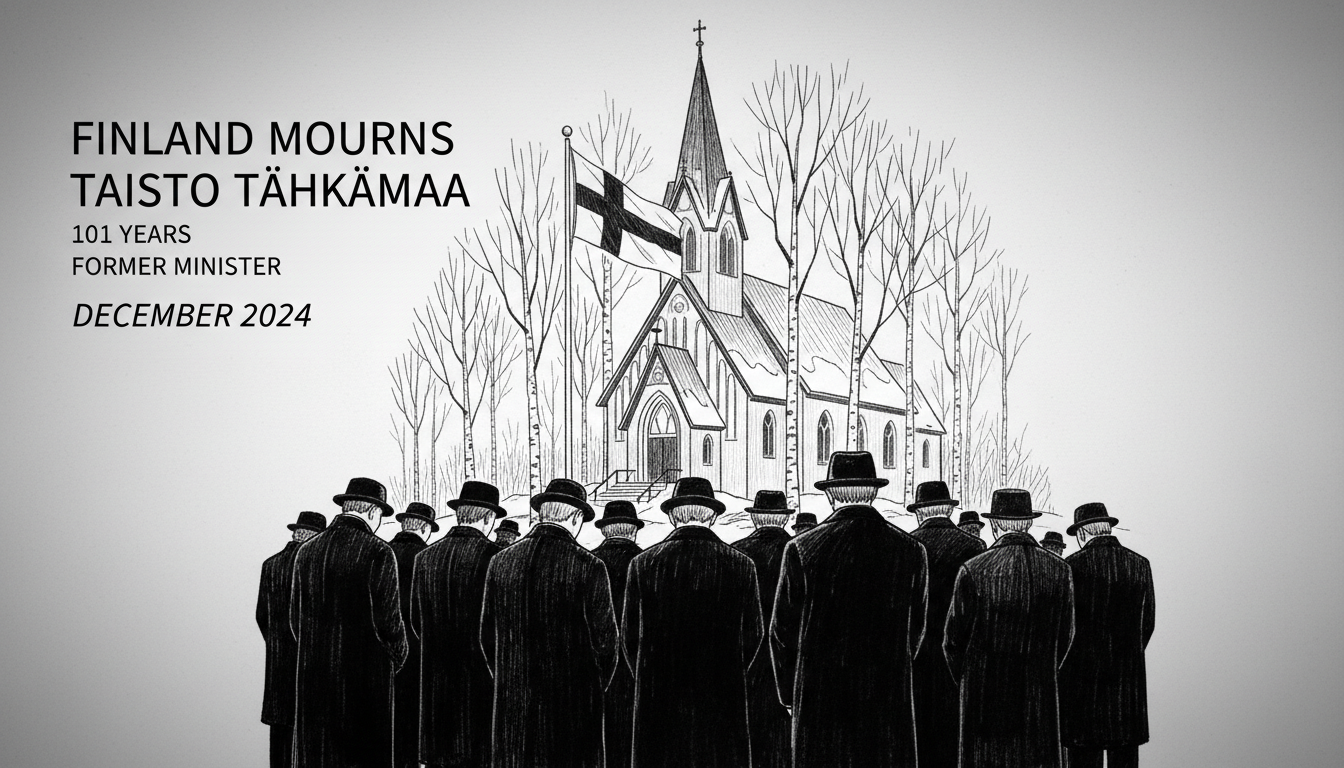
Finland's political world has lost its oldest surviving parliamentarian with the death of former Centre Party minister Taisto Tähkämaa. He died peacefully in his sleep on Sunday morning at the age of 101 in a care home in Kaarina, as confirmed by his daughter Sanna Tähkämaa. Born in 1924 in Parainen, Tähkämaa's life spanned a century of profound national transformation, from an agrarian society to a modern Nordic EU member state.
A Century of Service from Farm to Parliament
Taisto Tähkämaa’s political journey was rooted in the soil of Southwest Finland. He entered the Eduskunta as a Member of Parliament in 1970, representing the southern electoral district of Turku for the Centre Party (Keskusta). His career in the legislature lasted over two decades, concluding in 1991. Before politics, he worked as a farmer and was later appointed as a Counsellor of Agriculture, an honorary title recognizing expertise in the field. This background defined his political identity and policy priorities throughout his service.
His tenure in government was marked by significant responsibility during a delicate period in Finnish history. Tähkämaa held two key ministerial portfolios. He served as the Minister of Agriculture and Forestry, a natural fit for a farmer-politician from the agrarian Centre Party. Later, he took on the role of Minister of Defence. He occupied these positions in three separate governments during the 1970s and 1980s, a testament to his reliability and skill in coalition politics.
Steering Policy Through the Cold War Era
Tähkämaa's time in government coincided with the latter decades of the Cold War, a period demanding careful navigation for Finland. As Defence Minister, his work focused on maintaining and developing Finland's credible independent defence capabilities, a cornerstone of the nation's foreign policy. This era required balancing national security interests with the realities of geopolitics, all while managing the practical concerns of military readiness and conscription.
His concurrent experience as Agriculture Minister placed him at the heart of another critical transition: the modernization of Finland's rural economy. His policies helped guide the agricultural sector through structural changes, supporting rural communities while adapting to new economic realities. This dual expertise in defence and agrarian policy made him a unique figure, embodying two traditional pillars of Finnish national identity—security and self-sufficiency.
Political Legacy and Tributes Pour In
Reactions from Finland's political establishment highlighted Tähkämaa's enduring legacy. Centre Party Chairman and Finance Minister Riikka Purra described him as a "steadfast builder of Finland" whose work strengthened both national security and the vitality of the countryside. Fellow Centre Party veteran and former Prime Minister Esko Aho noted that Tähkämaa represented a generation of politicians for whom public service was a natural extension of community duty.
“The Finnish century was also Tähkämaa’s century. He was a central influencer in strengthening Finland's security and building society,” said political commentator Pentti Siika-aho, capturing the breadth of his impact. These tributes consistently paint a picture of a pragmatic, respected figure who operated with quiet effectiveness rather than flashy rhetoric, a style characteristic of his political generation.
Expert Analysis: A Bridge Between Two Finlands
Political historians view Tähkämaa's career as a bridge between distinct eras. “He belonged to the last generation of Finnish politicians whose worldview was fundamentally shaped by the nation's agrarian past and the experiences of the Second World War,” explains Dr. Laura Mäkinen, a political historian at the University of Helsinki. “Yet, he governed during a time of rapid industrialization, European integration, and shifting social values. His policy work, particularly in agriculture, was about managing that transition.”
His longevity offers a unique perspective. Having been born just seven years after Finland's independence, his life and career encapsulate the entire project of building the modern Finnish state. From a nation recovering from civil war to a prosperous EU member, Tähkämaa was both an observer and an active participant in this journey. His centenarian age allowed him to witness the long-term consequences of policy decisions made decades earlier.
Implications for the Contemporary Political Landscape
Tähkämaa's passing signifies more than the loss of an individual; it marks the closing of a chapter in Finnish political history. The generation of leaders who governed during the Paasikivi-Kekkonen era of active neutrality is now almost entirely gone. This shift changes the living connection to that formative period, placing greater responsibility on historians and archives to interpret its legacy.
Furthermore, his brand of centrist, agrarian-based politics has evolved. The Centre Party, once the dominant force in Finnish politics, has seen its traditional rural base shrink and its electoral fortunes fluctuate. Tähkämaa's career serves as a reminder of the party's historical roots and its central role in constructing the Finnish welfare state. His life story is a direct link to the political coalition that forged post-war Finland.
A Quiet Farewell in the Helsinki Government District
News of his death resonated through the halls of Parliament House and the adjacent government buildings in Helsinki's city center. While the day-to-day politics of climate bills, EU recovery funds, and NATO integration continued, veteran civil servants and older politicians paused to reflect. His career reminds current policymakers of the long arc of national development, where today's debates on security, food production, and rural vitality are continuations of discussions he helped lead.
Funeral arrangements are expected to be private, in keeping with his family's wishes and his personal style. Memorials are likely to focus on his substantive contributions rather than ceremonial pomp. The Centre Party announced it will hold a moment of remembrance at its next parliamentary group meeting, a fitting tribute for a committed party member.
Taisto Tähkämaa’s story is ultimately one of sustained, dedicated service. In an age of rapid news cycles and shifting political allegiances, his 21-year parliamentary career and ministerial service across three governments stand out. He witnessed Finland join the European Union, a move he supported as a logical step for the nation's future, far beyond the geopolitical constraints of his early ministerial years. His life prompts a final question for today's political leaders: what foundations are they building that will last a century?