
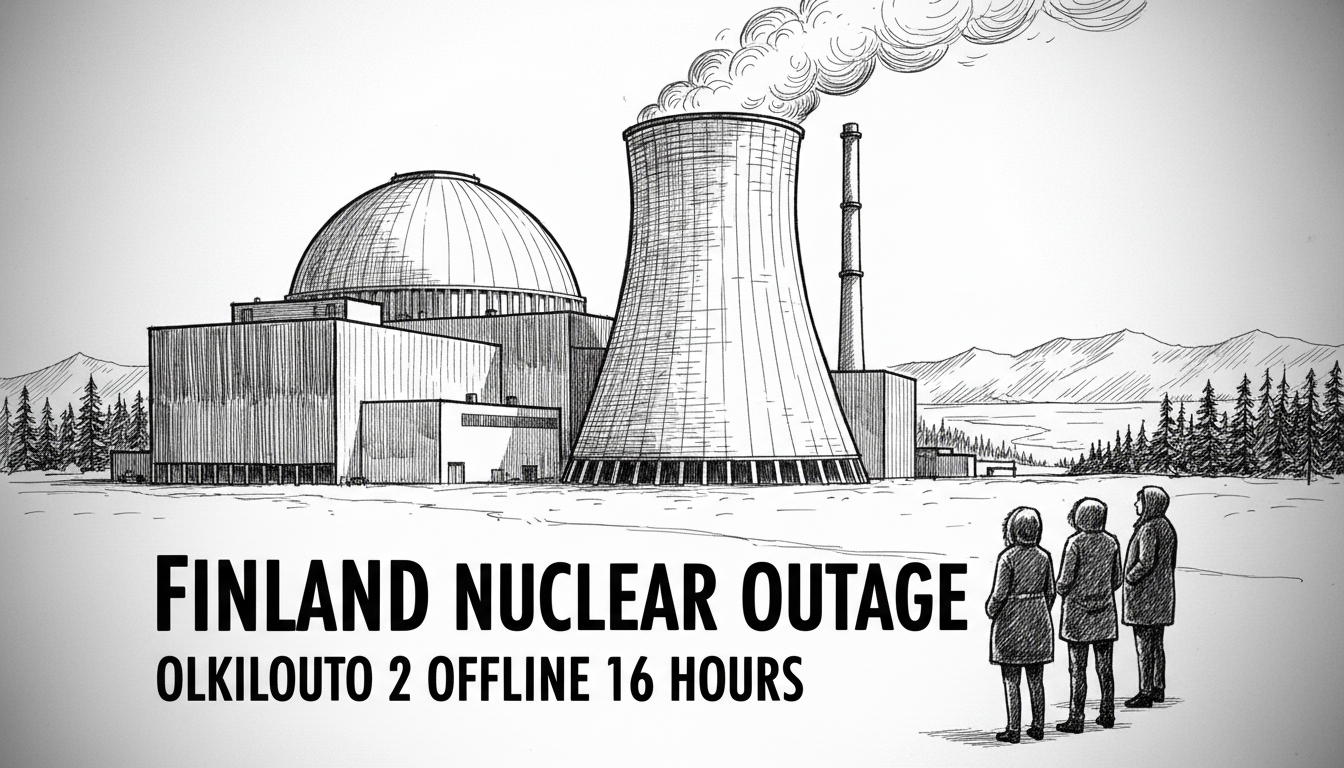
Finland's Olkiluoto 2 nuclear reactor is offline due to a technical fault, with the disruption expected to last approximately 16 hours. The 890-megawatt unit experienced a fault beginning at 10:59 AM local time, according to data published on the Nord Pool power exchange. This unplanned outage at one of the country's key baseload power sources immediately raises questions about grid stability and electricity prices during a period when Finland is aggressively pursuing energy independence and its 2035 carbon neutrality goal.
Immediate Impact on the Nordic Power Market
The outage was registered on the Nord Pool exchange, which coordinates electricity trading across Finland, Sweden, Norway, Denmark, and the Baltic states. Nord Pool's initial estimate of a 16-hour disruption provides a critical timeline for market analysts and grid operators. The loss of nearly 900 MW of constant, carbon-free generation creates an instant supply gap that must be filled by other sources. In the short term, this typically means increased reliance on hydro power, wind generation where available, thermal plants, and imports via cross-border interconnectors. The price impact is often felt most acutely in the Finnish bidding area, known as FI, within the Nord Pool system. "Any unplanned loss of a major unit like Olkiluoto 2 puts upward pressure on the system price," said a Helsinki-based energy analyst. "The duration is key. A 16-hour outage is significant but manageable if the weather is mild and wind generation is good. The real test comes if this extends beyond the forecast or occurs during a severe cold snap."
Finland's energy landscape has transformed in recent years. The long-delayed but now operational Olkiluoto 3 reactor, at 1600 MW, is Europe's most powerful and has substantially increased the country's nuclear capacity. However, OL2 remains a vital workhorse. The three reactors at the Olkiluoto site in Eurajoki collectively represent a cornerstone of national energy policy. Nuclear power provided roughly 30% of Finland's electricity production in 2022, a share that has grown with OL3's commissioning. This strategic reliance means that outages, even temporary ones, are closely monitored by the government and the Finnish Energy Authority.
Technical Faults and Nuclear Safety Protocols
The specific nature of the "technical fault" at Olkiluoto 2 has not been disclosed by the plant's operator, Teollisuuden Voima (TVO). This is standard procedure; nuclear operators prioritize precise diagnosis and safety over immediate public disclosure of technical details. The Finnish Radiation and Nuclear Safety Authority (STUK) oversees all such incidents. A spokesperson for STUK confirmed they had been notified of the reactor's shutdown and were in contact with TVO. "All shutdowns, whether planned or unplanned, are conducted according to strict safety protocols. Our focus is on ensuring the reactor is brought offline and online again safely," the spokesperson said. Olkiluoto 2 is a boiling water reactor that began commercial operation in 1980. It underwent a major modernization and power upgrade in the 2010s, extending its operational life. Such planned maintenance and upgrades are routine, but unexpected faults trigger automatic safety systems that shut down the reactor.
This incident highlights the complex balancing act of a modern nuclear-reliant grid. While nuclear provides stable, low-carbon baseload power, its units are large and inflexible. When one trips offline, the replacement power must come from elsewhere in the system almost instantly. Finland has invested heavily in interconnectors, notably the 1,400 MW Fenno-Skan link to Sweden and the 800 MW Estonia link (Estlink 2), which can provide crucial backup power. The performance of these links and the overall resilience of the Nordic grid will be tested during this 16-hour period.
Broader Implications for Finnish Energy Policy
The timing of this outage is noteworthy within Finland's ambitious climate policy framework. The Finnish Parliament, the Eduskunta, has legally binding targets for carbon neutrality by 2035. Achieving this requires a near-total decarbonization of the electricity sector, a goal for which nuclear power is central. The government, led by Prime Minister Petteri Orpo, views nuclear as a non-negotiable pillar of energy security, especially after Russia's invasion of Ukraine severed imports of Russian electricity and gas. "Our energy sovereignty is built on domestic production. Nuclear, wind, and hydro are the trinity that will get us to 2035," stated the Minister of Economic Affairs in a recent parliamentary debate. An outage like today's serves as a reminder that even this robust system has vulnerabilities.
Analysts are watching how this event influences the political debate around future energy investments. Proponents of diversified renewable energy will likely argue that a distributed system of wind, solar, and battery storage is less susceptible to single-point failures. Advocates for nuclear may counter that the outage is brief, the system is absorbing it, and the long-term reliability and output of nuclear outweigh these rare interruptions. The discussion also touches on the need for demand-side flexibility and storage solutions, which can help buffer the grid against such shocks.
Furthermore, the financial impact on TVO and its shareholders, which include major Finnish industrial energy users, will be calculated. Unplanned outages mean lost revenue from electricity sales and can incur costs related to replacement power. These costs, however, are not typically passed directly to consumers in the short term but are absorbed within the wholesale market's pricing mechanism.
Looking Ahead: Grid Stability in the Nordic Region
As the 16-hour clock ticks down, grid operators from Fingrid in Finland to Svenska Kraftnät in Sweden will be managing flows across the region. The Nordic power market is one of the world's most integrated, and it is designed for exactly this scenario. The diversity of sources—Norwegian hydro, Swedish nuclear and hydro, Danish wind, and Finnish nuclear—usually provides a strong buffer. The current reservoir levels in Norway and Sweden, the wind forecasts in the Baltic Sea, and the availability of thermal capacity in Finland will all determine the final price and security of supply impact.
This incident, while operational, feeds into a larger strategic conversation in Helsinki and Brussels. The European Union's energy policy, driven by the REPowerEU plan, emphasizes diversification and independence. Finland's model of high nuclear penetration is often cited as a case study. Yet, today's fault is a practical lesson that every technology has its operational risks. The true measure of a resilient energy system is not whether a component fails, but how quickly and smoothly the system adapts.
Will the Olkiluoto 2 reactor return to service as smoothly as Nord Pool predicts? The coming hours will test the protocols and partnerships that underpin Finland's energy security. For households and industries, the immediate effect may be subtle, reflected in marginally higher spot prices for electricity. For policymakers, it is another data point in the relentless challenge of keeping the lights on, costs manageable, and carbon emissions falling—all at the same time. The silent control rooms at Olkiluoto are, for now, the focal point of this complex equation.